

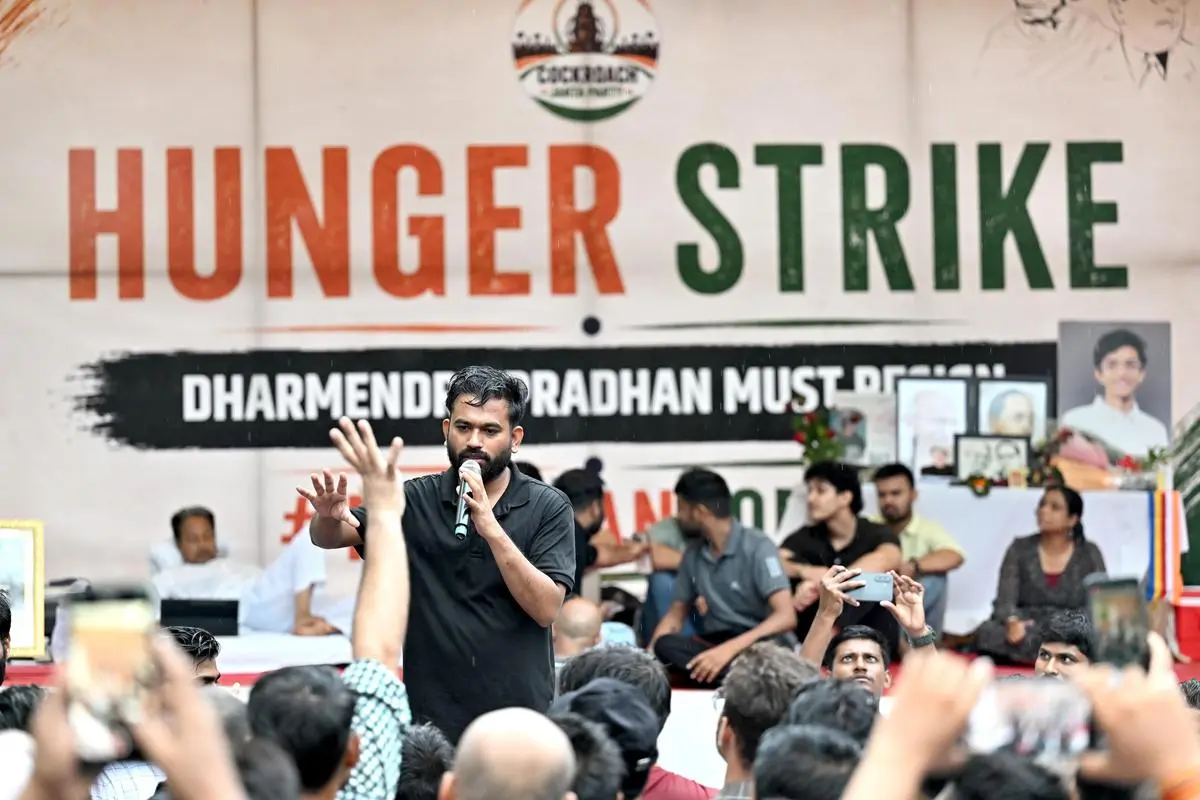
The Cockroach Janata Party protests were never just about leaked examination papers. Rather they slowly emerged into a story of institutional trust, digital activism, accountability, and a generation revolutionising democratic participation. For quite a few years, India’s young people have been described as politically apathetic, distracted by social media, or too polarised to sustain collective action. The unprecedented protests that unfolded across the country in July 2026 challenged that perception. What began as outrage over alleged examination irregularities evolved into one of the largest youth-led civic mobilisations in recent years, thereby compelling the resignation of Union Education Minister Dharmendra Pradhan and establishing various examination reforms at the centre of national debate.
The movement did not simply emerge from a conventional political organisation. It rapidly emerged from ordinary students; medical aspirants, civil service candidates, university students, parents, teachers, independent journalists, digital creators, and ordinary citizens, who cultivated a common cause in a single demand: and that’s “accountability”. At the centre of this mobilisation stood an unlikely symbol; the Cockroach Janata Party (CJP). What merely began as a modern satire on social media gradually elevated into an organisational platform that carefully synchronised demonstrations, relayed important information, communicated with supporters, and attentively articulated demands for the examination reforms. In an era where internet memes often disappear within a couple number of days, the Cockroach Janata Party demonstrated that humour could become a language of political mobilisation too.
When an Examination Crisis Matures into a Predicament of Trust
The principal catalyst for the protests was the widespread anger over alleged paper leaks and irregularities bearing on the high-stakes examinations. However, if we try reducing the movement to a single examination we would eventually overlook its broader magnitude. For many participants, the controversy embodied a deeper erosion of confidence in the institutions responsible for conducting examinations that determine educational and professional future, like NTA; the National Testing Agency. Years of intense preparation, significant financial investment, and emotional commitment left students asking a simple question: Can merit still be trusted???
The movement expanded because this concern resonated beyond one examination or a single category of students. International media soon recognised that the protests had moved beyond an education dispute. Reuters reported that negotiations between student leaders and the government were underway as the demonstrations gathered momentum, while global outlets including The Guardian, Associated Press, Financial Times, and France 24 documented both the scale of the mobilisation and the political pressure it generated. The controversy had paused to be about examination management alone. It had become a deliberation about governance.
The Rise of India’s ‘First Meme-Based Protest Movement’
Perhaps the most remarkable feature of the protests was not their size but their extraordinary diction. Previous generations often relied on speeches, pamphlets, slogans, and political rallies. But the contemporary generation Z added another dimension to the existing norms of revolutions: memes, Instagram reels, digital artwork, satirical posters, livestreams, independent journalism, and viral storytelling.
Throughout their demonstrations, protesters employed utmost humour without abandoning the seriousness of the issue. Cartoon imagery, redesigned political symbols, parody posters, pop-culture references, and satirical graphics circulated alongside exhaustive discussions of examination reform. The Unique Protest art became both a communication strategy and an activation tool. Instead of weakening the movement, the humour broadened its active participation. It reduced barriers to engagement, making the fierce and complex institutional issues accessible to millions of young people who navigated the protests first through social media rather than major traditional political channels.
The Cockroach Janata Party understood this drastic evolution. Its official communication repeatedly urged supporters to remain peaceful, avoid provocation, assist injured protesters, verify information before sharing it, and distinguish the movement from unrelated incidents of violence. Regardless of differing political interpretations, these public statements became an important part of the movement’s self-presentation.
Digital Platforms as Democratic Infrastructure
Social media did far more than publicise the protests; it became the movement’s organisational infrastructure. Several Independent journalists streamed events live from the Jantar Mantar protest sites. Content creators rendered complex developments into accessible explanations. Volunteers orchestrated legal assistance, medical support, food distribution, fundraising, accommodation, and transportation almost entirely through digital networks. Instagram stories documented events minute by minute. X (formerly Twitter) reinforced official statements and updates. WhatsApp groups coordinated logistics. YouTube channels provided long-form discussions. Rather than replacing street demonstrations, digital platforms escalated them.
This clearly exemplified an important shift in the execution of democratic participation. The distinction between online and offline activism became increasingly blurred. A protest no longer existed only in public squares; it also existed in millions of mobile phones. Generation Z did not just use technology during the protests.
It spearheaded political strategies through modern use of digital technology.
Beyond Students: A Coalition for Accountability
One of the most prominent voices to join the movement was education reformer Sonam Wangchuk, whose decision to undertake a hunger strike gave the protests a powerful moral dimension. For many participants, Wangchuk’s intervention closely associated their demands with a longer tradition of peaceful democratic resistance rooted in constitutional values rather than partisan politics. When Wangchuk’s health allegedly deteriorated during the fast, the movement responded not with escalation but with concern. The Cockroach Janata Party publicly urged him to end his fast, arguing that his message had already inspired millions of students and citizens as well. That exchange reflected an important feature of the protests: they consistently sought to frame themselves as a peaceful civic movement rather than a confrontation with the state.
The New Language of Democratic Protest
Perhaps the most enduring legacy of these protests lies in how they were conducted.
Roses were directly offered to police personnel. The sensible Protest art replaced vandalism. National flags appeared alongside handwritten placards demanding examination reforms. Instagram stories, reels, and memes coexisted with constitutional slogans and detailed policy proposals. Crowdfunding sustained volunteers. Independent journalists livestreamed events as millions watched in real time.
This combination of humour, digital creativity, and disciplined organisation represented something distinctive in India’s existing protest culture. Rather than rejecting social media as a distraction, Generation Z transformed it into an instrument of democratic participation.
International Attention and the Question of State Response
As demonstrations quickly spread across the country, international media increasingly turned its attention to the CJP protest of India. The emergence of sustained international coverage displayed more than the magnitude of the peaceful demonstrations. It revealed that distress about educational integrity, democratic participation, and institutional accountability in the world’s largest democracy had unfolded into questions of immediate global concern. At the same time, narratives surrounding the protests often differed depending on the source. Government representatives underscored maintaining public order and engaging in dialogue, while protesters showcased alleged excessive policing and the need for systemic reform. Thus appreciating these differing perspectives is essential to understanding the movement in its totality.
‘A Resignation Is Not a Substitute For Institutional Reforms’
The relinquishment of office of Union Education Minister Dharmendra Pradhan marked an essential political moment. It exhibited that the ongoing democratic pressure can have concrete consequences within a constitutional framework.
Yet reducing the movement to a single resignation risks inaccurate understanding of its central demand.
For many protesters, accountability does not merely end with ministerial responsibility only. They called for transparent investigations into reported examination procedural lapses, stronger safeguards against paper leaks, timely and credible examinations, structural changes within the periphery of examination agencies, protection of students’ futures, and continued public accountability. Whether every demand is in due course implemented remains to be seen. Nevertheless, the protests shifted the national conversation from individual responsibility to institutional reform, a passage that may prove more historic and significant than any single political resignation.
The Democratic Prominence of India’s Gen Z
It is too preliminary to ascertain the movement’s long-term political impact. However, one conclusion at this stage appears difficult to ignore. India’s Generation Z has demonstrated that democratic participation is expanding. This generation is as comfortable organising through encrypted messaging groups as previous generations were organising through student unions. It rapidly communicates through memes without abandoning serious political engagement. It blends satire with policy discussion, witty satire with constitutional language, and digital activism with peaceful demonstrations on the streets.
Critics may often strongly disagree with particular tactics, slogans, or political positions. Such disagreement is quite natural in any democracy, be it India or any other country. Yet the protests clearly illustrate that a generation often discounted as politically complacent possesses both the capacity and the willingness to organise collectively around issues it considers intrinsic. If the movement succeeds in bolstering transparency, institutional accountability, and public confidence in India’s examination system, its legacy will extend well beyond education policy.
It will stand as an embodiment of how a digitally aligned generation transformed frustration into civic participation; and how democracy continues to evolve alongside technology.
The Cockroach Janata Party began as a form of satire. It eventually became a symbol of civic mobilisation. The protests began with examination grievances but expanded into a significant broader conversation about governance, institutional trust, and democratic accountability. Whether history over time remembers this movement for the resignation of a minister or for the reforms it inspired will depend on what follows. Political milestones are important, but institutions are strengthened only through sustained reform. For India’s Generation Z, however, one achievement is already noticeable. They demonstrated that political participation need not follow traditional scripts. In the digital age, a meme can become a manifesto, a hashtag can become a movement, and a generation can remind a democracy that accountability remains one of its most powerful ideals.
Perhaps one of the most striking aspects of the movement was the active involvement of students from literature, political science, history, sociology, and several other disciplines alongside those directly affected by the examination crisis. Their presence revealed a long scholarly tradition within the humanities, which encourages readers to examine the political and social dimensions of everyday life. From the biting satire of Alexander Pope and Jonathan Swift’s Gulliver’s Travels to Franz Kafka’s The Metamorphosis, literature has on numerous occasions demonstrated that humour, symbolism, and allegory can become powerful instruments of political criticism. The Cockroach Janata Party echoed this tradition by transforming the image of Kafka’s Gregor Samsa; a figure reduced to a cockroach, into a symbol of collective resistance rather than humiliation. In doing so, the movement illustrated that literature is not merely an academic discipline confined to classrooms; its ideas continue to shape the language, symbols, and imagination through which societies express dissent and advocate for genuine accountability.
Article by Sruti Bhaumik