

On 16 August 2026, organisers say more than 13,000 people cast ballots in Indianapolis on Khalistan, a proposed independent Sikh homeland. The vote, run by Sikhs for Justice (SFJ), was non-binding and could not change the status of any Indian state. [1]
The vote was held half a world away from Punjab, for a country that does not exist. It raises questions about the demand’s origins, the violence of 1984, its current supporters and whether a separatist movement can speak for a diverse Sikh community.
Where the idea began
The idea of a Sikh state is older than independent India. On 9 March 1946, as Partition loomed, the Shiromani Gurdwara Parbandhak Committee (SGPC) passed a resolution calling for a Sikh state. Leaders feared Pakistan would leave key shrines and communities beyond Sikh control. It answered Partition anxiety; it was not a blueprint for today’s Khalistan. [2]
Partition then split Punjab. Lahore, capital of Maharaja Ranjit Singh, and Nankana Sahib, Guru Nanak’s birthplace, went to Pakistan. Most Sikh leaders chose to seek safeguards inside India.
The modern secessionist call came later. In 1971, Jagjit Singh Chohan, a former Punjab minister, placed a New York Times advertisement proclaiming a Sikh state, and later ran a symbolic government-in-exile with its own passports and stamps. He made noise abroad but did not speak for most Sikhs. [3]
Why it gained ground
After 1947, Sikh politics centred on Punjab’s place in India. The Punjabi Suba movement won a Punjabi-speaking state in 1966, when Haryana was carved out, but Chandigarh stayed a shared Union Territory. Disputes over Chandigarh, river waters and Centre–state powers festered.
In 1973 the Akali Dal adopted the Anandpur Sahib Resolution, calling for greater autonomy within a federal structure. The party presented it as autonomy, not secession. [4] The resentment was real, but it did not automatically mean support for Khalistan.
Into this gap stepped Jarnail Singh Bhindranwale, a preacher who rose in the late 1970s. Some historians say Congress leaders first encouraged him to weaken the Akali Dal; the claim is contested. In 1982 he joined the Dharam Yudh Morcha, which pressed the Anandpur Sahib demands. The agitation gathered many grievances under one banner and slid steadily into militancy.
1984: the turning point
By 1984, armed militants had taken positions inside the Golden Temple complex in Amritsar. In June, Prime Minister Indira Gandhi ordered Operation Blue Star. The army operation killed militants, soldiers and civilians, including Bhindranwale, and damaged the shrine. For many Sikhs it was a deep wound, and it became a rallying cry for separatists.
On 31 October 1984, two of Gandhi’s Sikh bodyguards assassinated her. Over the following days, mobs attacked Sikh neighbourhoods in Delhi and other cities. Men were killed, homes and shops burned, gurdwaras attacked. The Home Ministry cites the Ahuja Committee’s figure of 2,733 Sikhs killed in Delhi alone. The violence exposed grave failures of protection and led to allegations of political complicity and police inaction. [5]
The wait for justice was long. Former Congress MP Sajjan Kumar was convicted by the Delhi High Court in 2018 in a case involving five killings and the burning of a gurdwara. In February 2025 a Delhi court convicted him in a second case, over the murders of Jaswant Singh and his son Tarun Deep Singh, and he was later sentenced to life imprisonment. [6] These are findings against individuals, not against every Congress worker or voter.
That is why 1984 remains the movement’s emotional core, especially overseas. Acknowledging the grievance does not mean endorsing separatism.
How the insurgency ended
Punjab’s militancy ran through the late 1980s and early 1990s. Militants killed civilians, Sikhs and Hindus alike. The violence reached abroad: in June 1985 a bomb on Air India Flight 182 killed 329 people, most of them Canadians, in an attack attributed to Babbar Khalsa-linked plotters. [7] Security forces broke the militant groups with a hard crackdown, and allegations of unlawful killings and disappearances became part of the record.
The 1985 Rajiv Gandhi–Longowal Accord tried to settle disputes including Chandigarh, but was never fully implemented; militants assassinated Longowal weeks after he signed it. By the mid-1990s, public exhaustion, weakened militant groups and a return to elections had largely ended the insurgency. The grievances did not all vanish.
The situation today
In Punjab, Khalistan is a political current, not a majority platform. Simranjit Singh Mann’s Shiromani Akali Dal (Amritsar) openly backs it and contests elections, yet has struggled to build a broad base. [8]
The bigger jolt came in 2024, when Amritpal Singh won Khadoor Sahib as an independent while in detention. His party, Akali Dal Waris Punjab De, formed in January 2025, campaigns on drugs and governance, though his Khalistan stance remains a fault line. He was held under the National Security Act until it lapsed in April 2026, then re-arrested in the Ajnala police-station attack case, and is again in Dibrugarh jail. [8]
Context matters. In Punjab’s 13 Lok Sabha seats in 2024, Congress won seven, the Aam Aadmi Party three, the Shiromani Akali Dal one and independents two. [9] Amritpal’s win shows a real constituency in his seat; it does not show that Punjab wants secession.
Overseas the movement is louder, through diaspora networks, rallies and unofficial referendums. SFJ says its vote asks whether “Indian Governed Punjab” should become an independent country. That is advocacy, not a legally recognised vote by Punjab’s residents. [10] India has banned SFJ as an unlawful association since 2019. [11]
Politics, memory and the diaspora
A common suspicion is that the cause survives for political gain, or as a route to the West for Sikhs claiming persecution. The evidence does not establish either as a general explanation. Supporters cite 1984, religious identity, self-determination or distrust of the Indian state. Organisers can gain visibility, followers and donations, while political actors may mobilise votes around the issue. Those incentives deserve scrutiny without reducing every supporter to cynicism.
Money is documented in a narrower area. Canada’s 2025 risk assessment says listed terrorist entities, including Babbar Khalsa International and the International Sikh Youth Federation, have received financial support originating in Canada. [12] That finding concerns those listed violent groups; it should not be extended to peaceful Sikh organisations or diaspora supporters generally.
Migration is a separate, unproven claim. Canada’s Immigration and Refugee Board recorded about 32,200 refugee claims from India in 2024–25, roughly 19 per cent of 173,300 total claims. [13] The figure does not identify how many claimants were Sikh, cited Khalistan-related persecution or filed false claims. It therefore cannot show an organised migration strategy. Claims must be assessed individually: genuine persecution deserves protection, while fabricated claims should not be excused.
History, borders and the question of a homeland
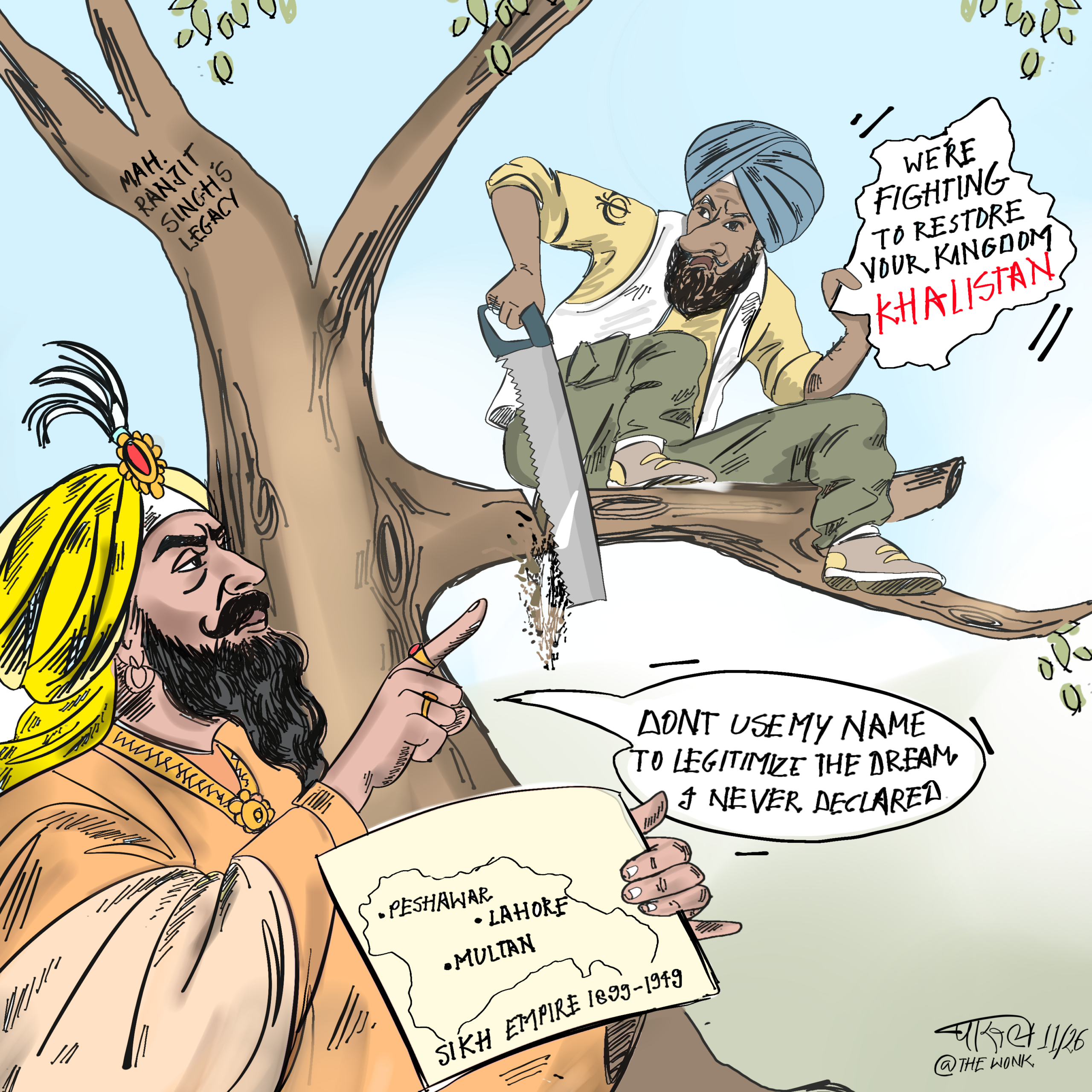
Supporters sometimes invoke Maharaja Ranjit Singh’s kingdom as a historical model. Centred on Lahore, it extended across territory now divided between India and Pakistan, including Multan, Peshawar and Kashmir. Its governing class included Sikhs, Hindus and Muslims. [14] It was not a modern nation-state defined by today’s borders, nor can its history be reduced to religious sovereignty.
Yet SFJ’s stated demand covers only Indian-governed Punjab. [10] Lahore, the Maharaja’s capital, Pakistani Punjab and Nankana Sahib, Guru Nanak’s birthplace, are left out. Is Ranjit Singh a territorial blueprint or a symbol of Sikh power and memory? The demand is far smaller than the empire it evokes, reflecting Partition and the movement’s present focus rather than a straightforward restoration.
Those vehemently demanding Khalistan from their stations abroad ever give up their present lives and come back here to actually take the fight on ground in a democratic manner??? Very doubtful! Individual choices cannot be predicted from slogans or referendum participation. Violence and armed uprisings have never achieved anything that lasted to see peace and success for its ilk.
Sikh identity and political choice
This distinction must guide the whole debate: Sikh identity is not the same as support for Khalistan. Many Sikhs are proud Indians who see no conflict between faith and nationhood, and serve in the armed forces, public institutions, politics and business. Some seek greater autonomy or stronger protection of Sikh rights but reject secession. Others support Khalistan, and they differ over its meaning and methods. These positions should not be collapsed into one community-wide view.
Khalistan began as one answer to fears for Sikh security, was hardened by 1984 and the insurgency, and now survives through Punjab politics and overseas advocacy. Its supporters are real, but they are one current within a diverse Sikh community, not its collective voice. Political incentives, historical memory and diaspora activity help explain its persistence, but do not prove a single motive or migration strategy. Those campaigning for statehood sitting safely in various Western Countries still owe Punjab a break from violence and a chance for its people to get the lasting peace and success that has long remained illusory.
Sources
- The Indianapolis Star, “Indianapolis Sikhs cast more than 13,000 ballots on Khalistan referendum” (17 Aug 2026).
- Kamaldeep Singh Brar, The Indian Express, “SGPC’s 1946 resolution on ‘Sikh state'” (15 May 2022).
- Randeep Ramesh, The Guardian, “Jagjit Singh Chauhan” (10 Apr 2007).
- The Indian Express, “As Amritpal Singh’s followers run amok, a brief history of the Khalistan movement” (2023).
- Press Information Bureau, “Benefits to 1984 Sikh Riot Victims” (11 Mar 2015).
- Delhi High Court, State through CBI v. Sajjan Kumar (17 Dec 2018); Delhi District Court, State v. Sajjan Kumar (12 Feb 2025).
- Commission of Inquiry into the Bombing of Air India Flight 182 (Major Commission), final report (2010).
- Kamaldeep Singh Brar, The Indian Express, “Amritpal Singh’s party seeks wider appeal” (30 Sep 2026); ThePrint.
- Election Commission of India, General Election to the Lok Sabha 2024, Punjab.
- 10.Sikhs for Justice, official FAQ on the Punjab Independence Referendum.
- Ministry of Home Affairs, notification declaring SFJ an unlawful association under the UAPA (2019).
- Department of Finance Canada, 2025 assessment of money laundering and terrorist financing risks.
- Immigration and Refugee Board of Canada, Information for the Minister, May 2025.
- Pashaura Singh, “Sikh Empire”, Wiley Online Library (2016).