

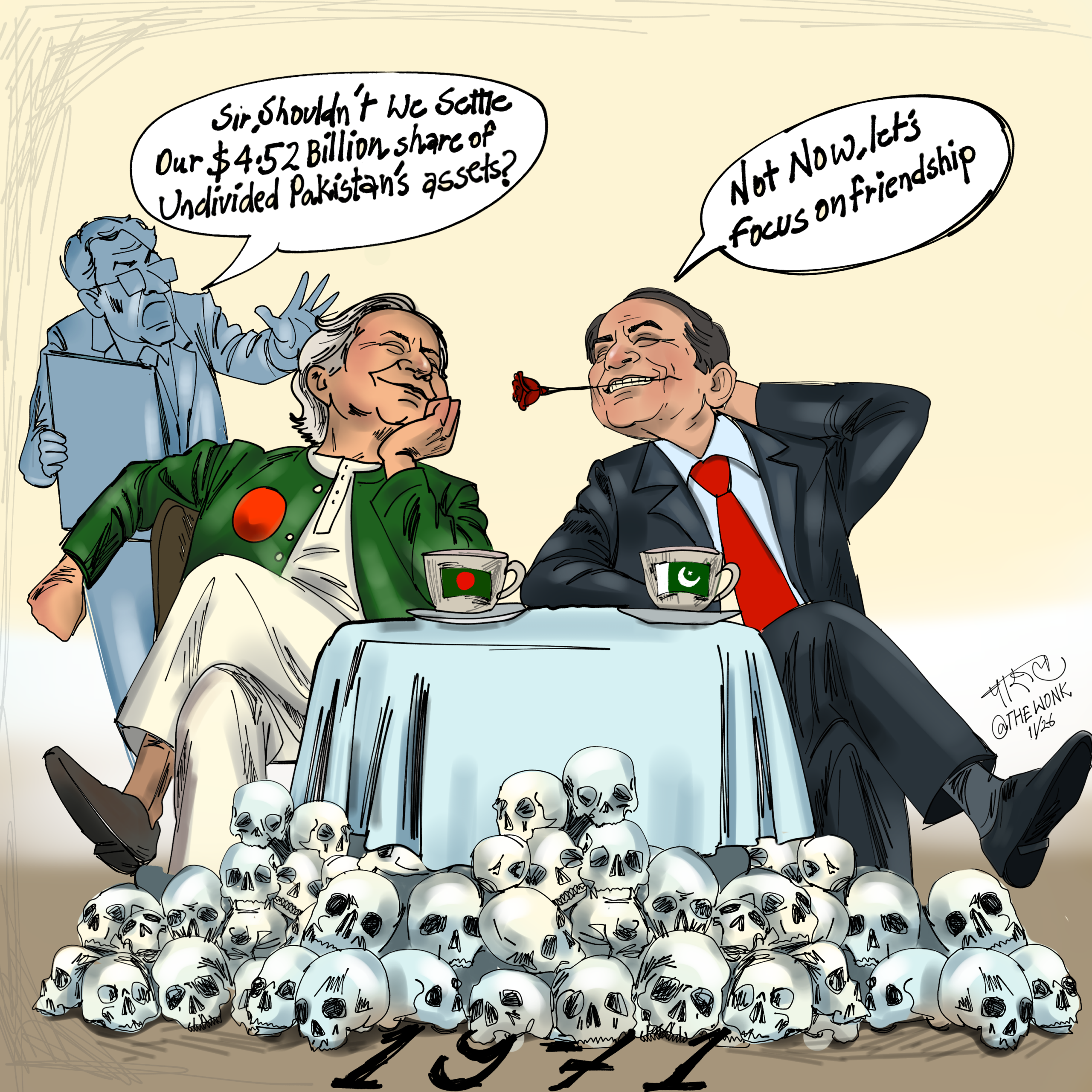
Bangladesh and Pakistan are rebuilding their relationship after years of limited diplomatic engagement. Trade is increasing, direct flights have returned, and political leaders from both countries are showing interest in working together.
These developments have attracted attention because the relationship between the two countries has never been simple. Bangladesh became independent in 1971 after a brutal military crackdown by the Pakistani army and a nine-month Liberation War. The memories of that period remain deeply connected to Bangladesh’s national identity.
So, with Dhaka and Islamabad moving closer again, an important question comes up: has Bangladesh forgotten what happened in 1971?
The answer is NO. Bangladesh is expanding its diplomatic and economic relationships, but its demands for an apology and resolution of historical issues remain on the table.
What has changed between Bangladesh and Pakistan?
Relations between the two countries began showing signs of improvement after Sheikh Hasina’s government fell on 5 August 2024, following a student-led uprising.
Since then, several developments have brought Bangladesh and Pakistan closer.
- November 2024: A direct container shipping connection between Karachi and Chattogram began operating. It was an important development after decades of limited direct maritime connectivity.
- January 2026: Biman Bangladesh Airlines resumed direct flights between Dhaka and Karachi on 29 January, ending a 14-year gap.
- Trade: Bangladesh imported approximately 52,000 tonnes of Pakistani rice in 2025, according to an analysis published by Bonik Barta.
- September 2026: Bangladesh’s Prime Minister Tarique Rahman met Pakistan’s Prime Minister Shehbaz Sharif in New York during the United Nations General Assembly.
During their September meeting, both leaders expressed interest in improving cooperation in trade, investment, connectivity, education, and tourism. They also discussed regional and international issues.
The meeting was another indication that both governments want to improve their relationship.
Source: Pakistan Prime Minister’s Office – September 2026 meeting
But what is driving this change?
For Bangladesh, stronger relations with Pakistan offer another opportunity to expand trade and diversify its international partnerships. Pakistan also sees opportunities to improve its economic and diplomatic engagement with Bangladesh.
An analysis published by Bonik Barta describes the changing relationship as one driven increasingly by practical and strategic interests.
In simple terms, both countries see economic and diplomatic reasons to work together. However, that does not mean their historical differences have disappeared.
Why does 1971 still matter?
To understand why the relationship remains sensitive, it is important to look back at the events of 1971.
At that time, Bangladesh was East Pakistan, while the western part of the country was governed from Islamabad. Political disagreements, economic inequality and demands for greater autonomy created growing tensions between the two regions.
On the night of 25 March 1971, the Pakistani military launched Operation Searchlight, a major crackdown against people in East Pakistan.
The operation targeted civilians, students, intellectuals and other groups. The violence eventually led to a nine-month Liberation War, which ended with the creation of independent Bangladesh in December 1971.
Bangladesh’s official estimate puts the death toll at around 3 million. However, historians and researchers have produced different estimates, and the exact number remains debated.
For Bangladesh, 25 March is observed as Genocide Day to remember the victims of the military crackdown.
This history is not simply an old political disagreement. It remains an important part of the country’s national identity and collective memory.
Bangladesh has not stopped demanding an apology
Despite improving diplomatic relations, Bangladesh has continued to raise questions about Pakistan’s responsibility for the events of 1971.
During foreign secretary-level talks in April 2025, Bangladesh formally asked Pakistan to issue an apology for the atrocities committed during the Liberation War.
It also raised the issue of $4.52 billion, representing Bangladesh’s claimed share of the assets of undivided Pakistan. This amount is Bangladesh’s demand. Pakistan has not accepted it as an agreed payment.
The discussions were important because they showed that Bangladesh was willing to improve diplomatic relations without dropping its historical demands.
Source: ThePrint – Bangladesh seeks Pakistan’s apology and $4.52 billion
The issue became more visible again in March 2026.
On Genocide Day, Prime Minister Tarique Rahman described the events of 25 March 1971 as one of the most brutal genocides in history. He also called the military crackdown a planned massacre and urged people to remember the sacrifices made during the Liberation War.
His father, Ziaur Rahman, was an army officer who announced Bangladesh’s independence on the radio on 27 March 1971, on behalf of Sheikh Mujibur Rahman.
The statement made it clear that the historical events of 1971 continue to hold importance for Bangladesh’s present leadership.
Source: ThePrint – Tarique Rahman’s Genocide Day statement
The 1974 agreement has not ended every disagreement
Pakistan has previously argued that the historical issues between the two countries were addressed through the 1974 tripartite agreement and later diplomatic engagements.
However, Bangladesh does not consider the matter fully resolved.
The 1974 agreement was signed by Bangladesh, India and Pakistan in New Delhi. One of its important issues was the future of 195 Pakistani prisoners of war who were being held in India and were accused by Bangladesh of serious crimes during the 1971 conflict.
Under the agreement, Pakistan’s representative stated that his government condemned and deeply regretted crimes that may have been committed.
Bangladesh subsequently decided not to proceed with trials as an act of clemency. It was agreed that the 195 prisoners of war could return to Pakistan.
However, the agreement did not contain an unambiguous formal apology or admission of responsibility from Pakistan.
This distinction is important when discussing why Bangladesh continues to demand an apology.
In August 2025, Pakistan’s Foreign Minister Ishaq Dar said that the 1971 issues had already been settled through the 1974 agreement and former Pakistani President Pervez Musharraf’s 2002 visit to Dhaka.
Bangladesh disagreed with this position.
An editorial published by The Daily Star on 25 August 2025 also argued that the historical issues remained unresolved.
The disagreement shows why the two countries can improve their diplomatic relationship while continuing to have different views about their shared past.
Read the original 1974 agreement
What about the stranded Urdu-speaking people?
Another issue that remains unresolved is the situation of Urdu-speaking people living in Bangladesh, many of whom are commonly referred to as Biharis.
Their situation goes back to the 1971 conflict and the events that followed independence.
Some members of these communities have sought repatriation to Pakistan, while others have established their lives in Bangladesh.
Bangladesh has also raised this issue in discussions with Pakistan. Reports have referred to approximately 324,000 people living in camps across the country, although population estimates and individual preferences vary.
It is important to understand that not everyone in these communities wants to move to Pakistan. Their circumstances and choices are different.
The issue remains a humanitarian and diplomatic concern that both countries have yet to fully resolve.
Is everyone in Bangladesh comfortable with improving ties?
Not necessarily.
The growing relationship with Pakistan also raises questions about how Bangladesh will balance its economic interests with the historical importance of 1971.
The Awami League historically placed greater emphasis on the Liberation War in its political messaging and approach to Pakistan. The BNP, on the other hand, has often been viewed as more pragmatic in its engagement with Islamabad.
However, improving diplomatic relations does not automatically mean that Bangladesh’s political parties or people have changed their views about the events of 1971.
The country can explore new trade opportunities, restore transport links and maintain diplomatic discussions while continuing to remember its history.
The important question is whether economic cooperation will also create space for meaningful discussions about unresolved historical issues.
So, has Bangladesh forgotten 1971?
No. The developments between Bangladesh and Pakistan do not suggest that the country has forgotten its past.
Bangladesh is simply trying to expand its economic and diplomatic options. Direct flights, shipping connections and trade agreements can benefit both countries, but they do not erase the events of 1971.
The apology demand, the disputed financial claims, and the unresolved humanitarian issues show that important differences remain.
The real challenge for both governments is to build a better relationship without avoiding difficult conversations about history.
Improving ties may be beneficial for Bangladesh and Pakistan, but lasting trust will require more than trade and diplomatic meetings. It will also require an honest approach to the past and a willingness to address the concerns that remain unresolved.
For Dhaka, moving forward does not have to mean forgetting 1971.