

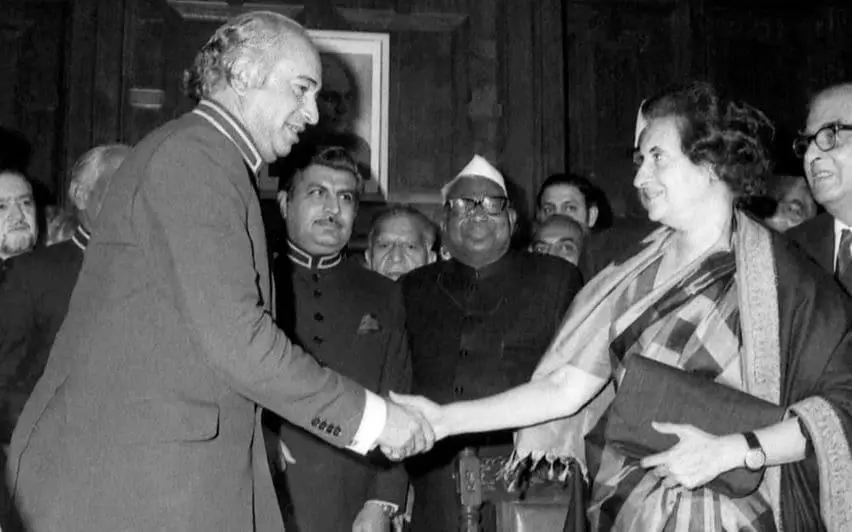
The Shimla Agreement was signed on 2nd July 1972 between Prime Minister Indira Gandhi of India and President Zulfikar Ali Bhutto of Pakistan. The agreement aimed to establish a new relationship between the two neighbouring countries after the 1971 India-Pakistan War and the creation of Bangladesh. This encouraged peace, diplomacy and bilateral talks between the two nations.
The main goal was to create a framework to resolve the dispute over Kashmir. The Ceasefire Line became the Line of Control and both nations agreed to respect it. However, almost 6 decades later the Kashmir issue remains the biggest flashpoint in South Asia.
Whilst the agreement was successful at creating key points of diplomacy and reducing tensions in the short term, it did not address the core political issues between the two nations. This caused the agreement to lose its effectiveness, shown by military conflict such as the Kargil War in 1999.
The Historical Context: A Peace Agreement After the 1971 War
The Shimla Agreement was created following the 1971 India-Pakistan War. Following the 1970 general elections tensions increased in Pakistan causing a military crackdown on East Pakistan. This caused a humanitarian crisis with many refugees fleeing to India. On 3 December 1971, Pakistan launched air strikes against Indian airfields, marking the beginning of the 1971 India-Pakistan War. India subsequently intervened militarily in East Pakistan, and following the surrender of Pakistani forces on 16 December 1971, Bangladesh emerged as an independent nation.
After the war there was an imbalance in power. India remained with the stronger military and Pakistan was struggling with the loss of face, prestige and a major chunk of its territory… in addition to having lost almost a lakh of soldiers as POWs to India. These prisoners of war gave India lots of bargaining space and leverage. In order to return to a normal relationship between the nations, Indira Gandhi and Zulfikar Ali Bhutto met in Shimla in June/July 1972.
The agreement known as Shimla agreement was signed on 2nd July 1972. The declared aims of the Agreement was Bilateral Dispute resolution (of the Kashmir issue), normalising ties between the two nations, and settlement of post war positions.
Why Did the Shimla Agreement Fail to Resolve Kashmir?
1. No Clear Roadmap for a Final Settlement
One of the most significant issues with the agreement was that there wasn’t a concrete plan to solve the dispute. Whilst it stated that peaceful negotiation was important, there was no time frame, framework or legally binding plan. The agreement didn’t outline what would happen to the political situation in Jammu and Kashmir. The Line of Control simply meant that the current situation would become a De Facto status.
Whilst India agreed they would respect the Line of Control and work towards bilateral discussion, Pakistan still saw the dispute as an international issue and wanted to retain their claim over Kashmir.
Both nations signed the same agreement yet both went into it and came out of it with varying interpretations and different.
2. Conflicting Interpretations of Bilateralism
Another large reason why the agreement wasn’t very successful was the disagreement on what bilateral discussion meant. India saw the agreement as meaning bilateralism would be the main way of solving outstanding disputes. This meant that unless both nations agreed, there wouldn’t be any third party involvement.
Pakistan wanted to continue to seek international support for the Kashmir issue. This created tension throughout the discussions. India saw internationalisation as going against the spirit of the Shimla Agreement whereas Pakistan believed that bilateral discussion hadn’t worked and internationalisation was still needed.
3. Political Instability and the Civil-Military Divide in Pakistan
As the agreement was signed by political leaders there needs to be political commitment to implement it. During this time Pakistan had many political issues. Bhutto struggled to boost national confidence, strengthen the military and deal with political opposition. The military still had a strong hold over security and foreign policy.
This caused issues as although the political leaders wanted to strengthen diplomatic relations, the security establishment may not have had the same views. The military coup in 1977 led by General Zia-ul-Haq made it harder to achieve a long term reconciliation. ‘Operation Gibralter’ never truly died down…just arose again in more subtle forms. Bleeding Inida through a thousand cuts remained the Pakistani establishments unofficial policy over Kashmir. Over time the security policy in Pakistan changed to be more focused on strategic rivalry with India.
4. Cross-Border Militancy and the Erosion of Trust
The agreement was also affected by the rise of militancy in Jammu and Kashmir from the late 1980s (particularly in 1989). India blames Pakistan for promoting cross border infiltration and militancy. Pakistan will usually deny this or argue they are only providing political and diplomatic support.
There were less successful bilateral talks. The agreement was clearly undermined in 1999 in the Kargil Conflict.
This demonstrates that there can still be conflict even if there is an intent to respect the LoC. This undermines the diplomatic agreements made in Shimla. Other issues such as the attack on Indian Parliament in 2001 and terrorist attacks in Mumbai in 2008 caused further erosion of the Shimla Agreement.
5. The Line of Control Managed the Dispute Rather Than Resolving It
A positive result was the clear identification of the ceasefire line as the Line of Control. This helped both sides understand the military implications.
The issue of sovereignty was not resolved. Whilst the area was divided by the Line of Control there was no agreement on the exact border. Both countries still claim ownership and the population is separated by a highly militarised line.
The agreement did not fully resolve the uncertainties in the northern sector. The issue of the Siachen Glacier caused India to carry out Operation Meghdoot in 1984. This demonstrates there were still key security issues to resolve meaning the Line of Control was used to manage the conflict.
The Shimla Agreement in the Changing Geopolitical Environment
There have been many changes to the geopolitical landscape in the region since 1972. Both countries undertook nuclear testing in 1998 causing changes to the security situation in South Asia. Nuclear deterrence caused the cost of a full scale conventional conflict to increase however this did not stop military conflicts occurring.
The strong strategic alliance between Pakistan and China has occurred. Alongside this, India have developed more international alliances and have increased their economic strength therefore increasing their diplomatic strength.
International involvement has remained a key factor in times of increased tension between India and Pakistan. This has led to a contradiction in the Shimla Agreement. Despite India favouring bilateralism, the geopolitical situation surrounding the security of the region has caused international attention.
Overall, the assumptions made within the agreement are increasingly hard to maintain within the new strategic landscape of South Asia.
What Lies Ahead?
The Shimla Agreement has also failed due to the continued use of cross-border terrorism by Pakistan. Over the decades, India has constantly accused Pakistan’s military and intelligence forces of supporting terrorist organisations. This has led to a lack of trust between both countries since the use of non-state actors as foreign policy has occurred. Terrorism has caused issues with diplomacy as the Mumbai attacks in 2008, the Pathankot airbase attack in 2016 and Pulwama attack in 2019 show. Therefore, it has been difficult to achieve peace between both countries.
The use of terrorism has created a paradoxical situation. Even though there are agreements within diplomacy, terrorism has caused tension within the two countries. Without consistent political commitment to achieving peace, there will never be an agreement that causes long term peace between the two countries. Due to one country seeing terrorism as a way to achieve strategic goals, there will never be peace. Furthermore, India’s security concerns cannot be separated from the wider political issue of Kashmir.
Over half a century later, the main takeaway from the Shimla Agreement is that whilst it can create a framework for peace, there is no guarantee of peace without political commitment. Whilst the Line of Control has helped to reduce the escalation of disputes, it has not removed the underlying antagonism. Overall, Kashmir cannot be held hostage to military actions and terrorism.
The Shimla Agreement has failed not because they attempted diplomacy but because there were never consistent conditions for peace. Without Pakistan removing terrorism as a tool of state policy and both countries showing genuine intent to overcome their differences, the Shimla Agreement will never be fulfilled. The Line of Control between the two nations has become a Line of Broken Trust between India and Pakistan!