

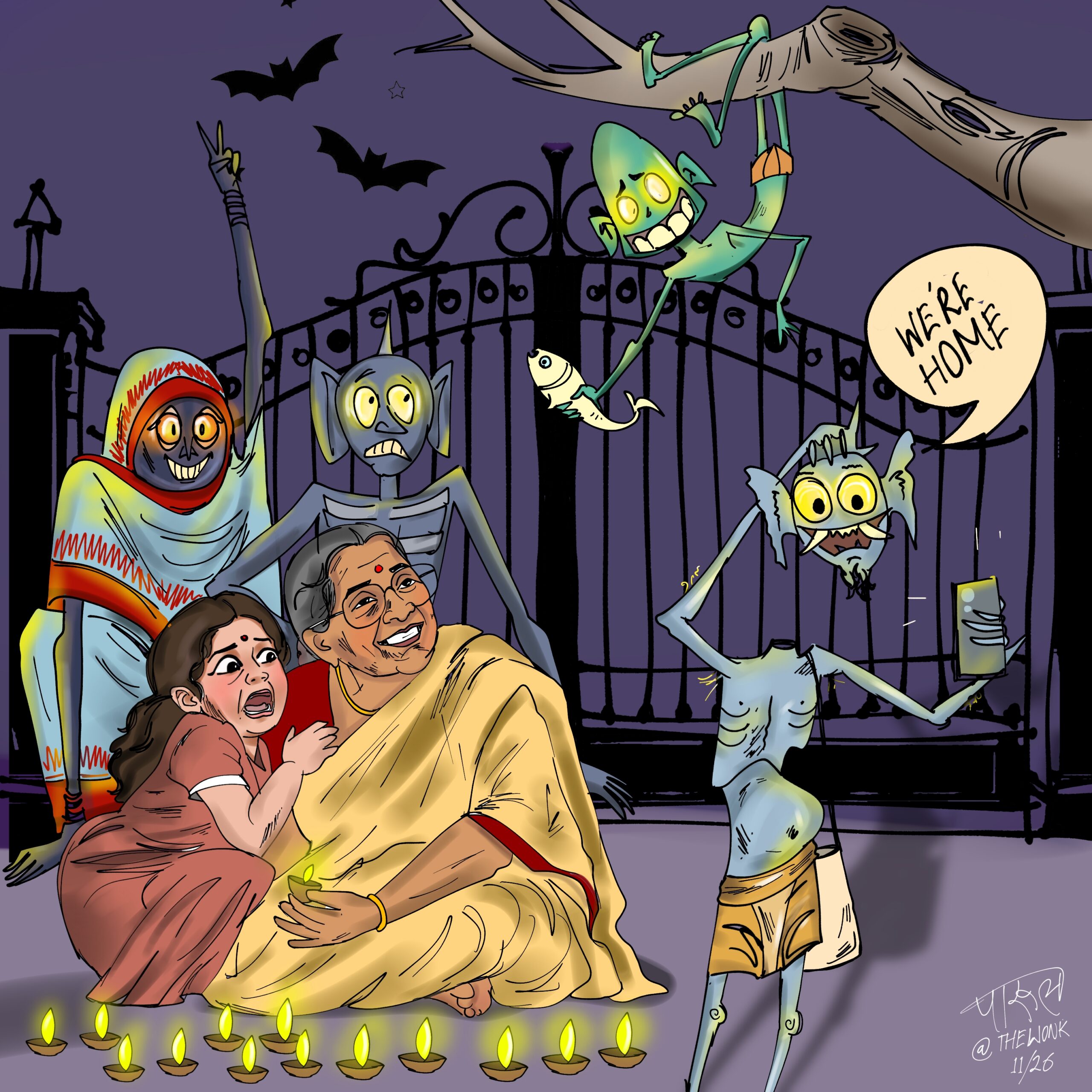
“এলো এলো দুর্গা এলো”, the customary tunes of this song announce the arrival of Goddess Durga, bringing with them the joy and vibrancy of Bengal’s festive season. Yet, as the celebrations of Durga Puja give way to Kali Puja, the mood takes a whole different turn. While much of India remains engrossed in celebrating Diwali, the festival of lights, Bengal finds a different kind of reassurance in another divine form of the Mother Goddess, Ma Kali, a fierce incarnation of Goddess Parvati. “ও তোর নামে কালী মুখে কালী অন্তরে তোর নাই কালিমা এবার তোরে চিনেছি মা।।”, the song captures this shift in devotion. In her name and on her face lies kali, the darkness, yet within her there is no kalima, no blemish. Here, darkness is not merely understood as the absence of light or something to be feared; it becomes a symbol of divine power, capable of stirring the soul and evoking a profound sense of spiritual depth and solitude.
For Bengalis, ghosts are not invariably entities linked to fear. They possess names, routines, preferred spots, and occasionally, even recognizable traits. A child reluctant to obey their parents might be cautioned that Bhutu is on the way. A grandmother may recount tales of a Petni or a Brahmadaitya. On the eve just before Kali Puja, fourteen earthen lamps are kindled throughout the home to welcome the spirits of departed ancestors. This prompts an interesting question: why does Bengal devote an entire night to honouring the dead with lamps while its folklore has embedded ghosts so deeply into its cultural awareness?
In Bengali custom, the connection with the deceased is not always shaped by fear or supernatural menace. During Bhut Chaturdashi, the act of lighting fourteen lamps is linked to honoring and inviting the spirits of fourteen generations of forebears. These are not merely unknown entities from an invisible realm, but individuals who once belonged to our families, whose memories persist within our homes and cultural consciousness. There is, perhaps, a certain warmth in this familiarity with the unseen. One is reminded of Satyajit Ray’s Goopy Gyne Bagha Byne and the memorable song, Bhooter Raja Dilo Bor. The King of Ghosts does not come to scare the main characters but to bestow blessings upon them. Perhaps this reflects the unique nature of Bengal’s connection with its ghosts: rather than fearing them, we respect them, include them in our narratives, and honour the lives that preceded us.
Bhut Chaturdashi is typically observed on the fourteenth lunar day, or Chaturdashi, of Krishna Paksha, just before Kartik Amavasya, when Kali Puja is celebrated in Bengal. The term bhut denotes a ghost or spirit, while Chaturdashi means the fourteenth lunar day. This religious festival is characterised by two notable traditions: Choddo Prodip, the lighting of fourteen earthen lamps around the home, and Choddo Shaak, the preparation and consumption of fourteen types of leafy greens. The most commonly cited Bengali explanation for the fourteen lamps relates to the return of fourteen generations of ancestors. Popular belief holds that the spirits of departed family members come back to their old homes on this night. The lamps guide them through the darkness, helping them find their way back to their families. In this perspective, the dead are not necessarily intimidating strangers. They might be grandparents, great-grandparents, and ancestors whose names and faces have slowly faded from family recollection. Another viewpoint suggests that the lamps serve to protect the home from roaming or unwanted spirits. Some traditions link the fourteen lamps to Goddess Chamunda, a fierce manifestation of the divine mother, accompanied by supernatural protectors of the household. These interpretations coexist in popular practice, though none can be considered the sole definitive explanation for the ritual. The lamps are positioned near doors, windows, courtyards, and other areas of the home, transforming everyday domestic spaces into sites of remembrance and protection.
The significance of the number fourteen also extends to the kitchen. Choddo Shaak refers to fourteen types of leafy greens, though the exact assortment varies between families and regions. Neem leaves, mustard greens, betho, hinche, sushni, shalinche, ghentu, and jayanti are among the varieties included in different traditional lists. This custom is especially intriguing from the perspectives of food history and seasonal awareness. Bhut Chaturdashi actually occurs during Bengal’s shift from autumn to winter, when certain greens are locally available. Some traditional explanations often associate their consumption with digestive and medicinal benefits too. While others merely connect the food with ancestral remembrance and protection from severe illness. A seasonal explanation is certainly plausible, but it would be unjustified to claim that the ritual was scientifically designed as a medical intervention. The historical origins of Bhut Chaturdashi, however, remain unclear. There is no firmly established historical date that totally explains the festival in its present form. A significant research lead is the work of a sixteenth-century Bengali ritual scholar Raghunandana Bhattacharya. His text, Krityatattva, is associated with the traditional list of fourteen greens. A 2017 paper in the International Ayurvedic Medical Journal, titled “Pharmacology and Ethno-Pharmacology of Traditional Bengali Cuisine ‘Choddosak’”, also discusses an early textual reference to the food custom. These citations are insightful, but they do not by themselves clearly determine the precise origin of every element of the modern tradition.
The supernatural, meanwhile, has a particularly vivid place in Bengali storytelling. The Petni is a female ghost, often associated in folklore with an unhappy or untimely death. The Shakchunni is often traditionally depicted wearing conch-shell bangles, while the Brahmadaitya, who is a Brahmin spirit, is sometimes portrayed as powerful or benevolent. The Mechho Bhoot is associated with fish, the Gechho Bhoot with trees, and also there’s another figure is Nishi, whose mysterious voice is believed to lure people away at night. These descriptions vary across local traditions, but they give ghosts discernible identities, habits and social constructs.
Bengali literature has helped to critically preserve and disseminate this imaginative world. Lal Behari Day’s Folk-Tales of Bengal (1883) collected traditional narratives, while Dakshinaranjan Mitra Majumdar’s Thakurmar Jhuli (1907) brought folktales to younger readers. Writers such as Upendrakishore Ray Chowdhury, Leela Majumdar, Bibhutibhushan Bandyopadhyay and Satyajit Ray further deepened Bengali children’s literature and the intense supernatural storytelling. For many who grew up watching television adaptations of Thakurmar Jhuli, these stories were not simply frightening entertainment; they were part of a generation’s shared memories. Bengal’s religious landscape adds another dimension to this. While Lakshmi Puja is central to Diwali celebrations in many parts of India, Kali Puja features a notable place in Bengal’s festive calendar. The worship of Ma Kali, a fierce manifestation of the divine feminine, forms part of the region’s significant Shakta tradition. Some strands of Bengali Shakta Tantra engage with death, cremation grounds and the overcoming of fear. Yet Bhut Chaturdashi should not inherently be characterised as a Tantric festival simply because it precedes Kali Puja. Nor should Tantra, folk beliefs about spirits and prevailing ideas of kala jadu ( black magic) be treated as synonymous. Rabindranath Tagore’s Chandalika, in which Prakriti, the protagonist, urges her mother to use a spell to bring the Buddhist monk Ananda back to her. The play offers a literary exploration of black magic and its repercussions, rather than the historical records of the festival’s origins.
Bhut Chaturdashi is time and again compared with Halloween because both incorporate spirits and the supernatural. But Halloween, observed on 31st October, has a layered history involving the Celtic festival of Samhain and Christian All Hallows’ observances. Its contemporary celebrations are widely associated with artistic and fancy costumes, trick-or-treating and horror entertainment. Bhut Chaturdashi, conversely, belongs to a Bengali Hindu ritual calendar and emphasises ancestral remembrance, fourteen lamps and fourteen greens. Bhut Chaturdashi is also quite different from North India’s Naraka Chaturdashi, even though they occur close together in the festival calendar. Referring to it simply as the Bengali Halloween overlooks these significant differences.
One of the most compelling ways to interpret Bhut Chaturdashi is by considering three linked concepts: memory, nature, and imagination. Fourteen lamps are lit to honour those who have gone before us; fourteen types of greens maintain a connection with seasonal produce and local flora; and ghost stories keep alive a tradition where the supernatural is part of everyday life. This evening, ghosts are not just beings of darkness. Some are remembered as ancestors; others continue to exist through stories, books, and childhood warnings. Perhaps this is what makes Bhut Chaturdashi distinct: Bengal has woven the supernatural into its home life, cuisine, and cultural identity.
~ Shob bhoot, bhoot noye, kichu bhoot odbhyut.
(Not every ghost is a ghost, some are quite extraordinary beings).