

From the familiar strains of Ailo Uma (উমা) Barite to the melancholy of Jawar Belay, from the rhythmic dhaak to the tears that converge in our eyes as the goddess departs, Dashami is an emotion you have taught us to live with. My higher studies and the hectic obligations of everyday life may have taken me away from you more often than I would like, but there are some things that never allow a Bengali to drift too far from home. The sound of the dhaak is one of them. So is the gravitational force of Pujo, that inexplicable Pichhutan which brings us back, wherever in India or abroad life has taken us.
I have grown up beholding you blossom with the arrival of Devi Paksha. During these two days of the year, Bengal certainly looks like a decked up bride, “O go Bodhu Shundori” adorned in all her splendour. The streets glow, the city awakens and every corner seems to carry the promise of celebration. Even the shiuli flowers vibrantly announce autumn. From Shashthi to Dashami, time seems to follow a different clock. Three in the morning becomes just another hour in Kolkata’s endless celebration. New shoes are compulsory, whether they are sneakers or sandals, and a band-aid is practically an oxygen bag for the feet. No amount of pain, however, can persuade us to abandon pandal-hopping. We will walk, queue, stumble, complain and continue, because none of us wants to miss what the city has spent months crafting for us.
And what a preparation it is ! Durga Puja is not simply an utshob ( festival); it is an entire ecosystem of art, labour, commerce, memory and belonging. Kumartuli comes alive with generations of artisans shaping clay into the goddess we have waited all year to welcome. Behind the ten days of celebration lie months of work by potters, painters, decorators, electricians, designers, organisers and countless others. The pandals are not merely structures to be photographed; they are pictorial representations of imagination, craftsmanship and collective effort. From intricately designed installations to traditional ekchala idols, the variety tells us how artistic creation continues to rejuvenate an old tradition.
The Bonedi bari Pujo’s offer yet another kind of intimacy, carrying charismatic family legacies, inherited rituals and the particular character of homes that have welcomed Uma for generations. The mela stalls, food vendors, small businesses and temporary shops sustain livelihoods of their own. Pujo is a “vyapar” as well as an utshob too, an economic season that nurtures people whose labour often remains invisible to those who arrive only to admire the accomplished spectacle. The festival wholeheartedly belongs to the artisans who make it, the workers who erect it, the vendors who sell through the night, and the visitors who bring the arteries of the city to life.
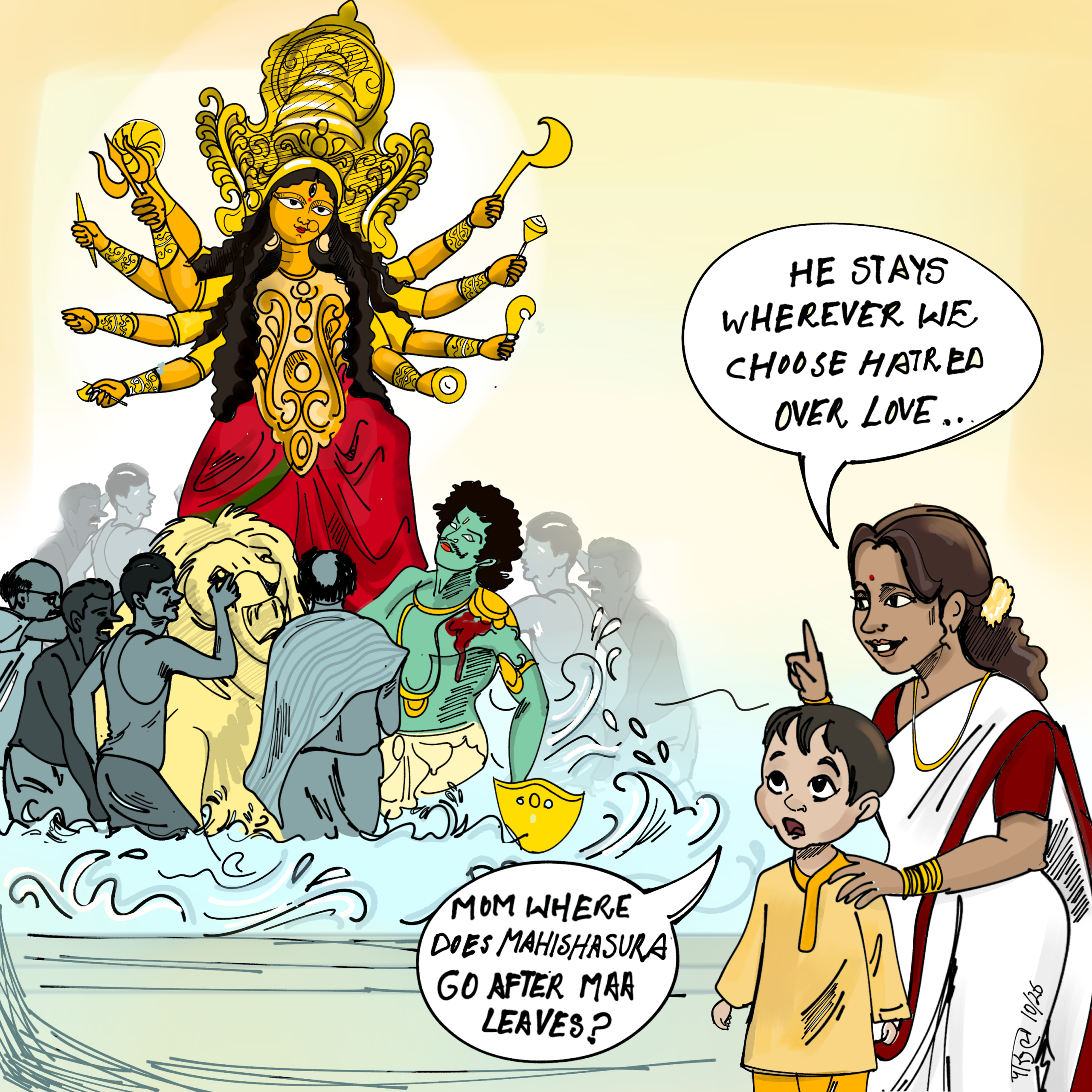
For us, Uma is not simply a deity descending to Earth. She is the daughter returning to her baper bari. ( father’s house), welcomed with affection, food and the best that a home can offer. The question “Ma, tui kemon achhis?”(Ma, how are you?), carries a tenderness that is very difficult to explain to anyone who has not grown up with this relationship. We call her Maa, yet we also welcome her as a daughter. During Sandhi Puja, the lamps radiate the moment between Ashtami and Navami. During the festivities, the pulses of dhunuchi naach, the devotional offerings of Maa er bhog and the joy of family gatherings make devotion something we can see, taste and share. And when Dashami arrives, women in white sarees with red borders gather for sindur khela, offering sindur to the goddess and to one another. It feels less like a farewell to a distant deity than an embrace of a daughter who must leave once more. Perhaps this is what makes Bengal’s Vijayadashami so unique: we offer sweets not only to the Goddess but, in this tradition, to Mahishasura too. Beyond the victory of good over evil lies a deeper symbol of compassion, the belief that even in the face of defeat, suffering, or wrongdoing, humanity must not abandon empathy. As literature consistently reminds us, our moral worth lies not merely in condemning evil, but in retaining our capacity for mercy. Perhaps that is the lesson Bengal asks us to carry beyond the ADIEU: that human sensitivity must stand above all else.
‘Asche bochor abar hobe’ is therefore not merely a phrase of consolation. It is a promise. The promise that the daughter will definitely return, that the dhaak will sound again, that the city will once again become a maze of pandals, and that the familiar pull of Pichhutan will bring us back home. Technology has changed how we experience this inheritance. Mahalaya which once brought many families together around the radio to listen to Birendra Krishna Bhadra; today, digital platforms carry festive memories far beyond Bengal. Social media, viral pandals and AI-generated advertisements have become part of this contemporary celebration of Bengal’s biggest carnival of the year. There is no need to deny these changes or assume that they have tarnished our very own Pujo. The conundrum is whether our appetite for the spectacular has outgrown our commitment towards the people sharing those spaces.
This year, that question became painfully urgent at Chorbagan in Kolkata. A stampede at a Durga Puja pandal on October 17 claimed 19 lives and injured 25 people. Reports raised serious concerns about the extreme crowd pressure, heavy rains and the arrangements at the venue. The prevailing circumstances require a thorough investigation, and responsibility must be established through evidence. But one thing should never be in question: such a loss of life must not become an accepted price of celebration. A festival that draws enormous crowds demands careful planning, safe entry and exit routes, effective crowd management, adequate personnel and readiness to respond to emergencies. The responsibility of the organisers and authorities is not fulfilled simply by allowing a celebration to take place; it includes sheltering those who come to become a part of it.
The state government has announced ₹25 lakh in compensation and a government job for one family member of each deceased person, alongside ₹5 lakh for each injured person and coverage of medical expenses. Such humanitarian assistance matters to families suddenly bereaved of a loved one, an income or a caregiver. Yet remuneration cannot be the ultimate conclusion of the story. The assertion that a family has at least received a job because someone died is an extremely disturbing way to frame a human loss. Death is not a benefit. No amount of money can return a child, a parent or a partner. Relief must be thoroughly accompanied by investigation, accountability and concrete measures to prevent another tragedy.
For the rest of us, Dashami still arrives with Shubho Bijoya. We embrace one another, exchange greetings and begin to look forward to next year. But for the families who lost their loved ones at Chorbagan, there can be no ordinary festive closure. Nineteen lives are not simply a number, and a tragedy does not become less significant because another tragedy has occurred elsewhere. We must never use one loss to downplay another. Each death deserves attention, each injured person is worthy of care, and every preventable tragedy rightfully merits serious scrutiny.
Bengal, there are other harsh realities I cannot leave unspoken. The controversies surrounding Left-affiliated bookstalls, including disputes over their removal and allegations of vandalism, raise a bunch of serious concerns about the spaces in which ideas circulate. Jürgen Habermas’s conception of the public sphere offers a useful way to comprehend wider democratic culture: people need places where they can witness unfamiliar ideas, debate differences and participate in public life.
सरस्वतिनमस्तुभ्यंवरदेकामरूपिणि. विद्यारम्भंकरिष्यामिसिद्धिर्भवतुमेसदा
And here, I cannot help but think of Saraswati, the goddess of learning, whom we invoke with reverence. We sing her praises, seek her blessings for our education and place our faith in the power of knowledge. The familiar Saraswati invocation verse, “Ya Kundendu Tusharahara Dhavala,” celebrates the goddess whose radiance is compared to the moon, snow and the white garland. Yet what does it mean to worship the goddess of learning if we fail to protect the spaces where knowledge is shared? What meaning does our Honour actually hold if bookstalls become mere targets of hostility, if books are treated as threats, or if public spaces for intellectual exchange are narrowed by coercion? A bookstall is more than a temporary shop. It is a meeting point for readers, a place where unfamiliar ideas are encountered and political differences are frequently debated. It can also introduce someone to a book that changes the main course of their life, or to a perspective that challenges what they have always believed for a long period of time. In Bengal, where literary culture and public discussion have long occupied a place in collective life, such spaces are not insignificant. Allegations of vandalism and disputes over the removal of Left-affiliated stalls should trouble anyone who believes that public culture must leave room for ideas one may not share. If Saraswati represents the pursuit of knowledge, our devotion to her must extend beyond ritual into the protection of learning, inquiry and dissent.
Perhaps this is where Apu’s Durga returns to the centre of our reflection. In Satyajit Ray’s Pather Panchali, Durga is not a goddess surrounded by elaborate installations and lights. She is a marginalised child whose life is shaped by poverty, deprivation and social judgement. Her story asks us to recognise the lives society fails to protect. We can commemorate the goddess in our pandals and grieve for the loss of the child on screen, but can we give due regard to vulnerability when it stands before us in everyday life?
On this Vijay Dashami, I wish that our valediction could carry vows beyond the ordinary demarcation of ritual. No woman should suffer violence or lose her life because of dowry, or be shamed for her complexion in a society that worships Goddess Kali. Durga’s many hands may symbolise divine power, but they should not become an expectation that women must excel concurrently at work, caregiving, education and domestic labour without limits. Let every woman, every Individual Durga have her own choices and the right to acknowledge that she cannot do everything. No Saraswati should be denied education because marriage is perceived as more urgent, and no Lakshmi should be denied dignity or opportunity because of the reality beyond her control. Nor should a boy be made to feel inadequate because he does not bear a resemblance to Kartik. Human worth cannot be determined against divine ideals of beauty, strength or perfection.
Dearest Bengal, I am penning this down because I love you, not because I have stopped holding on to faith in you. Your beauty lies in the shiuli flowers, the lamps of Sandhi Puja, the artistry of Kumartuli, the crowded streets at three in the morning and the women who welcome one another during sindur khela. It lies in the hands that make the goddess, the stalls that sustain livelihoods, the books that keep ideas alive and the people who come back every year because some part of them has never truly left.
Now Uma has already departed for her celestial realm, and Bengal’s own Umas; its daughters and other children are also returning back to their studies, workplaces and everyday responsibilities. We, too, must return carrying something more than photographs and memories. Let us carry a commitment to safer celebrations, greater inclusion, dignity for every person and accountability when lives are put at risk. Let next year’s Asche bochor abar hobe be a promise that we will celebrate with joy without being receptive to avoidable loss at its cost.
When we look at Ma Durga in the Darpan of Dashami, let us also look at the Bengal reflected there: its celebrations and contradictions, its compassion and its failures of care. If we immerse the goddess but leave our indifference untouched, what have we truly immersed?
Until the next year, my beautiful Bengal, may you keep shining, may your people return safely, and may every family have the chance to welcome the next Pujo with joy.
আমারসোনারবাংলাআমিতোমায়ভালোবাসি
শুভবিজয়া🙏
Views expressed disclaimers: The views are solely those of the writer. Our platform gives opportunities to various writers of diverse opinions. We try to remain as unbiased as we can.