

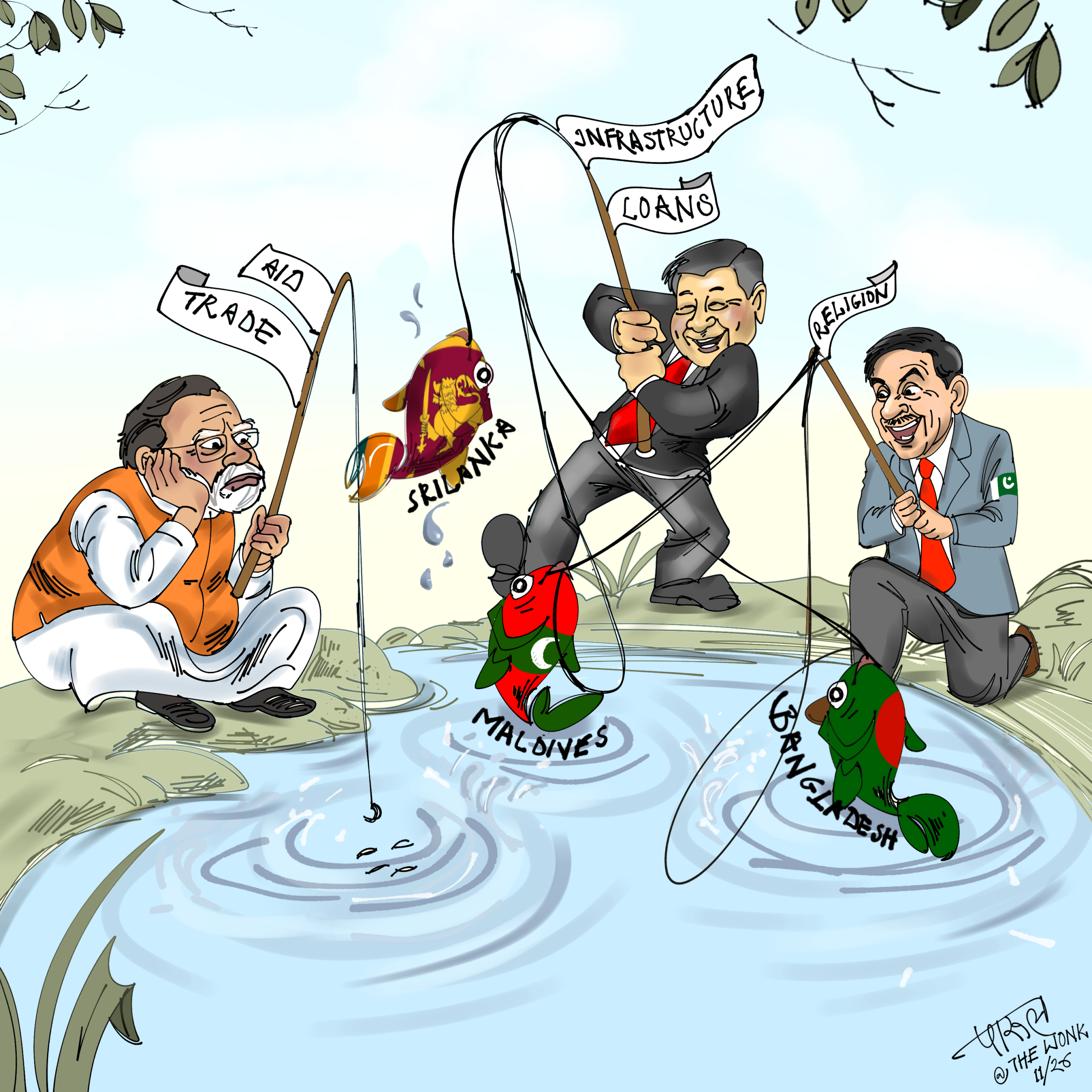
China means different things to different people across Asia.
For a business owner in Vietnam, it may be a market worth millions. For a fisherman in the Philippines, it may be the country whose coast guard ships appear in waters where he has worked for years.
In India, the conversation often turns to the disputed border, Chinese imports, and the growing trade gap. These are not conflicting accounts of two different countries. They are different experiences of dealing with the same one.
Over the past few decades, China has built a position in Asia that few countries can ignore. Its factories supply goods across the region, its companies invest in major infrastructure projects, and its government has become an influential voice in regional affairs. But its growing power has also brought disputes, especially over territory and maritime boundaries.
This is what makes China’s role difficult to judge. Countries want access to its markets and investment, but many are also cautious about its political and military ambitions. To understand why, it helps to look at what China is doing, rather than simply deciding whether it is a friend or an enemy.
The South China Sea: Where China’s Neighbours Feel the Pressure
The South China Sea is one of the clearest examples of the tension between China’s growing influence and the concerns of other Asian countries.
China claims a large part of the sea through the nine-dash line. The claim overlaps with the maritime claims of the Philippines, Vietnam, Malaysia, and Brunei. It also overlaps with Indonesia’s exclusive economic zone near the Natuna Islands.
An exclusive economic zone, commonly called an EEZ, gives a country special rights to explore and use resources in the waters extending up to 200 nautical miles from its coast.
There is a lot at stake here. The South China Sea carries major international shipping routes and supports fishing communities. It is also believed to contain oil and gas resources. For countries that depend on these waters, the dispute is not just about lines on a map. It affects livelihoods, trade, and national security.
The Philippines has been particularly vocal about its encounters with Chinese vessels.
In April 2026, satellite images reported by Reuters showed Chinese vessels and a floating barrier near the entrance to Scarborough Shoal, which is claimed by both China and the Philippines. The barrier appeared to have been removed after the weekend, but its presence was enough to raise concerns in Manila.
Another confrontation followed in July. The Philippines accused the Chinese Coast Guard of using water cannons against its vessels for a second day in a row. According to Reuters’ report from July 2026, the two countries had faced three confrontations in the South China Sea that week.
China disputed the Philippine account. It said the Philippine vessels had entered waters under Chinese jurisdiction and that its Coast Guard had acted after issuing warnings.
The disagreement over what happened is part of a much larger problem: both countries claim rights in the same area, and there is no shared understanding of how those claims should be handled.
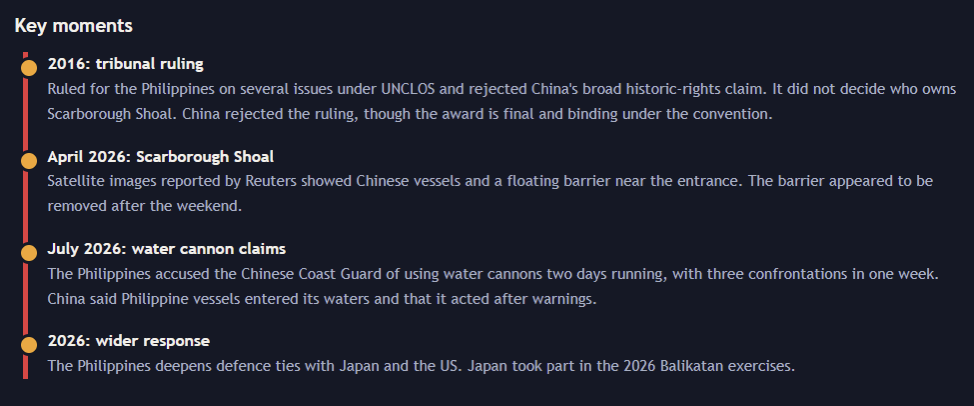
There is also an important legal background. In 2016, an international tribunal ruled in favour of the Philippines on several issues under the United Nations Convention on the Law of the Sea. It rejected China’s claim to historic rights over resources where those claims went beyond the limits allowed by the convention. It also found that China had violated certain rights of the Philippines in its exclusive economic zone.
The tribunal did not, however, decide who owns Scarborough Shoal. That distinction matters. The ruling dealt with maritime rights and the interpretation of international law, not sovereignty over the disputed feature.
China rejected the ruling, although the award is final and binding under the convention. The full decision is available in the 2016 arbitration ruling.
These disputes have consequences beyond the two countries involved. The Philippines has strengthened its defence relationships with partners such as Japan and the United States. Japan’s participation in the 2026 Balikatan exercises is one example of closer security cooperation.
This does not mean that every country in Asia wants to confront China. Many would rather avoid a military dispute altogether. But when incidents at sea keep happening, neighbouring countries have reasons to prepare for the possibility that tensions could get worse.
The Economic Relationship Is a Different Story
While the South China Sea creates political and security concerns, China’s economic relationship with the rest of Asia tells a very different story.
For many countries, China is too important a trading partner to ignore. Its factories supply everything from machinery and electronic components to everyday consumer products. Its companies also take part in construction, energy and transport projects across the region.
Southeast Asia offers a good example of just how closely the economies are connected.
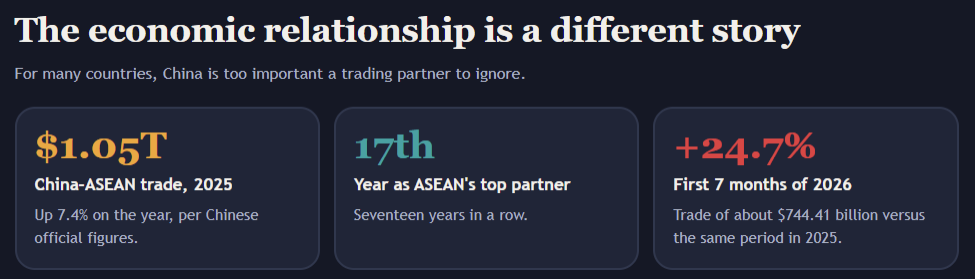
According to Chinese official figures, trade between China and ASEAN reached approximately $1.05 trillion in 2025, growing by 7.4% from the previous year. China remained ASEAN’s largest trading partner for the seventeenth consecutive year.
The numbers continued to rise in 2026. During the first seven months of the year, trade reached around $744.41 billion, up 24.7% compared with the same period in 2025.
These figures are reported by Chinese government sources and should be read in that context. Even so, they point to the scale of the economic relationship. Businesses across Southeast Asia rely on Chinese suppliers, customers and investment.
China’s Belt and Road Initiative, launched in 2013, is another major part of this relationship. The programme supports projects such as roads, railways, ports, power plants and other infrastructure intended to connect countries and improve trade.
According to the Green Finance & Development Center’s 2026 report, China’s Belt and Road engagement reached approximately $126.3 billion in the first half of 2026. This included around $49.8 billion in overseas investment and $76.5 billion in construction contracts.
The two figures describe different kinds of activity. Investment involves money committed to projects or businesses, while construction contracts cover work undertaken by Chinese companies. They should not be confused with one another.

For a developing country, a new railway, port or power project can make a real difference. Better transport links can reduce travel time, help local businesses move goods and connect smaller towns to larger markets. Such projects can also create employment.
But the benefits are not automatic.
A government still has to ask some difficult questions. Will the project generate enough economic activity to justify its cost? Can the country manage the repayments if loans are involved? Will local workers and businesses benefit, or will most of the work and profits go elsewhere? What will the environmental impact be?
These questions matter with any large infrastructure investment, regardless of where the money comes from. The World Bank’s 2025 Debt Transparency Report also highlights the importance of clear information about public borrowing.
It would be unfair to say that every Chinese-funded project creates a debt problem. Some may offer long-term value, while others may prove too expensive or deliver less than expected. Each needs to be judged on its own terms.
China’s investments can open doors for its partners, but they also support Chinese companies and wider strategic interests. There is no reason to assume that only one side benefits.
Why Southeast Asian Countries Have Mixed Feelings
Trade figures show how closely Southeast Asia is connected to China. They do not tell us whether people in the region trust Beijing.
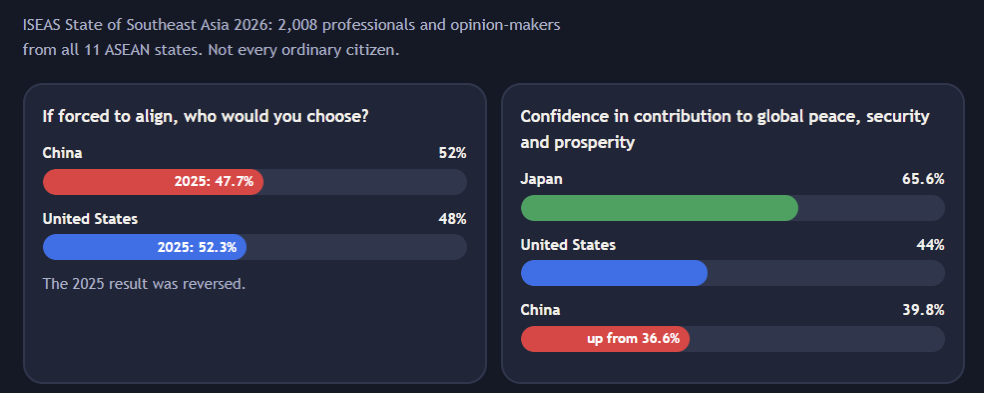
The ISEAS-Yusof Ishak Institute’s annual State of Southeast Asia survey offers a useful look at how regional professionals and opinion-makers view major powers.
The 2026 survey included 2,008 respondents from all 11 ASEAN member states. One question asked whether respondents would choose China or the United States if they had to align with one of them.
The result was close: 52% chose China and 48% chose the United States. In the 2025 survey, the figures were reversed, with 52.3% choosing the United States and 47.7% choosing China.

That result is interesting, but it should not be mistaken for a measure of trust.
When respondents were asked about confidence in a country’s contribution to global peace, security and prosperity, 39.8% expressed confidence in China. The figure was 44% for the United States and 65.6% for Japan. China’s score had improved from 36.6% in 2025, but it remained behind both countries.
At the same time, 55.9% of respondents identified China as Southeast Asia’s most influential economic power.
There is a reason these findings may appear contradictory. A country can be economically important without being fully trusted. Businesses may need Chinese suppliers, governments may welcome Chinese investment, and yet the same governments may worry about becoming too dependent on Beijing.
It is also worth remembering who took part in the survey. It reflects the views of selected professionals and opinion-makers, not every ordinary citizen in Southeast Asia.
The full findings and methodology are available in the ISEAS 2026 survey report.
The broader picture is that Southeast Asian countries want to work with China, but they also want room to make their own decisions. That balance is likely to remain important as China’s influence grows.
India and China: Business on One Side, Border Tensions on the Other
India’s relationship with China brings the same contradiction into sharper focus.
The two countries are major neighbours with a long history of trade and diplomatic engagement. They also have an unresolved border dispute, and relations became particularly strained after the Galwan Valley clash in 2020.
Since then, both sides have made efforts to reduce tensions. Diplomatic meetings have continued, and there have been attempts to improve communication along the border.
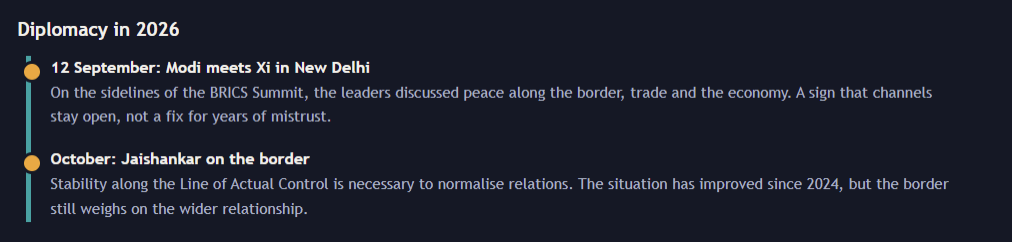
On 12 September 2026, Prime Minister Narendra Modi met Chinese President Xi Jinping in New Delhi during the BRICS Summit. According to the Indian government’s official statement, the leaders discussed bilateral relations and the importance of maintaining peace along the border, along with trade and other economic matters.
The meeting was a sign that both governments wanted to keep diplomatic channels open. But one meeting cannot settle years of mistrust or resolve every outstanding issue.
Trade is another area where India’s dependence on China is clear.
According to official Indian Embassy data, India’s exports to China reached approximately $19.47 billion in the financial year 2025–26. Imports from China were around $131.63 billion. This left India with a trade deficit of approximately $112.16 billion.
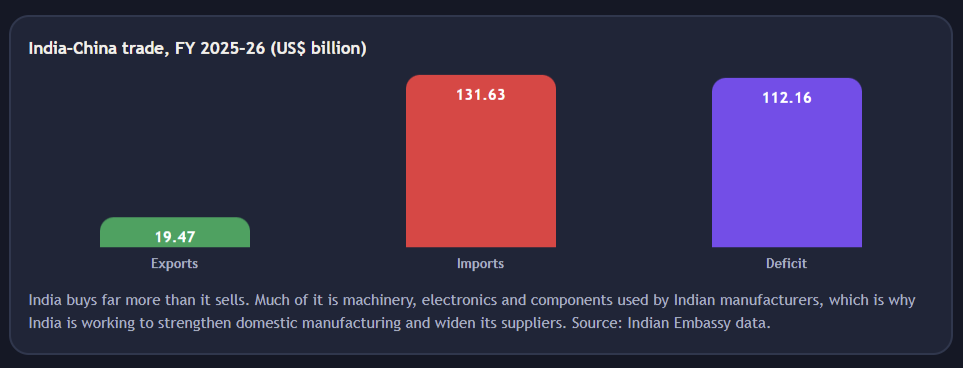
Put simply, India buys much more from China than it sells to it.
A large part of this trade involves machinery, electronics, industrial components and other goods used by Indian manufacturers. These imports support many businesses, but they also expose India to supply-chain risks.
This is one reason India has been trying to strengthen domestic manufacturing and widen its sources of supply. Reducing dependence is not easy, especially when Chinese products are deeply connected to existing production networks.
The figures are available through the Indian Embassy’s trade and economic relations data.
The border remains a separate concern. In October 2026, External Affairs Minister S. Jaishankar said that stability along the Line of Actual Control was necessary for normalising relations with China. Although the situation had improved since 2024, border issues continued to affect the wider relationship. His remarks were reported by ThePrint.
For India, this is the difficult part of dealing with China. Economic cooperation is necessary, but it cannot come at the cost of ignoring security concerns. The two countries may continue doing business, yet the border dispute will remain a major test of their relationship.
So, Which Side of China Should Asia Believe?
Perhaps the problem is with the question itself.
Calling China a bully ignores the economic opportunities it has created for its neighbours. Calling it a benevolent partner overlooks the pressure that some of those same neighbours face in territorial disputes.
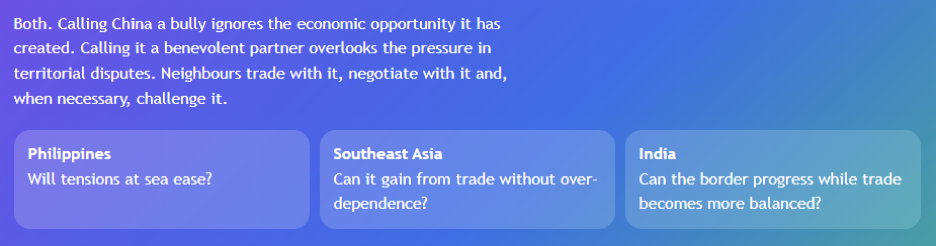
The Philippines may challenge China’s actions in the South China Sea while continuing to trade with Chinese businesses. Southeast Asian economies may welcome investment but look for other partners to avoid overdependence. India may need Chinese industrial supplies while strengthening its border security and domestic manufacturing.
None of this is unusual in international relations. Countries often cooperate where their interests meet and disagree where they do not. China, like other major powers, pursues its own national interests. The important question is how it uses its influence and whether its actions leave enough space for smaller countries to protect their own interests.
For Asia, the challenge is not simply to accept or reject China’s rise. It is to build relationships that bring economic benefits without weakening national independence, regional security or international rules.
Final Note
China has become too important to Asia to be treated as either a simple friend or a permanent enemy.
Its trade links and infrastructure projects have helped shape the region’s economy. At the same time, its approach to territorial disputes has made several neighbours more cautious about its growing power.
The coming years will show whether these two sides of China’s role can exist without creating deeper instability. Will tensions with the Philippines ease? Can Southeast Asian countries continue benefiting from Chinese trade without becoming overly dependent? And can India and China make lasting progress on their border while building a more balanced economic relationship?
These are more useful questions than trying to fit China into a single label.
Its neighbours will continue to trade with it, negotiate with it and, when necessary, challenge it. That may be the most realistic way to understand China’s place in Asia: not as a straightforward benefactor or bully, but as a powerful country whose actions will keep shaping the region’s choices.