

After British rule ended in 1947, the princely state of Jammu and Kashmir had the choice to join India or Pakistan. However, the Maharaja, Hari Singh, was unsure. Due to an incursion by tribal raiders from the Pakistani side in October, he signed an instrument of accession to India. Indian troops were then flown in. The first Indo-Pakistan war had begun.
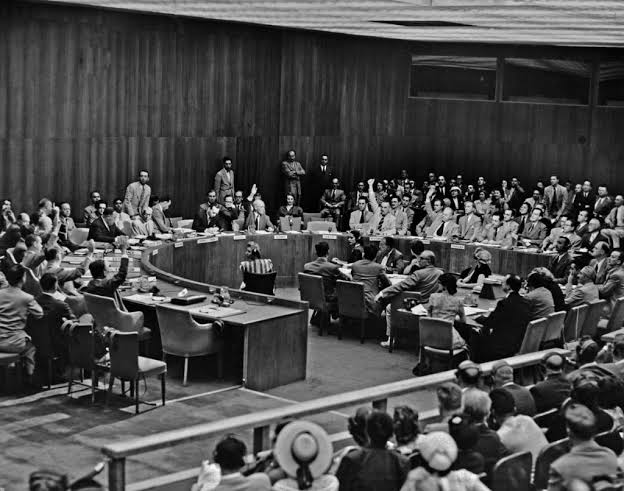
On the 1st of January 1948, India raised the issue to the Security Council. This is an important point to note, as it made the issue an international issue. However, by raising it India admitted that the issue would be decided by a vote. Resolution 47 was adopted on the 21st of April 1948. The resolution was passed by 7 votes to none with 4 abstentions (Belgium, Colombia, Ukrainian SSR and USSR). The UN Commission for India and Pakistan was expanded and recommendations made to stop fighting and create suitable conditions for a free and fair referendum on whether the state should join India or Pakistan.
A ceasefire took hold on 1 January 1949, and a ceasefire line was drawn across the state. The vote never took place.
What the resolution asked, and of whom
The most common mistake in the Kashmir debate is to treat Resolution 47 as a single demand. It was a sequence, and the order is the whole argument.
Pakistan was requested to use their best endeavours to ensure the withdrawal of the tribesmen and Pakistani nationals fighting in the state. India were to progressively withdraw their troops to the minimum level necessary to maintain order whilst a plebiscite administrator appointed by the UN Secretary General would organise the vote. Further resolutions were passed by the commission in August 1948 and January 1949 to clarify.
Indian commentators see this as favourable to them. An analyst has argued that the first request was for Pakistan to withdraw; this is also what India has continually requested. Therefore, as Pakistan never fulfilled the conditions, India had no obligation to do so. They also highlight that assurances were given that if the first parts of the August 1948 resolution were not fulfilled, the idea of a plebiscite would not be binding on India.
However, Pakistani writers highlight that the important thing is that the Council continuously emphasised that the accession would be decided via a free and fair referendum under UN auspices. This was agreed to by India. However, India later objected to all the demilitarisation formulas through various mediators showing they no longer wanted to have a vote they may lose. Both sides blame each other for the stalemate. There was much contention throughout history on how much and how quickly each army should withdraw.
Binding or advisory?
Another compelling argument is a legal one. India claims that the Kashmir resolutions were adopted under Chapter VI of the UN Charter, which addresses peaceful settlement of disputes, not Chapter VII, which authorizes the Council to enforce decisions. In this interpretation, Resolution 47 was a non-binding decision that was not guaranteed to be binding, as could not be the case for resolutions passed under Chapter VII. Indian authors note that Secretaries General Kofi Annan and Ban Ki-moon have dismissed comparisons to Iraq and similar cases under Chapter VII as apples and oranges.
The Pakistani legal responses maintain that the resolutions do not mention either chapter, that Article 25 of the Charter requires all members to implement decisions of the Council, and that the rigorous chapter VI and Chapter VII separation only became clear after the Korean War. One Pakistani legal submission argues that not a single one of the 17 resolutions refers to either Chapter VI or Chapter VII. It continues that since India itself submitted the dispute under the pacific settlement chapter, it cannot now refer to the matter as simply a domestic issue.
Both arguments are serious, and neither is a knockout. But there is an irony worth noticing. Yet there is a twist in this game. Pakistan presents these resolutions as binding, while refusing to accept the consequences that lead to its own obligations. India treats them as only advisory, yet uses their first clause to blame Pakistan.
Drifting away from the UN
Two decades of attempts to keep the Council at bay through negotiators such as Sir Owen Dixon and later Frank Graham followed. Ideas for only partial demilitarisation, regional plebiscites, and the appointment of a plebiscite administrator were proposed and defeated by each party’s suspicions. The countries again resorted to war in 1965, followed by the Tashkent Declaration brokered by the Soviets and another bout of fighting in 1971 which established Bangladesh and resulted in the Simla Agreement of 1972.
Simla is the point of contention on which the entire modern argument hinges. India says it promised both countries would work out their differences by themselves and there was no scope for the UN to get involved. Pakistan says the first line of its response was a reaffirmation of the UN Charter, and thus the UN was never excluded. Even some well meaning commentators are briefed to acknowledge the ambiguity.
In 1999 one commentator recorded how Pakistan is clinging desperately to the claim that India’s insistence that Simla is superior to the UN resolutions is false, and how ambiguous the language of Simla is. The line of control was indeed based on the 1949 ceasefire line, and both sides did agree to not change the status quo unilaterally. However, the question of how unilateral they can be is another matter entirely.
By the 1990s, an insurgency in the Valley had given the dispute a more violent and more complicated character. The Kargil conflict in 1999 showed how close the nuclear armed neighbours could come to open war, and Indian officials spent much of it calling for a return to the spirit of Simla.
2019: the status quo shifts
In August 2019, India abrogated Article 370 that granted Kashmir special status and divided it into two Union Territories. India described the move as an internal matter of the constitution. Pakistan condemned the move as a unilateral alteration of the status of occupied Kashmir in violation of the Simla Agreement. The UN Secretary General’s office offered a fudgey middle course, ‘The position of the United Nations is well known, as reflected in the Charter and relevant Security Council resolutions, namely that the final disposition of Jammu and Kashmir lies with the people of the region and should be resolved by peaceful means.’ Each government found something to quote.
2025: the crisis that changed the framework
On 22 April there was an attack in Pahalgam resulting in the deaths of 26 civilians – one of the most severe attacks on civilians in the region within the last decade. This was blamed by India on Pakistan backed militants. Although as noted by a report published by the US Congressional Research Service, “India has not made public any evidence of this connection to Pakistan” they suspended the 1960 Indus Waters Treaty on 23 rd April. Pakistan denied being involved however, the decision regarding the water (on which around 80% of their agricultural land and over 90% of their total water supply depends) was seen as a form of coercion.
In response to this Pakistan suspended the Simla Agreement on the 24th April. This is important in regard to the legal aspect of this article as this bilateral agreement, which India often uses as a reason to rule out the involvement of the UN, was suspended by one of the two parties involved. However, Indian commentators argue that Pakistan broke parts of the agreement anyway (such as Article 1 which prohibits unilateral changes and incitement). Pakistani commentators argue that India also suspended another treaty and took similar actions in 2019.
On 7 th May India launched Operation Sindoor where they attacked terrorist infrastructure with missiles. Pakistan responded with Operation Bunyan-um-Marsoos however a ceasefire was agreed upon late on 10th May. India argues that the ceasefire was agreed upon between the two countries however other governments claim to have played a part. Analysts state that this has resulted in a tenuous ceasefire with tensions being controlled but not resolved. The treaty suspensions survived the ceasefire.
Where things stand in November 2026
Nothing has changed from a year ago. The Indus Water Treaty is currently suspended following the first anniversary of Operation Sindoor and India states they no longer have obligations to uphold. Water is now another issue that is constantly causing friction between the two capitals.
Security issues are still occurring within the Indian administered Valley. There has been an attack on a CRPF post in Kulgam over the last few days prompting a search for two terrorists. This has also caused questioning of several suspects. Two special police officers have been killed in the forests of Kishtwar. Politically there has been a lot of controversy surrounding Farooq Abdullah, National Conference president. His comments about Pakistan being the ‘protector of the people of Jammu and Kashmir’ have caused a controversy and he has received harsh criticism from the BJP and others. He has also stated that his priority is to return the rights of J&K. Politicians in the Valley are still focused on this matter.
On the other side of the Line of Control, Pakistan administered Kashmir has its own turmoil. In late July/August 2026 PML(N) gained 31 seats after the election, however, voter turnout was low at only 48.24%. There have been harsh protests from the JKJAAC. In Rawalkot on the 5th November 7 protestors were killed and 23 injured. Drones were allegedly used in civilian areas. This shows that despite wanting to portray a united front, the situation is complicated. Pakistan is struggling to argue they represent the people of Kashmir due to the unrest in their area. Meanwhile, India is struggling to argue everything has been resolved due to the ongoing violence.
So where does the truth lie?
In the uncomfortable overlap, which satisfies neither capital.
The resolutions were real and India did agree to the idea of a plebiscite by taking the issue to the council. However, Pakistan’s involvement in the invasion of 1947 and failure to pull out as required are key reasons why the issue became stalled. The resolutions were advisory but have never been revoked by the council. They are still referenced by UN officials. Whilst Simla changed the diplomatic situation, it was not clear that the UN would no longer play a role.
Now everything is suspended meaning there is no active agreement in place for the bilateral approach that India favours. The events of 2025 show that this issue can still cause missile attacks between two nuclear powers within days of one massacre. Perhaps the resolutions are in place because they are beneficial. Pakistan can use them as legal and moral backing. India can use them as proof that their opposite never upheld their promises. As long as both sides can interpret them as a judgment against the other they do not have to see them as a reflection.
However, there are strong arguments against this neutral view. Indian analysts would argue that it does not take into consideration that Pakistan is driven by terrorism and the threat of militancy means no plebiscite can happen. Pakistani analysts would argue that it does not take into consideration that India controls the territory and therefore have the power to decide the issue themselves which is why the UN is important. Ultimately we have an old unresolved issue.
How much do we owe to a promise that has not been honoured and how much do we owe to the people?