

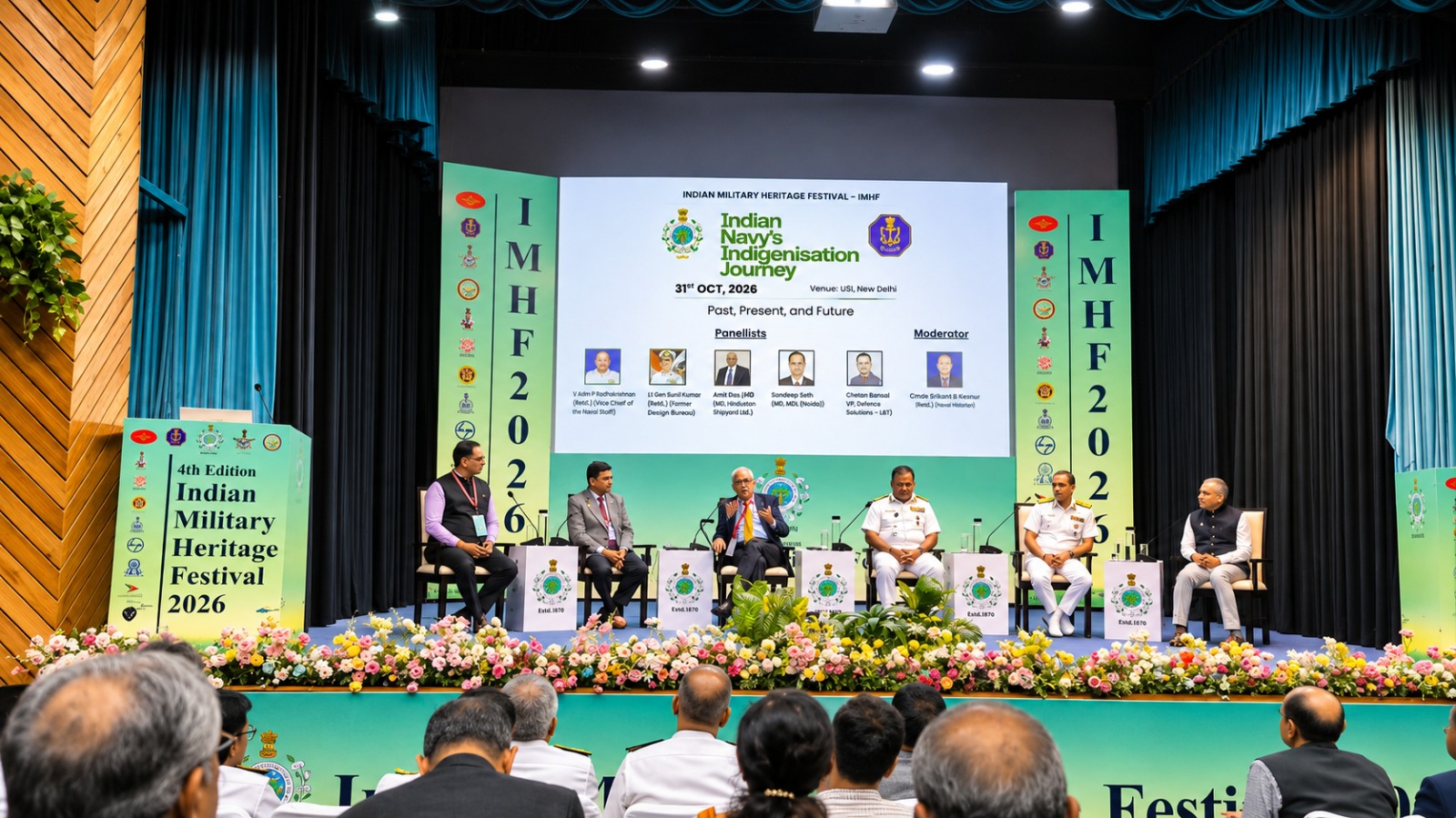
India’s military history is not merely a record of wars fought and victories won. It is also a story of institutional evolution, strategic adaptation and the lessons that continue to shape the country’s defence preparedness. This larger perspective came into focus at the fourth edition of the Indian Military Heritage Festival (IMHF) 2026, which concluded in New Delhi on October 31, bringing together military leadership, veterans, historians, authors, academics and strategic affairs experts for two days of discussions on India’s military past and its future security challenges.
Organised by the United Service Institution of India’s (USI) Centre for Military History and Conflict Studies (CMHCS) on October 30–31, the festival sought to take military history beyond specialist circles and bring it into wider public conversation. Its programme combined panel discussions, book launches, a tri-service exhibition, special addresses and conversations on military heritage, operational experience, technology, jointmanship and the human cost of conflict.
The festival’s opening address by Vice Admiral Sanjay Jasjit Singh (Indian Navy, Retd), Director General, USI, reflected the institution’s commitment to preserving and sharing India’s military heritage. He noted that what began as the first edition of the festival in 2023 had grown into a signature event of the institution.
“Good day to all the historians, distinguished guests and academicians. What began as the first edition of the Indian Military Heritage Festival in 2023 has, over the years, grown into a signature event of the United Service Institution of India. USI has a rich institutional legacy, supported by a library of around 72,000 books and an extensive archive of historical records. Among its prized archival holdings is an original copy of the document relating to the 1971 surrender. These resources reflect the Institution’s commitment to preserving India’s military history and making it accessible to future generations,” Vice Admiral Singh said.
The archival reference was particularly significant. Military history is often remembered through major battles and public commemorations, but original documents, institutional records and personal accounts provide evidence through which these events can be examined, understood and passed on to future generations.
The festival opened with a special session on the military history of the Garhwal Rifles, featuring Lieutenant General Syed Ata Hasnain, Governor of Bihar; other eminences; and Lieutenant General Dinesh Rana, among others. The programme also explored the contributions of the Garhwal Rifles in Operation Pawan, the history of the Corps of Engineers, Operation Safed Sagar during the 1999 Kargil conflict and the Indian Army’s wars between 1947 and 1999.
Other sessions brought forward dimensions of military history that are often less visible in conventional accounts of warfare. These included the shared military heritage of India and Britain, the experiences of soldiers’ families, military medicine and the role of doctors in conflict. A conversation on women officers who participated in India’s global sailing expeditions, Samudra Pradakshina and Navika Sagar Parikrama, also highlighted changing opportunities and contributions across the three services.
The maritime dimension received particular attention on the festival’s second day, with Indian Navy veteran and naval historian Commodore (Dr) Srikant B. Kesnur (Retd) playing a central role. He moderated two important sessions that connected the Navy’s historical journey with its present-day technological and strategic priorities.
The first, titled ‘Indian Navy’s Indigenization Journey – Past, Present, and Future’, brought together Vice Admiral B Sivakumar, Chief of Materiel; Rear Admiral Sujit Baxi, Director General, Warship Design Bureau; Captain (IN) N S Mohan Ram (Retd); Commodore Arun P Golaya (Retd); and Commodore Pramod R Kulkarni (Retd). The discussion examined the Navy’s transition from dependence on foreign suppliers towards indigenous ship design, domestic production and closer partnerships with Indian industry.
The central question was not simply how many warships India can build, but how effectively the country can design, develop, maintain and upgrade the technologies that sustain its maritime strength. The session reflected the growing importance of Aatmanirbharta in securing supply chains, supporting distant deployments and strengthening India’s ability to operate as a first responder in the Indian Ocean region.
Cmdre. Kesnur also moderated the session ‘1946–1971: Uprising to Risen’, which traced two defining moments in the evolution of Indian naval power. The discussion brought together Vice Admiral Anup Singh (Retd), Commander Vipin Sharma (Retd), maritime historian Swaroop Anand and defence journalist Sandeep Unnithan. It examined the 1946 Royal Indian Navy uprising, when Indian ratings challenged colonial authority, and the Indian Navy’s decisive missile-boat operations against Karachi during the 1971 India-Pakistan War. Together, the two episodes offered a perspective on the Navy’s journey from the final years of colonial rule to the emergence of a more confident maritime force.
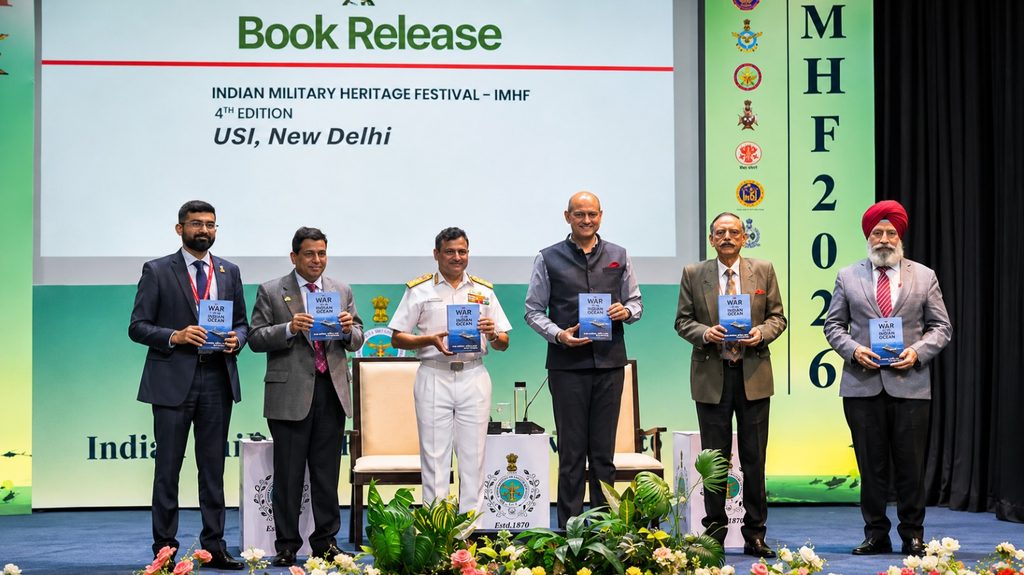
The sessions acquired an additional dimension with the release of the book of late distinguished leader Vice Admiral Mihir Kumar ‘Micky’ Roy – The War in the Indian Ocean, as curated back to shelf by Cmdre. Kesnur and Swaroop Anand of Meluha Maritime and published by Sabre and Quill. The book was among the three naval titles released during the festival’s Future Ready Navy segment, alongside Captain (IN) N S Mohan Ram’s A Builder’s Navy: The Long Road to Self-sufficiency in Warship Design and Commodore Pramod R Kulkarni’s Warship Design and its Management: A Systems Engineering Perspective. The releases brought together naval history, indigenous shipbuilding and the technical management of warship design—three subjects closely linked to India’s evolving maritime ambitions.
The wider strategic context was articulated by Chief of the Naval Staff Admiral Krishna Swaminathan in his address during the Future Ready Navy session. He placed the maritime domain at the centre of India’s economic growth, national security and strategic interests, underlining the country’s dependence on seaborne trade and the importance of protecting maritime routes and critical infrastructure as India moves towards Viksit Bharat 2047.
The CNS identified four major changes shaping the maritime environment: intensifying strategic competition around shipping routes and chokepoints; the growing influence of non-state actors and commercial entities; the expansion of the maritime domain from the seabed to outer space, accompanied by greater surveillance and transparency; and the wider availability of advanced technologies such as drones, artificial intelligence and satellite imagery.
His larger point was that disruptions at sea do not remain confined to the oceans. They can affect energy supplies, food and fertiliser availability, trade and supply chains, with consequences that eventually reach households and businesses on land. For a country with extensive maritime interests, this makes naval preparedness an essential part of economic and national security.
Admiral Swaminathan also outlined the Navy’s response: modernising its force, reviewing operational doctrines and strengthening indigenous technological and industrial capabilities. He emphasised that conventional naval platforms would continue to provide the foundation of maritime power, while unmanned and autonomous systems would add flexibility and scale. Self-reliance, he said, must extend beyond manufacturing to the ability to design, maintain, repair and upgrade critical systems domestically.
An important aspect of his address was the need to prepare for operations in environments where satellite-based positioning, navigation and timing services could be disrupted. While the Navy is working towards greater use of NavIC as the system matures, it is also developing alternative capabilities to remain effective in GPS- and satellite-based PNT-denied environments. This reflects a broader military requirement: the ability to continue operating when technologies and services that are normally taken for granted become unavailable.
The festival’s other discussions reinforced the idea that military history must inform present-day thinking. Sessions on the Indian Air Force’s role in Operation Safed Sagar, the integration of princely-state forces into the national military after Independence, institutionalising jointmanship through HQ IDS and the Andaman and Nicobar Command, and the experiences of women officers all offered different perspectives on how India’s Armed Forces have evolved.
The two-day event also featured a tri-service exhibition showcasing the histories and contributions of the Army, Navy and Air Force, with a special focus on the Garhwal Rifles. Book releases and discussions provided a platform for military professionals and researchers to bring archival material, operational experience and personal narratives into public discourse.
Ultimately, the fourth edition of IMHF made a case for treating military heritage as a living national resource. The value of studying the 1946 naval uprising, the 1971 operations, the Kargil conflict or the evolution of indigenous warship design lies not only in remembering what happened, but in understanding how institutions adapt to changing strategic circumstances.
As the CNS observed, the Navy must continuously recognize emerging trends and prepare for an uncertain future. The festival brought that thought into sharper focus: a nation that understands its military past is better placed to make informed choices about its defence future. By connecting history with technology, operational experience and strategic debate, IMHF 2026 offered a platform to do precisely that.