

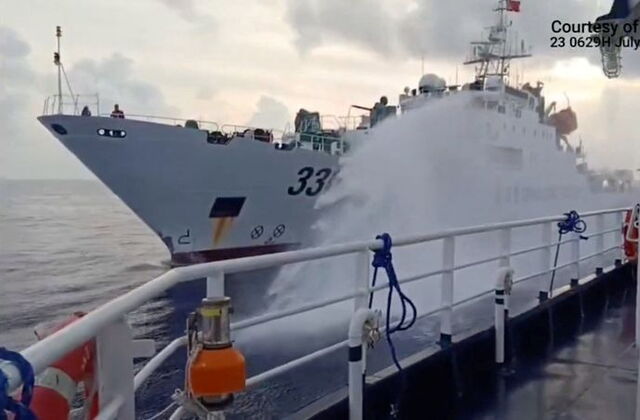
In July 2026, China and the Philippines clashed three times in a single week over the South China Sea, prompting joint US-Philippines-Japan maritime drills.
The China-Philippines conflict isn’t simply a disagreement over territorial claims to a few islands or reefs. It extends much further, involving fishing rights, energy resources, maritime territory, trade routes, and national security. The South China Sea, one of the world’s most strategically important waterways, is at the centre of this conflict.
What is the China-Philippines Water Conflict?
The tensions between China and the Philippines have become more visible in recent years. The countries have used their vessels and water cannons, blocked one another, and sometimes even collided. In July 2026 itself, there have been many confrontations around Scarborough Shoal and Second Thomas Shoal.
The dispute’s main issue is overlapping claims in the South China Sea. China claims a large portion of the sea through its so-called Nine-Dash Line. The Philippines, meanwhile, legally and tenably claims maritime rights in areas that fall within its Exclusive Economic Zone, or EEZ, under international maritime law.
“In the exclusive economic zone, the coastal State has sovereign rights for the purpose of exploring and exploiting, conserving and managing the natural resources…” – Article 56, United Nations Convention on the Law of the Sea (UNCLOS)
This is important because an EEZ gives a coastal State specific rights to explore, exploit, conserve and manage natural resources, including fish, oil and gas. Under Article 57 of UNCLOS, an EEZ can extend up to 200 nautical miles from the baselines used to measure the territorial sea.
The disagreement becomes essentially crucial around areas such as Scarborough Shoal and Second Thomas Shoal. This is because both have strategic and economic importance, while their surrounding waters are used by fishermen.
Why Does it Matter to Both Countries?
While the issue is recognized as a “water” conflict, it isn’t as simple as it sounds. It involves what lies in and under the water, making it more serious than ever.
The different areas of concern of this South China Sea conflict include:
Fishing Rights
Fishing is one of the biggest concerns. Thousands of people depend on the South China Sea for their livelihoods. Scarborough Shoal, for example, has long been an important fishing area.
The 2016 international arbitration ruling found that Chinese restrictions had interfered with traditional fishing rights at Scarborough Shoal.
Therefore, ordinary Filipino fishermen don’t consider this just a geopolitical argument. Access to fishing grounds can directly and significantly affect their income and food security.
Oil and Gas Resources
The seabed of the South China Sea is believed to contain significant energy resources. Having control over maritime areas could provide countries with opportunities for oil and natural gas exploration.
However, the 2016 arbitration tribunal found that China had interfered with Philippine petroleum exploration activities in areas where the Philippines had sovereign rights.
This makes the dispute economically important for both sides.
Strategic Location
The South China Sea is also a major international trade route, which means control and influence over these waters has enormous military and strategic value.
For China, maintaining a strong presence in the region supports its wider maritime and security ambitions. For the Philippines, protecting its maritime rights is closely connected to national sovereignty and security.
What is the 2016 Arbitration Ruling?
One of the most important milestones in the China-Philippines water conflict came in 2016.
The Philippines brought a case against China under the United Nations Convention on the Law of the Sea, or UNCLOS. The international tribunal largely ruled in favour of the Philippines.
It concluded that China’s sweeping historic-rights claim represented by the Nine-Dash Line had no legal basis under the relevant provisions of international law. It also found that several areas claimed by China fell within the Philippines’ EEZ and that China had violated certain Philippine sovereign rights.
However, there is a major problem: China rejected the ruling and continues to maintain its claims.
This has created a difficult situation. There is an international legal decision, but there is no easy mechanism to force the two countries to accept the same interpretation of their maritime rights.
What Does China Say?
According to China, it has historical rights and sovereignty over much of the South China Sea. Beijing rejects the 2016 arbitration ruling and says Philippine vessels entering areas claimed by China are violating Chinese sovereignty.
China believes that maintaining a coast guard presence and controlling activities around disputed features are necessary to protect its territorial claims.
China has also expanded its physical presence in the South China Sea. Recent satellite imagery reported by Reuters shows major construction at Antelope Reef in the disputed Paracel Islands, including a reclaimed island, harbour infrastructure and a possible runway. While China describes such projects as supporting civilian purposes, analysts see potential military significance in the expansion.
What Does the Philippines Say?
The Philippines argues that its rights should be determined according to UNCLOS and the 2016 arbitration ruling. For Manila, the issue is also about protecting fishermen and defending the country’s sovereign rights. Philippine officials have repeatedly criticised Chinese actions around disputed shoals and have increased patrols and cooperation with international partners.
The Philippines has strengthened its defence capabilities as tensions in the South China Sea continue. One notable step was its decision to purchase BrahMos shore-based anti-ship missile systems from India. In January 2022, the Philippines signed a contract worth around US$375 million for three BrahMos missile batteries, including launchers, training and related support. The first batch was delivered in April 2024. The BrahMos system gives the Philippines an additional coastal defence capability.
At the same time, Manila has strengthened its security relationship with the United States and other countries. In July 2026, the Philippines was joined by the United States and Japan in maritime exercises after a series of confrontations with China.
This international involvement further complicates the dispute.
Why is The Dispute a Matter of International Relevance?
The conflict is not just a bilateral issue between China and the Philippines.
The South China Sea is also disputed by Vietnam, Malaysia, Brunei, and Taiwan. It is a major route for international commerce and has enormous strategic importance for the wider Indo-Pacific.
If there are any serious military confrontations, it could affect shipping, energy markets, regional economies, and relations between China and the United States. It could also impact how smaller Asian countries respond to China’s growing power.
Final Thoughts
The 2016 arbitration ruling remains an important legal reference in the China-Philippines dispute. The ruling under UNCLOS recognised the Philippines’ rights in parts of its EEZ and rejected the legal basis of China’s historic-rights claims. While China has rejected the ruling, international law cannot work if countries simply choose which decisions they want to follow.
This also raises the broader issue of hegemony, where a larger and more powerful country can exert considerable influence over a smaller neighbour. In such situations, military and economic power can make it harder for international laws and rulings to be implemented effectively. However, the purpose of international law is precisely to provide common rules that apply regardless of a country’s size or power.
Ultimately, China and the Philippines need to find a peaceful and practical conclusion to their maritime dispute. This does not necessarily mean that either country must abandon all of its interests. However, both sides must respect the legal framework they have agreed to and use dialogue to resolve their differences. International law cannot remain credible if nations accept it only when it works in their favour.
Article by Gayatri Sarin