

Democracy is ordinarily reduced to a familiar proposition: government by the people, of the people and for the people. Its most visible form of expression is the vote. We are accustomed to thinking that democracy is jeopardised when governments fall, institutions are challenged, elections are disrupted or if violence enters the political process.
What if the question is not whether people are allowed to vote, but whether they can trust the institution deciding who appears on the electoral roll in the first place?
Over the past few weeks, the scrutiny surrounding Chief Election Commissioner Gyanesh Kumar has moved through voter-list revisions, internal dissent within the Election Commission of India (ECI), questions over electoral-roll software, a Supreme Court challenge, political accusations and street protests demanding his resignation. Taken separately, each may appear to be another political controversy. Taken together, however, they raise a more underlying question:
What happens when the institution responsible for ensuring electoral legitimacy itself becomes the subject of public distrust?
That is a question more significant than whether Gyanesh Kumar is “good” or “bad”, and larger than whether the Bharatiya Janata Party controls the Election Commission. Neither conclusion can be established merely from the available evidence. The more consequential issue is whether India’s electoral watchdog can maintain public confidence in the process through which it determines who gets to participate in elections.
Who is Gyanesh Kumar?
Gyanesh Kumar, a 1988-batch Kerala-cadre IAS officer, became India’s 26th Chief Election Commissioner on February 19, 2025. He had served in senior positions in both the Kerala and Union governments and became an Election Commissioner in March 2024.
His appointment itself bears institutional significance. He was the first Chief Election Commissioner appointed under the 2023 law governing appointments to the Election Commission, which altered the composition of the selection committee. That has fed into a wider discourse about the independence of the institution. But that appointment is not, by itself, the controversy thoroughly analysed over here. The more important question is what happened after Kumar assumed the office. At the centre of it is the Special Intensive Revision, or SIR, of electoral rolls.
The voter list is where democracy begins
The ECI’s stated purpose behind SIR is straightforward on its face: to clean electoral rolls by properly identifying duplicate entries, deceased voters, people who have shifted their residence and others who may not be eligible, while ensuring that eligible voters remain enrolled. The controversy lies not simply in the stated purpose but in its execution.
More than 13 crore names were left out of draft electoral rolls across 30 States and Union Territories during the exercise, according to The Indian Express. That figure has become one of the most contentious numbers in the debate.
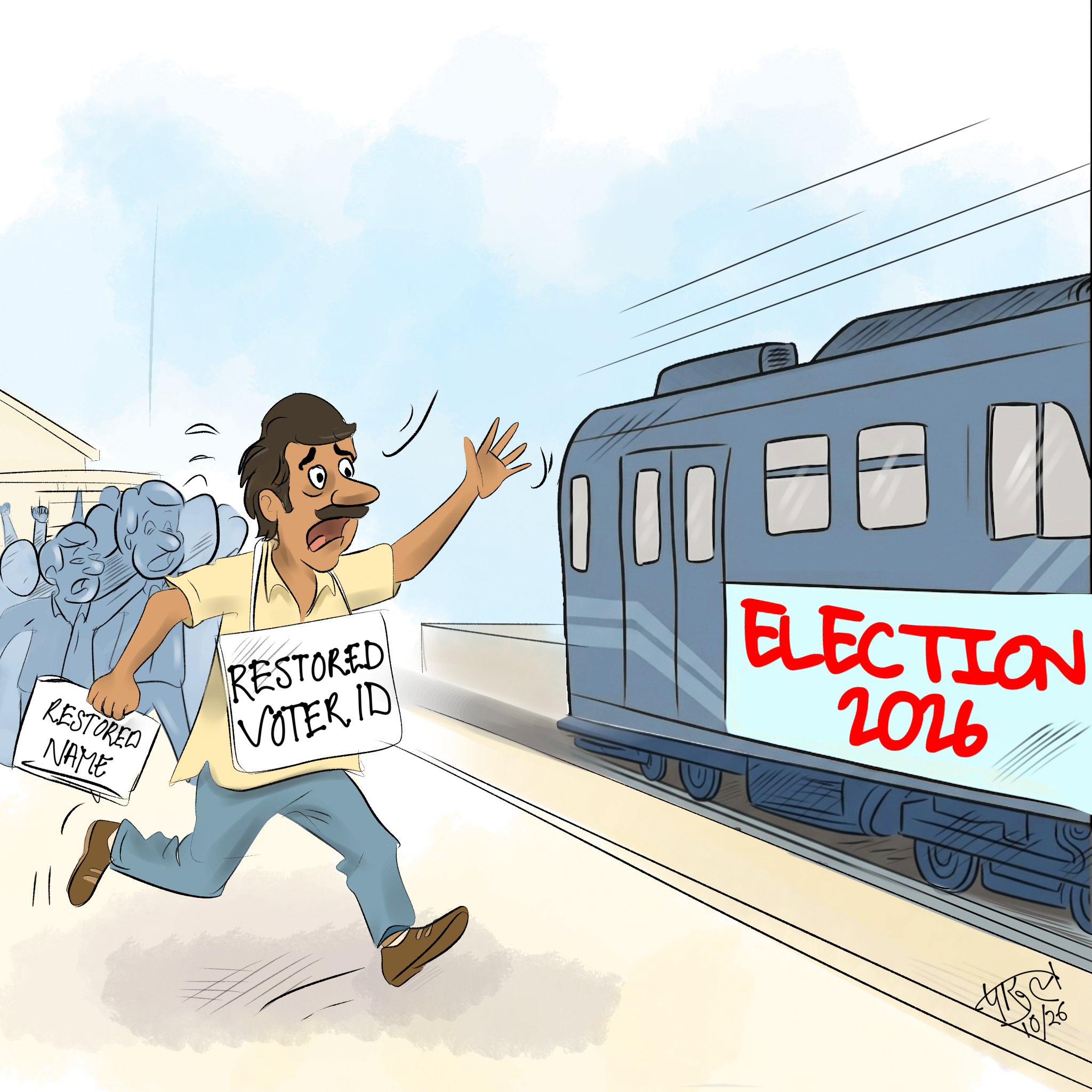
But the exact precision matters here. It would be absolutely inaccurate to say that the ECI “deleted 13 crore voters”. These were names left out of draft rolls. The ECI has maintained that the exercise does not automatically amount to permanent disenfranchisement and that eligible citizens have mechanisms through which they can be included again. Yet a democratic question still pertains. Suppose a citizen is ultimately found eligible and restored to the electoral roll. What happens if that citizen was absent from the roll on the day an election was held? And what about its consequences?
Re-enrolment may restore the name, but it simply cannot restore the vote that was not cast. This is why the issue cannot be reduced only to a technical dispute over electoral databases. A voter list is not merely an administrative document. It is the first gate through which the constitutional right to participate in an election is exercised. The ECI itself has now instructed the 20 States and Union Territories where SIR has been completed to administer a special drive to identify eligible voters who were left out and immediately enable their re-enrolment. The revised process uses ordinary Form 6 without the additional SIR-specific announcement that had generated controversy.
This is an important step towards addressing the problem. But it also leaves behind a very difficult question hanging over the process: what mechanism answers for an eligible voter who could not vote before the correction was made? Then came the internal documents. This is where the controversy became considerably more serious.
On September 25, The Indian Express released senior journalist Ritika Chopra’s investigation into the functioning of the three-member Election Commission. The exclusive investigation has documented that the Election Commissioners Sukhbir Singh Sandhu and Vivek Joshi had officially recorded objections at least 14 times over approximately ten months to decisions and processes that they said had been taken without their knowledge. This is not simply a story about two commissioners completely disliking the Chief Election Commissioner.
The objections reportedly pertained to four broad areas of electoral administration:
registration of new voters; deletion and restoration of names; appeals against decisions restoring voters; and the control and security of electoral-roll data and the technology through which that data is managed.
That distinction seriously matters. Political parties can often accuse an Election Commissioner of partisanship. Such accusations are merely political claims. But when the members of the constitutional body itself record objections in their official notes, then the question seems to deliberately move from political rhetoric to institutional process. And surprisingly the ECI did not deny that the notes existed. But its response was quite different. The Commission described such notes as an integral part of normal decision-making, internal suggestions and checks and balances, and maintained that the Commission’s final decisions during the relevant period were unanimous.
Both these facts can exist in tandem. Two commissioners can record objections during deliberations. The institution can ultimately take a unanimous decision. But the question, therefore, is not simply whether there was a difference of opinion. It is: what does unanimous agreement mean inside a constitutional body when disagreement has already been registered ?
That is a much more important question than the simple political slogan of the day.
The “Form 6” point of contention
One of the most revealing examples came through Form 6, the application used by citizens seeking inclusion in the electoral roll. In July 2026, an additional SIR-related declaration appeared on the online Form 6. Applicants were asked to signal whether their own name, their parent’s or grandparent’s name, or neither appeared in the electoral roll from the previous SIR period. The problem was not purely the continuance of the question. Applicants could not proceed without addressing it.
According to Chopra’s investigation, Election Commissioner Vivek Joshi had already recorded an objection on May 16, saying Form 6 could not be changed in this manner without the relevant rules being amended. Sandhu agreed on May 19.
Yet a shift became apparent.
Who controls the vote when the software controls the roll?
The most momentous part of the dispute may not be a paper form at all. It may be the software. The Electoral Registration Officer, or ERO, is the statutory authority
tasked with the electoral roll at the constituency level. The concern raised by the two Election Commissioners was that the incremental centralisation of the electoral-roll database through the ECI’s technology systems could interfere with the authority of officials who are retaining responsibility for maintaining those rolls.
Vivek Joshi reportedly sought an audit to establish which officials actually owned credentials capable of amending voter data and proposed independent technical oversight.
That produces an unusually modern constitutional question:
If an officer legally authorised to decide a voter’s eligibility makes a decision, but the central software prevents that decision from being entered or implemented, where does the real authority lie , with the statutory officer or with the software architecture?
The question sounds technological. It is actually constitutional. That is why the Goa case involving 97 voters matters far beyond the number itself.
The Goa 97
According to Chopra’s investigation, Goa’s EROs inspected cases involving 97 voters and found them eligible. Yet the software did not allow the EROs to reverse the earlier deletion. The local officials have repeatedly sought the necessary technical intervention. Eight emails were reportedly sent over seven days. But the provision was not operationalised before the final electoral roll was published.
Later, many of those affected voters had to use the ordinary Form 6 route to pursue re-enrolment. The number 97 is small in a country with hundreds of millions of voters.
The institutional principle is not.
‘West Bengal’ and the bigger question of authorisation
West Bengal adds further complication. The reported figures include 22.21 lakh appeals by deleted voters seeking restoration and another 16.10 lakh appeals seeking deletion of voters whom judicial officers had included or restored. The crucial question was not whether every one of those appeals was legitimate or illegitimate. It was: who authorised the 16.10 lakh appeals?
Sandhu apparently sought answers about who had authorised them, who had filed them and under whose authority they had been commenced. The investigation disclosed that neither Sandhu, nor Joshi, nor the West Bengal Chief Electoral Officer had been informed about the basis of the process.
Again, the issue is institutional authorisation. When a constitutional body tries to exercise extensive power over electoral rolls, the question of who made a decision is not a bureaucratic footnote. It is part of the authenticity of the decision itself.
The technology trail
The concerns did not abruptly emerge after the September investigation. According to The Indian Express, questions about the relationship between electoral law and the ECI’s technology systems had been raised months earlier.
In November 2025, before ECINet was launched, officials had emphasised that statutory functions of EROs, District Election Officers and Chief Electoral Officers had to remain with those officers and that IT systems should comply with the law. In January 2026, another warning reportedly emphasised that the system should not restrict an ERO’s discretion. ECINet was launched on January 22, bringing more than 40 applications and portals under a common technological framework. The ECI presented the system as an effort to improve efficiency and transparency. But by April, Sandhu had raised concerns about IT modules and portals being progressed without being presented to the Commission. He reportedly said that he had learnt about some evolutions through the media. Joshi separately raised concerns about communications being issued in the name of the ECI without the requisite approval of the Commission. In May, Joshi formally raised the issue of the gradual centralisation of the voter database and proposed an independent technical audit, expert involvement, a review of ECINet’s legal compliance and an examination of who possessed credentials to alter voter data.
Sandhu endorsed the proposal in July. By August, he allegedly recorded that he did not know what action had been taken. The technology question had therefore become inseparable from the institutional one. When the dispute reached the Cabinet Secretary. The internal contention spiralled further in July.
Following a work-allocation order affecting administrative and IT responsibilities, Sandhu and Joshi reportedly wrote separately to the Cabinet Secretary, raising objections under Sections 18(1) and 18(2) of the 2023 law.
On July 30, they jointly set aside the deployment pending consensus within the Commission. That is significant because the disagreement had moved beyond internal notes about electoral rolls. Two members of the constitutional body had taken their concerns to the country’s senior-most civil servant. And then there was another striking detail: according to Chopra’s investigation, the three Election Commissioners had their first full Commission meeting in four months on September 9. The ECI’s response did not completely elaborate why the full Commission had not met between May and August. The existence of the gap is verified. Its explanation is not something that should be invented by a journalist. That distinction is very crucial. Article 324 is where the story becomes constitutional. The Election Commission is not supposed to function as the personal office of one official. Article 324 secures the Election Commission as the constitutional authority overseeing elections. The Commission has operated effectively as a multi-member body since 1993. The 2023 law further provides a framework for how Commission business is to be conducted. Section 18 provides for unanimity where possible and majority decision-making when there is a difference of opinion, while also dealing with the procedure and allocation of work within the Commission.
This is why the real question is not:
Does Gyanesh Kumar support the BJP?
The findings available does not establish that conclusion, but the deeper question is:
How should a three-member constitutional body exercise authority when its members disagree over decisions affecting electoral rolls?
And there is also a second question that may prove even more prominent in the years ahead: What happens when the technological system through which the Commission exercises that authority begins to determine what statutory officers can and cannot do?
The ECI’s defence cannot be ignored
A fair account cannot stop with the Indian Express investigation. The ECI has said that conflicting views are a normal part of institutional deliberation. It has not disputed the existence, dates or contents of the 14 notes reported by The Indian Express. Instead, it has said that the notes were part of the decision-making process and that the Commission’s final decisions were unanimous. The Commission following this announced a series of mechanisms, including procedures for circulation of meeting agendas, recording of minutes, approval of foreign travel, review of IT modules, autonomous technical expertise for ECINet, greater access for field officials and compliance with commissioners’ directions.
But they do not automatically answer every question raised by the investigation.
Who approved the Form 6 change? What happened to the objections about software access? Why did the full Commission not meet for months?
These are questions that should be answered through records, explanations and, where necessary, judicial scrutiny. Not through mere political certainty.
From the newsroom to the street
By October 5, the debate had reached the Supreme Court. The Court immediately issued notices to the Election Commission and the Centre on petitions challenging the functioning of the Gyanesh Kumar-led Commission and allegations that decisions relating to the SIR were taken without the required collective process. It, however, rejected at this stage to restrain or suspend Kumar, saying that it would first examine the records and reactions before reaching any conclusion. The Court also made clear that decisions found to have been taken contrary to statutory obligations could thereafter be annulled. Importantly, it clarified that it had not approved any modification to Form 6 and said it would investigate the record to determine who had made the changes.
The issue soon spilled into the streets through the mode of protests. On October 2, protesters calling for Kumar’s resignation undertook to gather in Delhi despite police restrictions. Around 550 people were detained, according to The Indian Express. Further detentions followed on October 3, including those of activist Neha Bora and Yogendra Yadav. Three FIRs were also registered over the October 2 protest.
Reuters independently of this, have reported that protesters breached barricades on October 3 while demanding Kumar’s resignation.
The timing was conspicuous. October 2nd is Gandhi Jayanti , a day inseparable from India’s historical memory of civil disobedience.
But the longstanding analogy has certain limitations too. Contemporary protesters cannot simply be conflated with Gandhi’s movements, nor can every police action be treated as analogous to colonial authoritarianism. The useful question is narrower: how does a democracy respond when citizens challenge the institutions through which their democratic participation is organised?
The answer cannot lie in choosing between institutional authority and public protest. It lies in making the process capable of surviving scrutiny. A voter list is ultimately a record of citizens entitled to participate in democracy; its credibility therefore depends not merely on who controls it, but on whether that control can be explained, examined and trusted.