

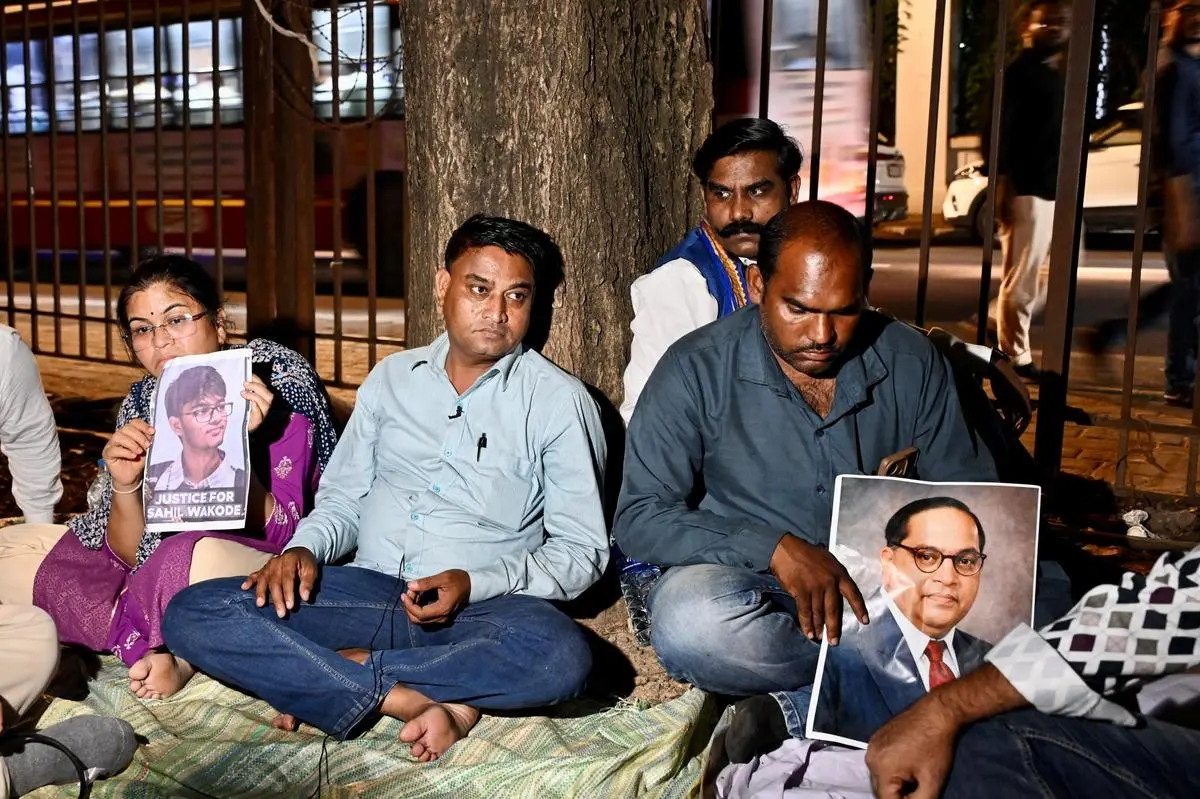
A student ends his life. An examination incident precedes his death. An allegation of cheating emerges. Then comes a protest, an FIR, allegations of caste discrimination, a professor’s defence, institutional action, political commentary and, finally, demands for systemic reform.
Somewhere in between, the original question can disappear.
The death of IIT Bombay student Sahil Wakode on September 18 has become a controversy of precisely that kind. Wakode, a second-year B.Tech student in Energy Science and Engineering, died by suicide hours after an examination incident in which he was reportedly found using a mobile phone and had allegedly uploaded the question paper to ChatGPT. IIT Bombay in its initial statement described the episode publicly, saying he had been counselled and that no disciplinary action had been triggered. The institute later expressed regret, saying it was inappropriate to frame the circumstances surrounding his death before they had been established through investigation. That apology matters because it acknowledges a central problem.
At present, “Sahil cheated” is not a conclusive finding. Nor is the contrary claim that caste-based harassment caused his death an established finding. His parents have alleged casteist remarks and harassment by Professor Suryanarayana Doolla; an FIR has followed under provisions including the SC/ST (Prevention of Atrocities) Act and abetment of suicide. Professor Doolla has been ousted from his administrative position and has now been sent on leave while the matter is investigated. IIT Bombay’s Faculty Forum, on a parallel track, has defended him and said that the inquiry should establish the facts. A student has also openly and officially questioned the caste-discrimination allegation.
The point is not to decide which side is telling the truth without examining the evidence. It is to concede that there are different standards for allegation, protest and proof. That distinction has become increasingly difficult to maintain in India’s campus politics.
From ‘One’ death to ‘18 demands’
The protests at IIT Bombay quickly moved beyond the question of Professor Doolla.
Students formally presented an 18-point charter covering independent investigation, professor accountability, student representation, counselling, hospital care, mental-health training, grievance mechanisms, academic-malpractice procedures and protection against retaliation. They insisted on, among other things, a 24-hour psychiatrist-on-call service, counsellors in hostels, documentation of interactions in malpractice cases, greater student institutional participation and a permanent student-wellbeing task force.
The protest was not merely a demand to “suspend the professor”. It was an argument about what a premier educational institution is indebted to its students.
The IIT Bombay director signed the charter after several days of protest. But signing the document did not mean that every demand had been promptly put into effect; the administration maintained that matters involving individual accountability would follow due process. A subsequent ten-member committee was appointed to examine the circumstances surrounding Wakode’s death, while the Mumbai Crime Branch continued its investigation.
This is where the protest performs an important democratic function: it can force institutions to answer questions they might otherwise answer over the course of time.
But protest cannot itself answer those questions.
That is the difficult boundary.
The Cockroach Metaphor and the Campus Scenario
The disparity becomes clearer when placed beside India’s recent Cockroach movement. The movement began as a satirical youth gathering and expanded after examination controversies into a wider expression of frustration over education, employment and institutional accountability. Chatham House described the movement as having tapped into broader dissatisfaction among young Indians, while Reuters reported how examination setbacks and the pressures surrounding competitive examinations helped bring young people together across social and economic divisions.
The IIT Bombay protest did not emerge directly from the Cockroach movement, and there is no basis for claiming that one caused the other. But there is an analytical parallel that is very important to recognise. In both these cases, a specific grievance becomes a vessel for a much larger institutional frustration. An examination controversy becomes a conversation about the education system. A student’s death becomes a conversation about mental health, caste, professor accountability and student representation.
The critical danger commences when the larger narrative becomes so authoritative that it starts determining the facts of the original case.
The protest can demand an investigation.
It cannot replace one.
And then comes the ‘Politics of Labelling’
The IIT Bombay controversy has also acquired another layer: the politics of ideology.
The debate has already produced attempts to associate campus activism with various ideological groups, including claims about humanities students and political radicalism. In the online media, the controversy has even generated calls to remove or “ban” humanities from IITs. But the participation of humanities students in a protest does not establish that humanities students collectively coordinated the protest.
Nor does criticism of an institution automatically make someone a true radical.
This is notably relevant in the contemporary political climate, where the language of dissent itself has become contested. Prime Minister Narendra Modi recently used the phrase “dimagi Naxals”, while Union minister Kiren Rijiju later said the term referred to people who support Maoists or separatists and reject the Constitution, rather than simply opposition politicians.
The broader question is certainly uncomfortable: how quickly does disagreement accumulate a label?
A protester becomes ideological. A professor becomes oppressive. A student becomes a cheater. A humanities department becomes political. A disagreement over reservation becomes a referendum on merit.
And the original evidence slowly begins to disappear beneath these labels of conduct.
Merit cannot be discussed outside society
This is also why the surfacing debate around caste and “merit” deserves attention without being curtailed to a reservation-versus-merit slogan.
Ajantha Subramanian’s “The Caste of Merit”: Engineering Education in India analyses IITs precisely through this tension. Her scholarship directly asks how caste and merit interact within institutions that present themselves as highly meritocratic. Her argument is not that achievement is unreal; rather, she critically evaluates how historical and social inequalities can consistently shape who gets recognised as “meritorious” in the first place.
That simply does not mean every accusation of caste discrimination at an IIT is inherently true. It means that the question cannot simply be brushed aside by saying: “These are India’s most meritorious students, so caste cannot matter here.”
Education does not occur in a social vacuum.
Nor should the opposite conclusion be accepted automatically: “A student belongs to a marginalised caste, therefore any adverse academic interaction must be caste discrimination.” Both these approaches reach conclusions without sufficient regard for the evidence.
India’s intellectual history has confronted this problem for decades, from Ambedkar’s Annihilation of Caste to generations of Dalit writing that have documented the persistence of caste beyond formal legal equality.
The sensitive question is therefore not merely whether India should choose meritocracy or reservation.
It is: what does merit mean in a society where people do not begin from identical social conditions?
That is a debate much larger than IIT Bombay.
The pressure inside the IIT
There is another uncomfortable question.
IITs are among India’s most selective institutions. Students enter after years of intense competition. The argument that students who reach these institutions should be competent in handling such extreme academic pressure is understandable. But selection for academic excellence does not make a person psychologically impervious.
A recent compilation based on RTI responses and media reports records 74 suicides or unnatural deaths across IITs between 2021 and September 18, 2026, including 13 in 2026 by that date. The data cannot establish why those students died, but the scale is sufficient to substantiate serious questions about students’ wellbeing and institutional support.
That does not mean every professor is responsible. It does not mean every academic penalty is detrimental.
It does not mean academic standards should be diluted.
And it undoubtedly does not mean cheating should be endorsed if an investigation establishes that cheating ensued.
It means something simpler: academic discipline and student dignity do not have to be opposing principles.
If Wakode did use illicit technology in an examination, that conduct should be tackled through due process. If casteist remarks were made, that too must be established and addressed through due process. If neither claim is established, neither should be altered into a public verdict. That is exactly why the investigation matters.
Before we decide who is guilty
The CCTV footage now being thoroughly examined, the examination records, digital evidence, witness accounts, the allegations made by Wakode’s family and the divergent accounts from students and faculty all matter because they can move the discussion from narrative to documentary evidence.
Until then, perhaps the most responsible position is also the least satisfying one:
We do not yet know the whole story. And that inconclusiveness should not silence protest. It should discipline it.
A society needs protest because institutions can sometimes fail. It needs institutions because public anger cannot always determine guilt. It needs humanities because technical expertise cannot merely explain society by itself. It needs merit because competence certainly matters, but it also needs to ask how social privilege and exclusion build the conditions under which merit is measured and recognised.
The IIT Bombay case, therefore, is not simply IIT Bombay versus Sahil.
It is not professors versus students.
It is not humanities versus engineering.
It is not reservation versus merit.
And it simply should not become another contest between political labels. It is a test of whether a society can grieve without hastily judging, protest without prematurely convicting, and probe without becoming quite unsympathetic to injustice. The Cockroach movement showed how quickly an examination grievance can become a language of wider youth exasperation.
The IIT Bombay protests underscore how quickly a student’s death can become a battlefield over institutional power. But between grief and judgment lies something less dramatic, and far more important: proof. And that is something neither a protest, a professor, a political label nor a viral post can act as a replacement for.