

From a mere online youth movement born out of witty satire to a tussle over electoral accountability, the Cockroach Janata Party’s campaign raises some difficult questions about voter exclusion, institutional independence, the right to protest and the limits of state power.
On October 10, as Mahalaya marks the trajectory from Pitri Paksha to Devi Paksha in the Bengali cultural calendar, the national capital, Delhi finds itself contending with a different kind of public reckoning. The imagery of Mahishasuramardini, Durga overcoming Mahishasura, belongs to a cultural tradition that celebrates the defeat of injustice. Yet, in the national capital, protesters seeking to secure accountability from the country’s chief electoral authority have faced barricades, prohibitions and widespread detentions. The juxtaposition is dramatic, although mythology cannot easily determine the legality of contemporary political actions. That question must be clearly examined through evidence, constitutional principles and the conduct of public institutions.
The Cockroach Janata Party (CJP) is currently demanding the immediate resignation of the Chief Election Commissioner of India; Gyanesh Kumar, taking its campaign from a mere online literary satire to an open challenge over electoral autonomy. Its October 10 mobilisation at Jantar Mantar was sought to bring voter-roll grievances into the public arena. Instead, the day has become a wider collision over electoral trust, the regulation of civil resistance and the limits of preventive policing.
From the exam grievances to electoral accountability
CJP emerged in May 2026 as an online satire campaign responding to remarks attributed to Chief Justice of India Surya Kant during a court hearing on May 15. Its appeal soon extended beyond the original controversy. Youth unemployment, uncertainty about careers, examination irregularities and frustration with institutional accountability provided a wider constituency for its message. Its first major campaign was centred on the NEET examination controversy and demands for accountability from the then Union Education Minister Dharmendra Pradhan. CJP in the aftermath continued as a protest organisation rather than immediately establishing a conventional political party. Its activities included probing public institutions and raising questions about the gap between official claims and conditions experienced by citizens. The movement’s shift towards the Election Commission is therefore not a sporadic episode. It eventually marks a change in the institution being contested : from the administration of examinations to the administration of elections.
That transition essentially matters because electoral participation is not an ordinary administrative service. A citizen who cannot secure an eligible place on the electoral roll may lose the opportunity to exercise a constitutional right at a particular election.
Background on the SIR controversy
The Special Intensive Revision (SIR) is an Election Commission exercise to review electoral rolls, identify duplicate, deceased and otherwise ineligible entries, and firmly ensure that eligible voters are included.
The controversy surrounding the SIR is not merely about a few figures on a page; it is about those specific people whose right to vote may depend on whether their names appear on the electoral rolls. Reports indicate that more than 13 crore names were omitted from draft electoral rolls across 30 States and Union Territories. However, this number requires careful interpretation. It does not mean that 13 crore eligible voters have necessarily been permanently deprived of their voting rights. The omissions may include deceased voters, duplicate entries, people who have moved and cases that require further verification. Yet behind every disputed entry may be a citizen trying to understand why their name has disappeared and what they must do to restore it. The central question, therefore, is not simply how many names were removed, but how many eligible voters were wrongly excluded and whether they have a clear, accessible and transparent way to have their names reinstated. An electoral process can fulfil its purpose only when every eligible citizen has a fair opportunity to exercise the right to vote. There is also a severe consequence that administrative statistics cannot fully capture. If an eligible voter is wrongly excluded and an election takes place before the omission is corrected, a later restoration cannot simply return the opportunity to vote in that election. Depending on the election, the next opportunity may not arise for quite a few years. The Election Commission maintains that SIR is intended to improve electoral rolls and that its decisions follow established legal procedures. But critics have raised some serious allegations and concerns about unjustified exclusions, documentation requirements and transparency.
What do these objections reveal about the Commission’s internal functioning?
The controversy further escalated after an investigation by Ritika Chopra in The Indian Express, made public on September 23, reported that Election Commissioners Sukhbir Singh Sandhu and Vivek Joshi had recorded objections on at least 14 occasions over roughly ten months. Their reported concerns involved changes to Form 6, access to electoral-roll software and aspects of the requests for the review process in West Bengal. The Election Commission acknowledged the presence of the notes but described them as part of its decision-making process, asserting that its decisions were unanimous.
Subsequent reporting by The Indian Express on September 27 added further context. The newspaper reported that the Commission had announced nine decisions responding to several concerns raised by the two commissioners, although questions concerning Form 6 and appeals in West Bengal remained unresolved in that report. These subsequent events should be considered alongside the original investigation. The reported objections and the Commission’s response do not, by themselves, establish individual wrongdoing. They nevertheless raise important questions about openness, institutional independence and electoral accountability that merit scrutiny.
CJP and other critics have converted these questions into a political demand for Kumar’s resignation and changes to, or the suspension of, SIR. Three questions must remain independent: were eligible voters wrongly excluded; did particular decisions or systems violate legal eligibility criteria and does the evidence warrant Kumar’s resignation?
The 2023 appointment law: why does it matter?
The debate about the Election Commission’s independence extends far beyond the SIR controversy. The Chief Election Commissioner and Other Election Commissioners (Appointment, Conditions of Service and Term of Office) Act, 2023, changed the composition of the committee recommending appointments to the Commission.
In its March 2023 judgment in Anoop Baranwal v. Union of India, the Supreme Court had directed that, until Parliament enacted a law, appointments should be recommended by a committee comprising the Prime Minister, the Leader of the Opposition in the Lok Sabha and the Chief Justice of India. The Court was deliberating on the absence of a statutory appointment procedure.
The 2023 Act instead provides for a committee consisting of the Prime Minister, the Leader of the Opposition and a Union Cabinet Minister nominated by the Prime Minister. The Chief Justice of India is no longer part of the statutory selection committee.
What actually necessitated this change ? The government formalised through legislation to implement a statutory process under Parliament’s authority. Critics argue that replacing the Chief Justice with a minister nominated by the Prime Minister increases executive influence over appointments to an institution that must act independently of the government. The dispute often concerns the balance between parliamentary lawmaking and safeguards for electoral autonomy; the change itself does not prove that a specific appointment or decision was unduly influenced. The law also contains a provision protecting the CEC and Election Commissioners from legal proceedings in relation to acts, words or decisions connected with the discharge of official duties. The scope and constitutionality of that protection are matters of legal debate, not grounds for presuming that every official action is beyond close observation.
Is CJP independent, or becoming an opposition platform?
CJP’s campaign has attracted several student organisations, opposition politicians, actors and other public figures. At Bengaluru’s Freedom Park on October 8, hundreds gathered for a protest involving Dhruv Rathee, actor Prakash Raj and student leader Aishe Ghosh. The event included a People’s Tribunal intended to hear accounts from people who said their names had been wrongly removed from electoral rolls. The movement represents an attempt to move beyond slogans and collect individual grievances. Such testimony can identify problems that might otherwise remain overlooked. CJP’s “Record Everything” campaign similarly reinforces citizens to document events and share footage. Videos can establish what happened in a particular place, provided their origins and context are verified. They cannot, by themselves, establish the scale of an asserted nationwide pattern or prove that electoral improper intervention occurred.
The movement’s slogans, including “Gaddar Gyanu Must Go” “Gyanu, its done bro” and “Save Democracy”, translate an institutional dispute into the language of internet culture. This can make a very complex issue approachable, but it can also turn a demand for investigation into a verdict before the evidence has been rigorously investigated.
The INDIA bloc’s October 9 meeting with President Droupadi Murmu highlights that the controversy has evolved into formal political channels. The delegation, led by Congress president Mallikarjun Kharge and Rahul Gandhi and including Trinamool Congress leader Mamata Banerjee, submitted a memorandum demanding Kumar’s resignation, an end to SIR, a return to paper ballots and a review of elections staged over the previous two years. The leaders’ accounts of the President’s response should not be treated as proof that the allegations were accepted or that a formal investigation was mandated.
The INDIA bloc’s reported plan for a larger Delhi protest on October 12, with Mamata Banerjee likely to participate according to Trinamool Congress, reveals that the political campaign is likely to continue. CJP’s movement and the opposition’s campaign overlap, but they should not by default be treated as the same project.
The State’s response to the ‘Dissent’
The October 10 demonstration became a confrontation over the right to assemble and the government’s commitment to maintain public order.
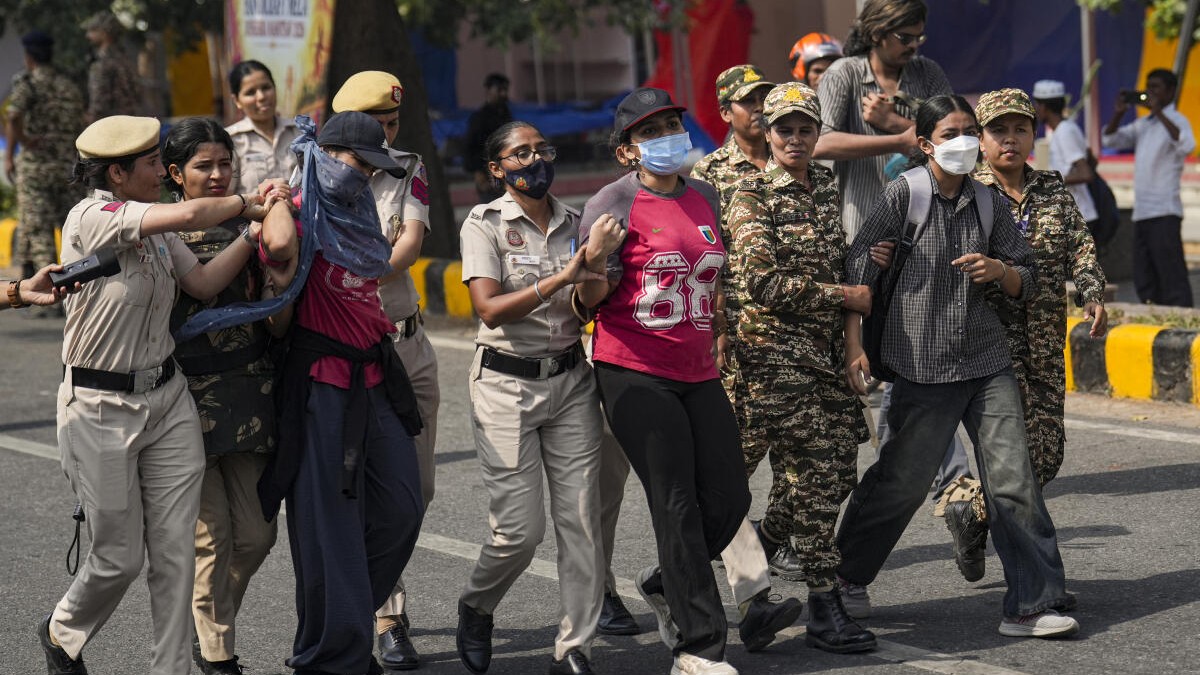
Delhi Police strictly denied CJP permission to protest at Jantar Mantar, saying the application was submitted on October 7, only three days before the proposed gathering, despite a ten-day notice requirement. Police also cited public-safety concerns and alleged previous non-compliance with conditions. These are the authorities’ stated reasons. The resulting security operation was extensive. Several other media outlets reported at least 1,000 detentions overnight before the demonstration. Later reporting described hundreds more detentions, metro restrictions and substantial disruption to rail services.
CJP organisers Abhijeet Dipke, Saurav Das and Ashutosh Ranka were reportedly detained after their flight landed at the Delhi airport. Dhruv Rathee was also apparently detained at his Gurugram residence. News organisations also reported custodial actions involving student activists, opposition leaders and journalists covering the protest. Newslaundry, for instance, reported that members of its reporting team were detained and that phones used for reporting were confiscated.
The Supreme Court’s intervention on October 9 is especially very significant. It deliberately expressed concern about the breadth of restrictions affecting metro and railway services and directed that there should be no complete prohibition on their movement, emphasising the need to avoid unnecessary hardship to the public. It also stressed on the fact that the right to protest must be exercised within the relevant legal framework and summoned the organisers and student representatives for a hearing on October 10.
The constitutional distinction is clear. Articles 19(1)(a) and 19(1)(b) protect citizens’ freedom of expression and peaceful assembly, subject to essential constraints. Police can govern or prohibit a particular gathering in a lawful surrounding context. But the absence of permission does not, by itself, establish that every detention or every restriction on movement was necessary and adequately measured.
The comparative assessment drawn by some organisers with the Quit India Movement of 1942 signals their resolution to continue despite detentions. It is a political analogy, not proof that contemporary India and British colonial rule are equivalent. Similarly, claims that India is under a constitutional Emergency are political rhetoric unless supported by the relevant legal facts. There has been no formal constitutional Emergency that has been established in the developments discussed over here. The fundamental question pertains, and that is whether restrictions were based on empirically supported risks, applied consistently and limited to what was necessary. Reports alleging that protesters were detained while seeking refuge at Gurdwara Bangla Sahib, should be thoroughly inspected through verified footage, eyewitness accounts and official accounts of events. If the same rules were applied alternatively to resisting groups, the authorities must explain why.
Is There Any Evidence of a Foreign Backed Political Agenda?
The controversy has also been surrounded by claims on social media that the United States is seeking regime change in India and that CJP or opposition-aligned groups are part of that effort.
Two real developments have been placed beside one another to support this discourse. On October 8, the Trump administration deferred new and pending PERM labour-certification applications involving eight major technology companies, including Tata Consultancy Services, Infosys, Wipro, HCL Technologies, Cognizant, Capgemini, Microsoft and Adobe. PERM is part of the process through which employers sponsor certain foreign workers for employment-based permanent residency. The suspension affects that route; it does not inherently cancel prevailing green cards or suspend the H-1B programme itself. The administration cited alleged abuses of the system, not a stated policy of seeking regime change in India.
As a separate matter, Elon Musk and Rahul Gandhi exchanged public messages about delays in regulatory approval for Starlink’s commercial launch in India. That exchange concerned a business and regulatory dispute. Neither development, on its own, substantiated that the US is financing CJP, coordinating the protests or attempting to replace the Indian government.
Such claims require evidence of funding, coordination, instructions or a demonstrable operational link. The coincidence of events in the news is not evidence of causation. The same evidentiary threshold must apply to all sides. Claims that protesters are foreign proxies cannot be accepted without evidence; claims that every police action is politically influenced cannot be agreed upon without documentation either.
From Protest to a Test of Democratic Rights
The confrontation on October 10 extended far beyond Jantar Mantar. At least four former chief ministers; Mamata Banerjee, Arvind Kejriwal, Pinarayi Vijayan and Manik Sarkar, were detained amid a sweeping police operation against those seeking to protest the Election Commission’s functioning and the Special Intensive Revision (SIR) of electoral rolls. Economist Jean Drèze, AISA president Neha Bora, actor Imran Khan, activists, lawyers, students and journalists were also among those detained across different locations. CJP founder Abhijeet Dipke, spokesperson Saurav Das and organisation in-charge Ashutosh Ranka were detained shortly after their flight landed in Delhi. The party subsequently claimed that the three had been taken to undisclosed locations and remained unreachable, fueling apprehensions about their access to legal assistance and communication.
The restrictions have extended beyond detentions. Mobile internet services were suspended for 24 hours within a four-kilometre radius of the Janpath–Kartavya Path crossing, while Metro station closures and extensive train cancellations disrupted public transport. The Supreme Court had questioned blanket restrictions on Metro and railway services, drawing attention to those measures intended to maintain order must not cause unnecessary hardship to the public. These developments raise various questions that cannot be answered simply by invoking major security concerns: Why should citizens lose access to the internet and freedom of movement simply because a protest is planned, and how far can such restrictions go in the name of maintaining order?
Detention is not the same as arrest, and neither term alone establishes that an individual has committed an offence. Authorities must operate within the law, and concerns about undisclosed whereabouts, access to lawyers and the treatment of detainees warrant clear answers. The episode therefore prompts a larger constitutional question: when the state can regulate peaceful protest, what safeguards ensure that its powers are exercised lawfully, transparently and proportionately?
The contrast raises a difficult question about the priorities of the institutions. At a time when authorities can deploy advanced surveillance technologies and extensive security arrangements, why must women’s access to education be disrupted because their safety cannot be adequately assured? Is there any satisfactory answer for this? Following the reported sexual assault near Lady Shri Ram College, several concerns about campus security immediately prompted temporary changes to physical classes and renewed attention to safety measures. Yet the larger issue extends beyond any single incident. Students should not have to choose between their education and their sense of security, nor should any kind of restrictions on movement and transport leave them struggling to fulfil academic obligations either. Reports of uncertainty over offline classes and attendance arrangements during the October 10 protests raises further questions about how institutions balance academic responsibilities with students’ safety and practical circumstances. These situations demand a consistent, humane approach: safety measures must protect students without unnecessarily limiting their opportunities, and attendance expectations must account for genuine barriers to reaching campus. The responsibility of institutions is not simply to manage disruption, but also to ensure that students can learn, travel and participate in university life with dignity and without fear.
With Dipke, Das and Ranka unable to lead the public gathering, CJP has designated its organisation-in-charge, Ajinkya Shinde, to lead the protest on Sunday, October 11. Srijan Bhattacharya SFI General Secretary has also called out for unity against the dictatorial regime. The party had prepared for this possibility, and Shinde urged supporters to continue the movement, including wherever police attempted to stop them. His appointment signals that the campaign intends to continue despite the detention of its principal organisers.
Evaluating Calls for Kumar’s Resignation
That is a political demand, not a conclusion established merely by the scale of the street demonstrations.
The case for public accountability rests on the importance of public confidence in elections, the reported objections within the Commission and the need to explain any documented procedural failures. But the demand also raises questions CJP must answer. What evidence determines Kumar’s personal responsibility for each decision whose legitimacy is contested? Is resignation the adequate corrective mechanism before the facts have been fully examined? What legal safeguards would prevent similar problems under a future CEC?
Resignation alone would not automatically resolve concerns about voter-roll software, access to electoral data, authorisation procedures or the protection of eligible voters. Yet procedural reform must not become a means of avoiding individual accountability if evidence lays down personal responsibility. The broader issue is electoral trust. It has at least three dimensions: procedural trust in the accuracy and legality of voter-roll changes; institutional trust in the Election Commission’s decision-making; and public trust that eligible citizens can vote and obtain a fair response when their names are missing. These dimensions are related but clearly differentiated. Public suspicion can be politically amplified, but that does not make legitimate questions generally cease to exist. Equally, public anger cannot revoke and replace evidence or legal examination.
The CJP story is therefore larger than one protest or one resignation demand. It genuinely probes whether a movement born out of youth frustration can sustain a rigorous case for institutional accountability, and whether the state can enforce lawful restrictions without unnecessarily obstructing peaceful dissent.
A voter’s lost opportunity to take part in an election cannot always be restored by correcting a list later. That is why the Election Commission must answer credible questions about exclusion, and why those interrogating it must substantiate their claims. Public trust cannot be demanded; it has to be earned. People need to know how decisions are made, why they are taken and whether those responsible are willing to answer for them. Ultimately, the real test for the Election Commission, the CJP and the state is not who raises the loudest voice, but who is prepared to face difficult questions and offer honest answers.
Behind every number in a detention report is a human being, who is a student whose family is waiting for a call, a young person anxious about what happens the very next moment, or a citizen who went out believing that the right to raise a voice was part of living in a democracy. The consequences of such a response cannot be merely measured by the number of people taken away alone. Their families truly deserve timely information about their loved ones, those in custody must be treated with dignity and given access to legal assistance, and no one should be left uncertain about their safety or whereabouts.
बोल कि लब आज़ाद हैं तेरे. बोल ज़बाँ अब तक तेरी है
~ In a democracy, freedom of speech and the right to protest are not threats to be feared, but rights to be protected. An unarmed zubaan is not a missile, and dissent is not an act of war.