


Imagine an ordinary Sunday afternoon.
Family members are visiting. The house is busy. Someone says, “Could we have some tea?”
Nobody asks who will make it. Nobody gives instructions. Yet, almost automatically, one woman gets up.
She may have already spent the morning cooking, cleaning, helping the children, or taking care of other family members. Still, when something needs to be done, everyone looks at her.
No one in the room may mean any harm. No one may even notice what just happened.
That is what makes patriarchy difficult to recognize. It does not always look like discrimination. Sometimes, it simply looks like a normal day.
What Does “Smash Patriarchy” Actually Mean?
The word “smash” can sound aggressive, so it is worth explaining.
It does not mean attacking men. It does not mean rejecting families, cultures, or traditions. It means challenging a system of expectations that can place people into fixed roles because of their gender.
Who is expected to cook? Who handles the money? Who looks after elderly parents? Who is expected to give up a career after having children? Who gets encouraged to speak up, take risks, or make important decisions?
These expectations are not always written down. Often, they are passed from one generation to another without anyone stopping to ask whether they still make sense.
A system is not a person. We can care about our parents, partners, relatives, and traditions while still questioning some of the rules we inherited.
That is what smashing patriarchy should mean: not attacking people, but questioning unfair expectations.
The Numbers Tell a Clear Story
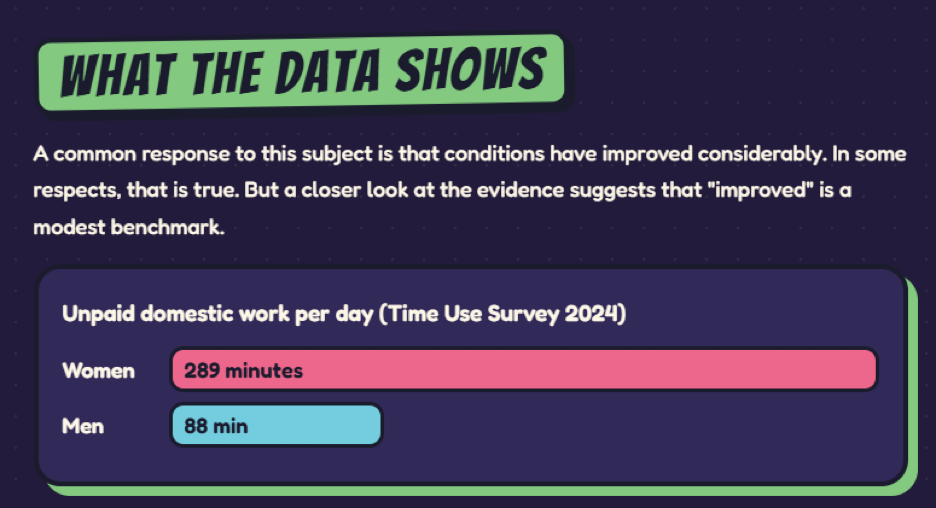
India has made progress on gender equality, but there is still a large gap in how unpaid work is shared.
India’s Time Use Survey 2024, conducted by the Ministry of Statistics and Programme Implementation, found that women aged six and above who participated in unpaid domestic services spent an average of 289 minutes a day on that work. Men spent 88 minutes.
The difference is substantial.
The survey also found that 81.5% of women aged six and above participated in unpaid domestic services for household members, compared with 27.1% of men.
Women also spent less time on culture, leisure and mass media activities. Female participants spent an average of 164 minutes a day on these activities, compared with 177 minutes for male participants.
These numbers do not tell us what happens in every household. But they do show a clear national pattern: women continue to carry a much larger share of unpaid domestic work.
The wider gender gap is visible too.
According to the World Economic Forum’s Global Gender Gap Report 2025, India ranked 131st out of 148 economies. India’s overall gender parity score was 64.4%, while its score for economic participation and opportunity was 40.7%.
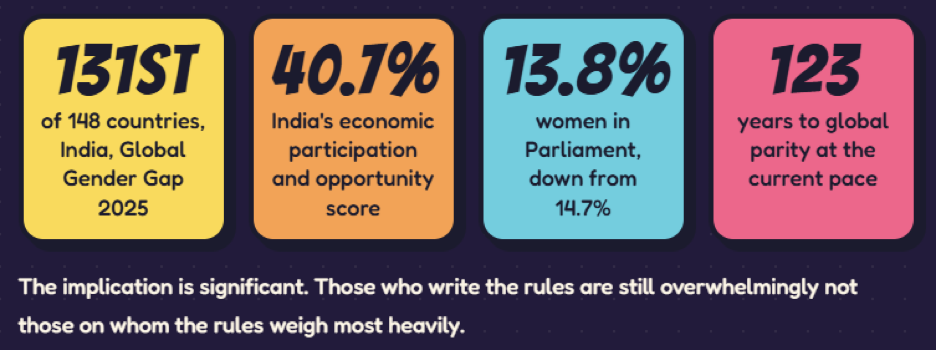
Globally, the World Economic Forum estimates that, at the current rate of progress, it could take 123 years to reach full gender parity. This is not a prediction that equality will definitely take 123 years. It is an estimate based on current trends.
That distinction matters.
Progress is possible. But progress does not happen automatically.
Safety Is Part of the Conversation
Gender equality is not only about household chores, salaries, or career opportunities. Safety matters too.
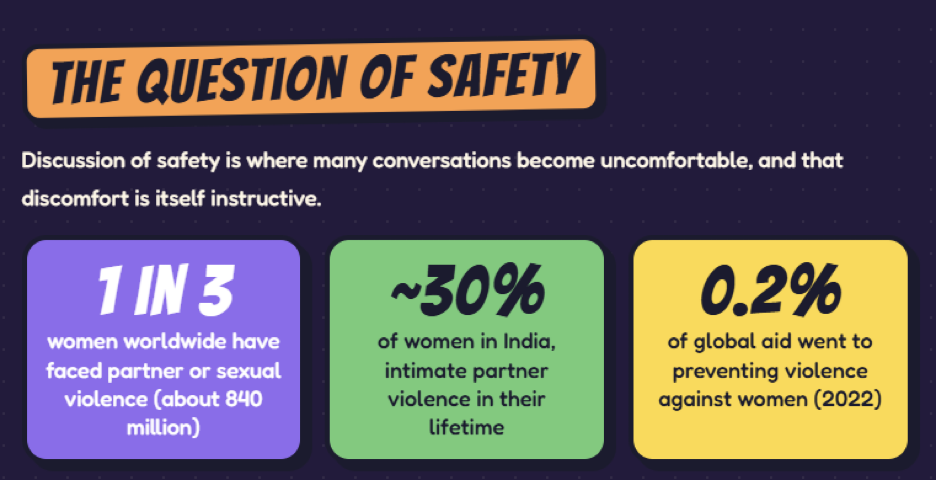
In November 2025, the World Health Organization and UN partners published updated estimates on violence against women. The report found that nearly one in three women worldwide, or about 840 million women, have experienced partner or sexual violence during their lifetime. The estimates are based on data from 168 countries collected between 2000 and 2023.
The report also found that progress has been extremely slow. The global prevalence of intimate partner violence has declined by only about 0.2% per year over the past two decades.
India also faces this problem. WHO’s updated estimates indicate that nearly 30% of women aged 15 to 49 in India have experienced intimate partner violence during their lifetime. More than one in five experienced such violence in 2023.
These statistics are difficult to read. But ignoring them does not make the problem smaller.
They remind us that conversations about equality must include safety, consent, respect, and freedom from violence.
Why Does Patriarchy Continue?
Patriarchy does not survive only because some people deliberately want to control others.
It can continue because people become used to certain roles.
A girl sees her mother doing most of the housework and may grow up thinking that this is simply what women do.
A boy sees his father rarely doing household chores and may learn the same lesson from watching him.
Nobody needs to say it out loud.
Then there is another familiar question: “What will people say?”
It can influence everything from a woman’s choice of career to whether a man takes parental leave or whether a daughter is encouraged to live independently.
People often follow these expectations because challenging them can create conflict.
This is also why women can sometimes reinforce traditional roles. That does not necessarily mean they support inequality. Many have spent years learning how to function within the system they inherited. Changing those expectations can feel risky, unfamiliar, or even disrespectful to the way they were raised.
The better question is not, “Who is to blame?”
It is, “Does this rule still make sense?”
“That is how we have always done it” is not, by itself, a good reason to keep doing something.
Men Are Affected Too
Talking about patriarchy should not mean pretending that men face no pressure.
Men can also be given rigid expectations.
A boy may be taught that showing sadness makes him weak. A man may feel that he must always be the main provider. A husband may be expected to solve every financial problem without asking for help.
These expectations can be harmful.
That does not mean men and women experience gender inequality in exactly the same way. They do not. But it does mean that rigid gender roles can limit everyone.
This is why the conversation should not be framed simply as women against men.
It is about questioning an old set of rules that tells people what they are supposed to be based on whether they are male or female.
Men have an important role in changing those rules too.
What Can We Actually Change?
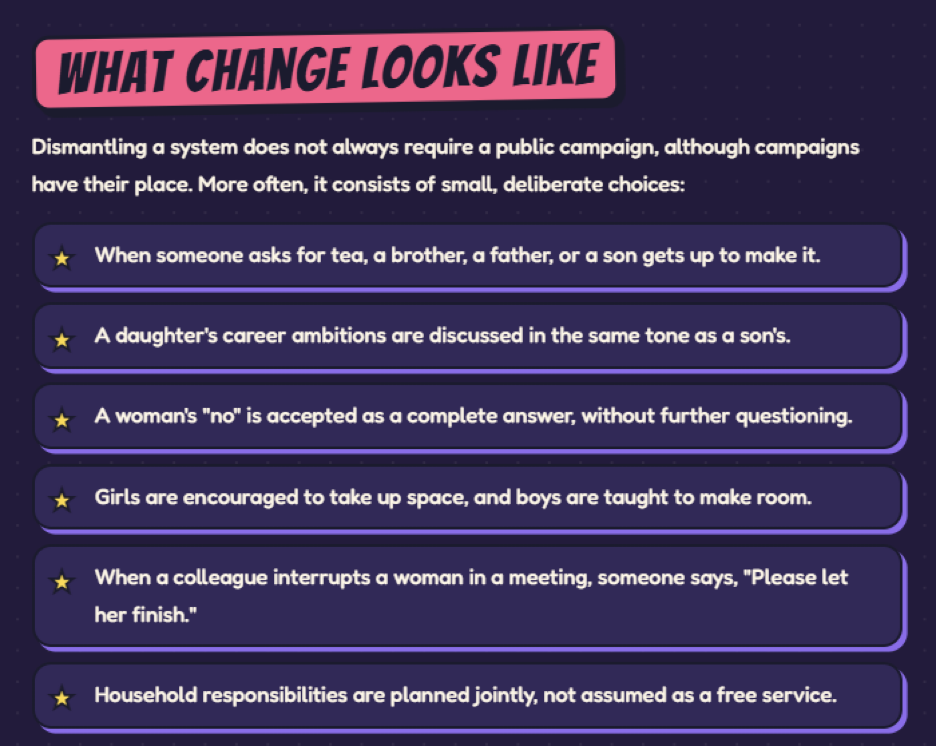
Changing a culture does not always require a major campaign.
Sometimes it starts with ordinary decisions at home and at work.
Social change often begins with things that seem too small to matter.
The first time a man gets up to make tea, someone may joke about it. The first time a son learns to cook for the family, it may feel unusual. The first time a daughter is encouraged to make an important decision for herself, relatives may have opinions.
But repetition changes what feels normal.
Eventually, nobody asks why the son is cooking or why the daughter wants a career.
It is simply normal.
Equality Is Not About Taking Something Away
Gender equality is sometimes presented as if one group must lose for another to gain.
It does not have to work that way.
Sharing household responsibilities does not take anything away from men. Encouraging girls to build careers does not make boys less important. Teaching boys to express emotions does not make them weak.
The goal is to give people more choices instead of forcing them into roles they never chose.
A woman should not have to prove that she can do everything before she is allowed to ask for help.
A man should not have to hide exhaustion because he is expected to be strong.
A daughter should not have fewer opportunities because she is a daughter.
A son should not have fewer emotional choices because he is a son.
“Smash patriarchy” does not have to mean anger, blame, or hostility.
It can mean paying attention.
Who gets up when the tea is requested?
Who takes care of the children?
Who gives up opportunities when the family needs flexibility?
Who makes the important financial decisions?
Who gets heard in a meeting?
Who is told to adjust?
These questions can reveal the rules we have stopped noticing.
The good news is that inherited rules are not permanent. We can change them.
We can share the work at home. We can raise boys and girls with the same expectations of respect and responsibility. We can listen when women speak. We can give men permission to ask for help. We can question traditions without disrespecting the people who came before us.
Change does not have to begin with a grand gesture.
Sometimes, it can begin with something as ordinary as asking:
“Why is she the one who always has to get up?”
And then getting up ourselves.
Sources
- WHO, “Lifetime toll: 840 million women faced partner or sexual violence” (Nov 2025): https://www.who.int/news/item/19-11-2025-lifetime-toll–840-million-women-faced-partner-or-sexual-violence
- The Week, “WHO study reveals shocking rates of violence against women globally” (India figures): https://www.theweek.in/news/health/2025/11/25/who-study-reveals-shocking-rates-of-violence-against-women-globally.amp.html
- Business Today, “Time Use Survey: Women take on most of household and caregiving work” (MoSPI, Feb 2025): https://www.businesstoday.in/india/story/time-use-survey-women-take-on-most-of-household-and-caregiving-work-465946-2025-02-25
- IAS Gyan, “Time Use Survey” (leisure figures): https://www.iasgyan.in/daily-current-affairs/time-use-survey
- The News Minute, “India falls to 131st position in Global Gender Gap Index 2025”: https://www.thenewsminute.com/news/india-falls-to-131st-position-in-global-gender-gap-index-2025
- NWM India, “India slips to 131 position on the Global Gender Gap Index 2025” (political representation figures): https://nwmindia.org/features/inksights/india-slips-to-131-position-on-the-global-gender-gap-index-2025/