

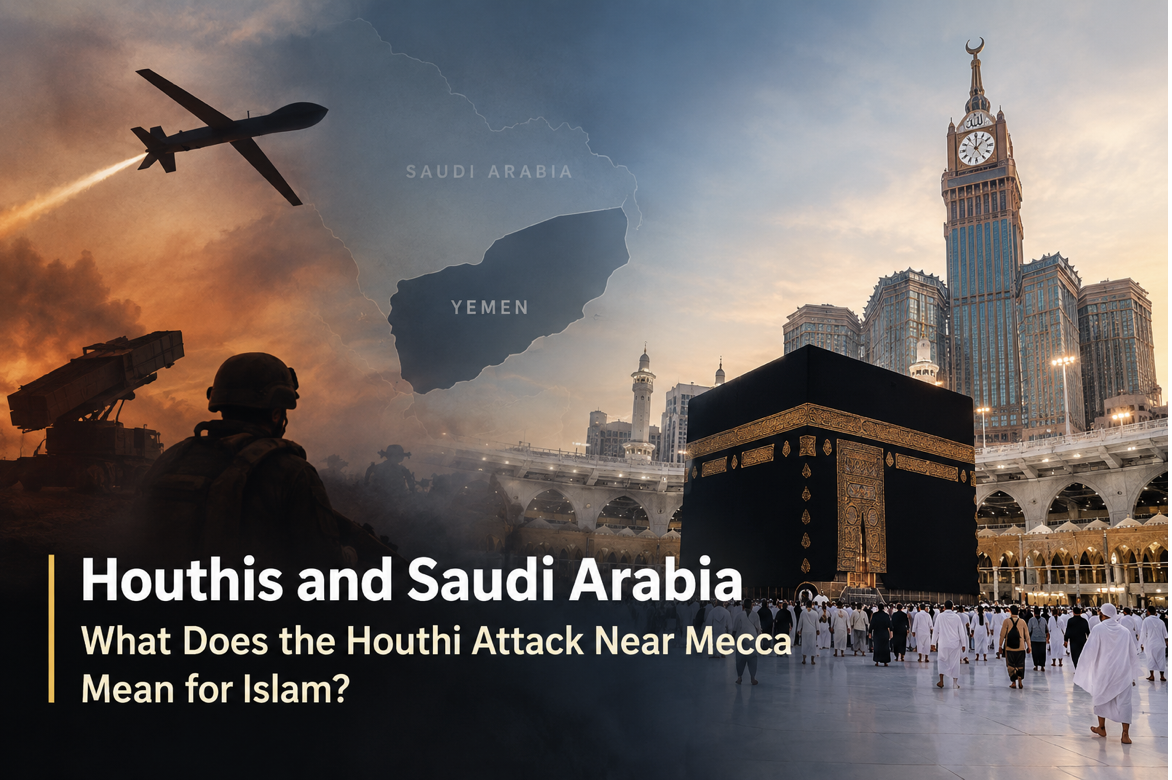
Mecca is not an ordinary city. It is the holiest city in Islam and the place where millions of Muslims travel every year for Hajj and Umrah. The Kaaba, located inside the Grand Mosque, is also the direction Muslims face during their daily prayers.
This is why any security threat near Mecca can become much more than another military incident.
On September 15, Saudi Arabia said its air defences intercepted and destroyed a Houthi drone south of Mecca before it entered the restricted airspace over the holy city. The Saudi-led coalition said the security of Mecca, the Two Holy Mosques, and pilgrims was a red line. However, the Houthis have denied targeting Mecca.
This raises an important question: What does the reported Houthi attack near Mecca mean for Islam, Saudi Arabia, and the wider Muslim world?
The answer is complicated.
The drone did not strike the Grand Mosque or the Kaaba. It was intercepted before entering the restricted airspace, according to Saudi authorities. At the same time, the Houthi leadership has rejected the Saudi claim that Mecca was the target.
Still, the incident is important because of where it happened.
Why Is Mecca So Important?
Mecca has a unique position in Islam.
It is the birthplace of Prophet Muhammad and home to the Kaaba, which Muslims consider the most sacred site in Islam. It is also the centre of the annual Hajj pilgrimage, one of the Five Pillars of Islam.
Every year, millions of Muslims from different countries travel to the city for Hajj and Umrah. This means that the security of Mecca is not only a Saudi concern.
Muslims across Asia, Africa, the Middle East, Europe, and other parts of the world have a direct religious connection with the city. Therefore, a military threat near Mecca can create concerns far beyond the immediate Saudi-Yemeni conflict.
What Actually Happened Near Mecca?
According to Saudi Arabia, a Houthi drone was intercepted south of Mecca on September 15.
Saudi officials said the drone was destroyed before it entered the prohibited airspace over the holy city. The incident came after several days of Houthi attacks on Saudi territory and a wider escalation between Saudi Arabia and the Houthis.
Saudi Arabia has described the incident as an attempt to target Mecca. But there is another side to the story.
The Houthis have denied targeting Mecca or any Islamic holy site. Houthi leader Abdul-Malik al-Houthi called the Saudi claim a heinous lie, while Houthi officials said their attacks were directed at Saudi military and strategic targets.
This is important because there is currently a difference between what Saudi Arabia says happened and what the Houthis say happened.
Saudi-led coalition spokesperson Turki al-Maliki said that Saudi air defence forces intercepted the drone before it could enter restricted airspace. He called the incident “a deliberate act intended to provoke the feelings of millions of Muslims” and warned that the coalition would take “necessary and deterrent measures” against the Houthis. Houthi military spokesman Yahya Saree strongly rejected Riyadh’s account. He said the group had targeted Saudi oil facilities and military bases located “far removed from the holy places” and accused Saudi Arabia of fabricating the incident.
What is clear is that a Houthi drone was reported intercepted near Mecca. What remains disputed is whether Mecca itself was the intended target.
Why Does the Location Matter So Much?
A drone attack on a military base and a drone threat near Mecca do not have the same meaning.
Saudi Arabia has military bases, airports, oil facilities, and other strategic infrastructure that have been targeted during the wider conflict. Mecca is different. It is a religious centre for Muslims around the world.
The city also receives large numbers of pilgrims, meaning that any military incident in the area creates an additional risk to civilians. This is why Saudi Arabia immediately described the protection of the holy sites and pilgrims as a red line.
The Organisation of Islamic Cooperation also condemned what it described as an attack on the holy city. Several Arab and Muslim-majority countries have similarly expressed support for Saudi Arabia and concern about the reported incident.
Pakistan’s Prime Minister Shehbaz Sharif condemned what he described as a “dastardly and heinous” attack on Mecca. He said that “the people of Pakistan are saddened and perturbed by this outrageous act.” The reaction showed that concern over the incident extended beyond the Gulf and was shared by countries across the wider Muslim world.
How Did the Houthi-Saudi Conflict Begin?
To understand this incident, it is necessary to understand the larger conflict between the Houthis and Saudi Arabia.
The Houthis are a political and military movement based in Yemen.
In 2014, the group took control of Yemen’s capital, Sana’a, and expanded its control over large parts of the country. Saudi Arabia then led a military coalition that intervened in Yemen in 2015 in support of the internationally recognised Yemeni government. The conflict continued for years.
A UN-backed truce in 2022 significantly reduced major fighting, but it did not produce a permanent political settlement. The situation has now become more dangerous again.
The Houthis have increased attacks involving drones and missiles, while Saudi Arabia has carried out military strikes against Houthi positions in Yemen. The wider conflict has also become connected to the security of the Red Sea and the Bab el-Mandeb Strait.
This means the incident near Mecca is part of a much larger regional conflict.
Is This a Religious Conflict Between Sunnis and Shias?
This is one of the more complicated questions. The Houthis come from Yemen’s Zaydi Shia tradition, while Saudi Arabia is predominantly Sunni.
Because of this, the conflict is sometimes presented as part of a wider Sunni-Shia rivalry. However, describing the entire conflict in those terms would be too simple.
The war also involves political power, territory, security, regional influence, and the relationship between the Houthis and Iran.
Saudi Arabia has its own security concerns because Yemen shares a long border with the kingdom. The Houthis, meanwhile, have developed significant military capabilities, including drones and missiles, and have used them against Saudi territory and other targets.
Therefore, the conflict cannot be understood only through religion. This distinction becomes even more important when discussing Mecca.
There is more to the story. The Houthis follow the Zaydi Shia tradition, which is different from the Twelver Shia Islam followed in Iran. So, describing the conflict simply as an Iran-Saudi proxy war based on Sunni-Shia divisions misses some of the complexity.
History also adds an interesting layer. In the 1960s, Saudi Arabia supported Zaydi royalist forces fighting against Egypt’s Gamal Abdel Nasser. Riyadh provided them with weapons and financial support. This means Saudi Arabia’s relationship with Yemen’s Zaydis has not always been shaped by a simple Sunni-Shia divide.
Iran has also warned against viewing the incident only through a sectarian lens. Tehran has pointed to previous disputed or alleged “false flag” incidents in the region, which it says can be used to deepen divisions between Sunni and Shia Muslims. However, Iran has not directly confirmed or denied whether the Houthis were responsible for launching the drone.
Fawaz Gerges, a professor of international relations at the London School of Economics, has also questioned what the Houthis would gain by targeting Mecca. Speaking to TIME, he said such an attack would be “catastrophic” for the group and described it as a “lose-lose” situation. Gerges also suggested that the drone may have been a relatively unsophisticated homemade weapon that simply went off course rather than being deliberately aimed at Mecca. At the same time, he noted that Saudi Arabia’s description of the incident as an attack on Islam’s holiest site gives the event a much stronger emotional impact than presenting it simply as a military incident.
Does the Incident Change the Meaning of the Conflict?
Yes, it can.
An attack against a military facility is generally understood through military and strategic calculations. A threat toward Mecca carries a religious meaning as well.
For Muslims, the city has importance that goes beyond Saudi Arabia’s borders. This is why several governments and organisations reacted strongly to the reported incident.
The Arab Parliament said that targeting Mecca would go beyond an attack on Saudi security because of the city’s importance to Muslims worldwide. Jordan also condemned what it described as an attempt to target Mecca.
At the same time, the Houthi denial means that the religious interpretation of the incident should be treated carefully.
If the group did not intend to target Mecca, then describing the incident as a deliberate attack on Islam would go beyond what has been independently established.
What Does This Mean for Saudi Arabia?
For Saudi Arabia, protecting Mecca is a major security responsibility. The kingdom has to protect the holy sites while also keeping pilgrims and civilians safe. This is not easy during a period of increasing drone and missile attacks.
A drone does not need to cause major physical damage to create a security problem. It can force air-defence systems to respond, create fear among civilians, disrupt movement, and raise concerns about the safety of pilgrims. There is also another problem.
Saudi Arabia cannot treat the area around Mecca like an ordinary battlefield. Millions of Muslims visit the city, and any major military incident could have consequences for religious activities.
Therefore, preventing another incident near the holy city is likely to remain a major concern for Saudi security authorities.
What Does This Mean for the Muslim World?
The wider significance is perhaps even greater. Mecca belongs geographically to Saudi Arabia, but its religious importance extends across the entire Muslim world.
This means that an incident near the city can produce reactions from countries that are not directly involved in the Yemen conflict.
However, Muslim-majority countries do not all have the same political relationships with Saudi Arabia, Iran, or the Houthis. Some have close relations with Riyadh. Others have different political positions.
Therefore, the incident does not automatically mean that the entire Muslim world will respond in exactly the same way. But the basic concern is much wider.
The safety of Mecca and the protection of pilgrims are issues that have importance for Muslims regardless of their nationality.
Has Saudi Arabia Already Retaliated?
Yes. The situation moved quickly after the drone was intercepted near Mecca. On September 19, the Houthis claimed strikes on “sensitive sites” in Riyadh and on Aramco facilities in Yanbu, using a mix of missiles and drones. Smoke and flames were seen near a fuel depot at King Khalid International Airport, though Saudi authorities reported no casualties or damage, and the Houthi claims could not be independently verified. What Saudi Arabia did confirm was that its air defences intercepted a ballistic missile aimed at Riyadh at dawn the same day, the first confirmed Houthi attempt to target the capital during the latest escalation.
Saudi Arabia had not announced a major new round of strikes on Sana’a following the Riyadh incident. Its confirmed response has centred on intercepting the ballistic missile aimed at the capital and repeating its warning that the coalition will take “necessary and deterrent measures” against the Houthis, alongside a wave of regional diplomatic solidarity. This builds on an earlier, well-documented wave of Saudi airstrikes in mid-September: the Houthis said Saudi warplanes carried out roughly 300 air raids across Yemen in the five days before the Mecca drone was intercepted.
Several regional governments, including Pakistan, Egypt, Türkiye, Jordan, Kuwait and Bahrain, also expressed support for Saudi Arabia after the attempted strike on Riyadh. Pakistan’s military leadership described its commitment to Saudi security as unconditional.
UN Special Envoy for Yemen Hans Grundberg has called on all sides to show restraint, warning that the growing exchange of attacks could develop into a much wider conflict. Ahmed Nagi, a senior analyst at the International Crisis Group, has also said that the Houthis’ movements towards Saudi territory and the Red Sea coast appear to be part of a broader strategy. Speaking to Al Jazeera, he noted that the move towards the western coast is not only about controlling territory but also has a maritime dimension.
At the same time, mediation efforts have continued through Oman. However, neither side has publicly confirmed the details of any proposed ceasefire.
Could This Lead to More Escalation?
This is another important question.
Saudi Arabia has warned that it will take necessary measures to protect the Two Holy Mosques and its territory. The Houthis, meanwhile, continue to deny targeting Mecca while claiming responsibility for other attacks against Saudi targets.
This creates the possibility of another cycle of escalation. More Houthi attacks could lead to more Saudi military action in Yemen. More Saudi strikes could lead to further Houthi attacks on Saudi territory.
And if future attacks come close to Mecca or other heavily populated areas, the political and religious consequences could become even greater.
This is why the incident matters beyond the immediate question of whether one drone was intercepted.
Conclusion
So, what does the Houthi attack near Mecca mean for Islam?
First, it is important to be precise.
Saudi Arabia says a Houthi drone was intercepted south of Mecca before entering the city’s restricted airspace. The Houthis deny that they targeted Mecca.
There was no reported strike on the Kaaba or the Grand Mosque. But the incident still matters because of the importance of Mecca.
For Saudi Arabia, it is a security issue involving the protection of the Two Holy Mosques and millions of pilgrims.
For the wider Muslim world, it is a reminder that the consequences of the Yemen conflict can reach places with religious importance far beyond the battlefield.
The incident also shows why reducing the Houthi-Saudi conflict to a simple Sunni-Shia confrontation would not explain the whole picture. There are political, military, territorial, and regional factors involved.
In the end, the biggest concern is not simply where the drone was intercepted. It is how close a regional conflict has come to one of the most important religious places in the world.
Mecca is not just another location on a battlefield. Its importance means that any threat around the city can have consequences far beyond Saudi Arabia and Yemen.
Sources:
New sources for the added content (quotes, retaliation section, Sunni-Shia expansion):
- https://edition.cnn.com/2026/09/16/middleeast/saudi-arabia-houthis-mecca-attack-intl-hnk — al-Maliki and Yahya Saree quotes
- https://time.com/article/2026/09/16/saudi-arabia-declares-mecca-a-red-line-as-houthis-deny-targeting-holy-site/ — Fawaz Gerges (LSE) analysis and quotes
- https://www.euronews.com/2026/09/16/yemens-houthis-claim-they-shot-down-saudi-fighter-jet-deny-targeting-mecca — Pakistan PM Sharif quote, Zaydi vs. Twelver Shia distinction
- https://www.aljazeera.com/news/2026/9/8/saudi-houthi-fighting-in-yemen-escalates-what-happened-and-whats-next — Ahmed Nagi/ICG quote
- https://www.aljazeera.com/news/2026/9/7/houthis-accuse-saudi-arabia-of-killing-seven-in-yemen-prison-attack — UN envoy Hans Grundberg’s restraint statement
- https://www.npr.org/2026/09/19/nx-s1-5974980/saudi-arabia-houthis-attempted-attack-capital — confirmed Riyadh ballistic missile interception
- https://www.timesofisrael.com/saudi-capital-issues-first-air-raid-alert-since-renewed-fighting-in-yemen/ — Sept 19 Riyadh incident detail, al-Malki statement
- https://www.washingtonpost.com/world/2026/09/19/houthis-claim-attacks-sensitive-sites-saudi-arabian-capital/ — Sept 19 Riyadh incident, Houthi claims
- https://www.nationalheraldindia.com/international/verify-before-alleging-drone-attack-on-mecca-iran-and-houthis-tell-riyadh — Iran’s “false flag” caution, 1960s Saudi/Zaydi royalist history