

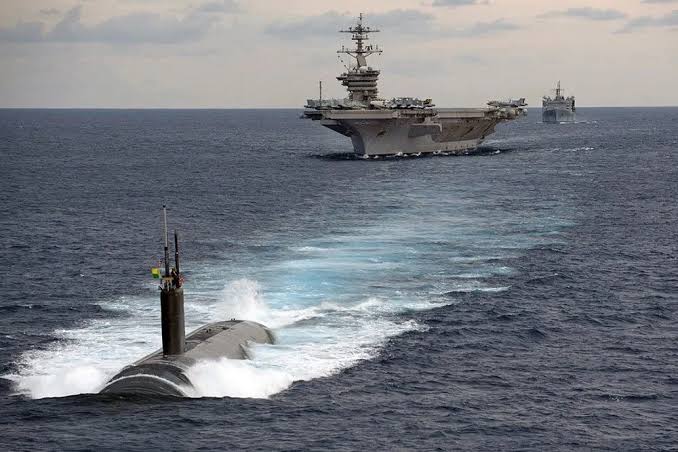
For more than a century, naval strategists have argued over what truly gives a country command of the sea. Is it the aircraft carrier, with its vast flight deck, fighters, helicopters and radar horizon? Or is it the submarine, hidden beneath the surface, difficult to detect and capable of threatening even the most heavily protected fleet?
The debate has never really ended because the answer has never been simple. An aircraft carrier (combat battle group) is visible power. A submarine is an invisible danger. One tells the world that a navy has arrived. The other makes an adversary wonder where it is.
The argument has acquired a new urgency in 2026 because the world’s major maritime powers are building both. China is expanding its carrier fleet while simultaneously investing heavily in submarines and undersea warfare. The United States continues to depend on carrier strike groups while maintaining the world’s most sophisticated nuclear-submarine force. Australia is spending decades and enormous resources on nuclear-powered submarines under AUKUS. South Korea is now openly examining nuclear-powered submarines as part of its future maritime strategy.
India, sitting astride the Indian Ocean, cannot afford to treat this as an academic argument. The history of naval warfare already provides the first answer. The aircraft carrier’s rise during the Second World War changed the meaning of naval power. Battleships, once the symbols of maritime supremacy, increasingly became vulnerable to aircraft launched hundreds of kilometers away. The carrier gave the navy something revolutionary: a mobile airfield that could move with the fleet.
But the submarine presented the opposite revolution. It made the ocean itself a hiding place. During the Second World War, submarines demonstrated their ability to attack major surface forces, merchant shipping and even aircraft carriers. Historical records show that submarines accounted for a significant share of carrier losses during the war.
The lesson was not that the carrier had become obsolete. It was that the carrier could never operate alone. That remains true today. Perhaps the clearest Indian example came during the 1971 war.
INS Vikrant became the centerpiece of India’s naval campaign in the eastern theatre, supporting operations and contributing to the isolation of East Pakistan. But its movements were influenced by the presence of Pakistan’s submarine PNS Ghazi. India had to account for the possibility that the submarine could threaten its most valuable naval asset. The eventual loss of Ghazi removed a major concern and allowed Vikrant greater freedom of action.
That episode captures the essence of the carrier-submarine relationship. A carrier creates options. A submarine creates uncertainty. The Falklands War provided another dramatic lesson.
In 1982, Britain sent a carrier-led task force thousands of miles from home to retake the Falkland Islands. HMS Hermes and HMS Invincible were vital to the campaign. The Argentine submarine ARA San Luis conducted patrols and forced the British to devote considerable resources to anti-submarine warfare. More decisively, British nuclear submarine HMS Conqueror sank the Argentine cruiser General Belgrano, after which the Argentine surface fleet withdrew towards safer waters.
The carrier had enabled Britain to project air power far from home. The submarine had demonstrated that a hidden platform could impose enormous operational caution on an entire fleet. This is why the question should never really be framed as carrier versus submarine.
The more intelligent question is: what kind of war is a navy preparing to fight, and what does it need its fleet to achieve?
A carrier is extraordinarily useful when a country needs sustained air power at sea, beyond the reliable reach of land-based aircraft. It can provide fighter cover, early airborne warning, surveillance, anti-submarine helicopters, command facilities, humanitarian assistance and a visible political presence.
It is also mobile diplomacy. A carrier group entering a region communicates something before a single aircraft takes off. But that visibility is also its vulnerability.
A modern carrier operates inside an increasingly dense web of satellites, long-range anti-ship missiles, submarines, drones, maritime patrol aircraft and unmanned underwater systems.
China’s maritime rise illustrates this transformation particularly well. Beijing is building a navy designed not merely around individual warships but around a wider system of sensors, missiles, aircraft, submarines and shore-based capabilities. Its growing carrier force is therefore only one component of much larger maritime architecture.
The submarine occupies an especially important place in that architecture because it complicates an adversary’s calculations.
A carrier can be tracked. A submarine may not be. That difference has enormous strategic value.
A submarine does not have to sink an aircraft carrier to achieve an operational effect. The mere possibility that one is operating nearby can force a carrier strike group to change its route, increase anti-submarine patrols, deploy helicopters, alter aircraft patterns and devote sensors and escorts to finding a threat that may not even be there.
This is the economics of uncertainty. The submarine can sometimes impose costs simply by remaining hidden. Yet, submarines have their own limitations. They cannot provide the persistent air umbrella that a carrier can. They cannot easily support humanitarian operations. They cannot visibly reassure a partner nation. They cannot launch large numbers of aircraft to control the airspace over a maritime task force.
And conventional submarines have another constraint: endurance. An air-independent propulsion submarine can remain submerged for extended periods, but a nuclear-powered submarine can remain underwater for much longer and sustain higher speeds without depending on atmospheric oxygen for propulsion.
That is why nuclear-powered submarines have become such coveted strategic assets. Australia’s AUKUS programme is an indication of how seriously major powers view this capability. Canberra’s planned nuclear-powered submarine fleet is intended to give Australia greater range, endurance and undersea reach in the Indo-Pacific.
India faces a different set of circumstances. The Indian Ocean is not the North Atlantic or the Western Pacific. Geography gives India a natural strategic advantage, but geography alone does not guarantee maritime control.
India sits near the center of a maritime space connecting the Persian Gulf, the Arabian Sea, the Bay of Bengal and the approaches to Southeast Asia.
That geography makes aircraft carriers useful. But it also makes submarines extremely important. The Indian Navy’s carrier programme gives New Delhi the ability to maintain mobile air power at sea. INS Vikrant, India’s first indigenously designed and built aircraft carrier, represents not simply another warship but the country’s ability to build a large floating airbase. Its commissioning in 2022 marked an important milestone in India’s indigenous naval construction.
But a carrier fleet without a strong underwater shield would be incomplete. The carrier needs submarines to help complicate enemy surveillance and protect maritime approaches. It needs destroyers and frigates for air defence and anti-submarine warfare. It needs maritime patrol aircraft, helicopters, satellites and unmanned systems to build the picture around it.
In other words, the carrier is not the fleet. It is the center of a system. The same is true of the submarine.
A submarine operating without reliable intelligence, communications, satellite support, maintenance infrastructure and broader maritime awareness is not an invisible superweapon. It is simply an expensive platform operating alone.
This is where the old debate becomes misleading. The real contest is no longer between a ship above the water and a ship below it. It is between systems.
The future maritime battlefield will connect satellites, carrier aircraft, submarines, surface ships, drones, seabed sensors, cyber networks and long-range missiles. And increasingly, the underwater domain itself is becoming contested. China’s reported development of large unmanned underwater vehicles and dedicated platforms to deploy them illustrates where undersea warfare may be heading. Recent reports describe a large Chinese vessel being developed to launch and recover extra-large unmanned underwater vehicles. Beijing has not publicly confirmed the vessel’s precise role, so its eventual operational significance remains uncertain.
For India, this should be a strategic caution. The Indian Ocean is becoming more transparent above the surface and more opaque beneath it. Satellites can watch ships. Long-range drones can monitor vast stretches of ocean. Artificial intelligence can process enormous volumes of maritime data. But the underwater world remains considerably harder to observe continuously.
That makes the seabed and the submarine environment the next great strategic frontier. There is also a financial reality.
Aircraft carriers are among the most complex and expensive military platforms ever built. They require aircraft, escorts, replenishment ships, maintenance facilities, trained crews and a large logistical ecosystem. A carrier is therefore not simply a procurement decision. It is a national commitment.
Submarines also demand enormous investment, particularly nuclear-powered boats. The answer for India, therefore, should not be to choose one and discard the other. It should be to determine the right balance. India needs carrier aviation because the Indian Ocean is too large to be viewed only through coastal air bases. It needs submarines because the same ocean is too vast and too transparent to rely exclusively on surface forces.
It needs conventional submarines for regional operations. It needs nuclear-powered attack submarines for sustained blue-water operations. It needs ballistic-missile submarines for strategic deterrence. And, it needs aircraft carriers capable of operating as part of integrated carrier battle groups rather than as solitary symbols of national prestige.
The lesson from history is remarkably consistent. The Japanese carriers at Pearl Harbor demonstrated the destructive reach of naval aviation. The German U-boats demonstrated the strategic power of the undersea domain. Vikrant demonstrated India’s own carrier potential in 1971. Ghazi demonstrated the fear that a submarine can generate even when its fate remains uncertain. The Falklands showed that a submarine can radically alter the behaviour of an entire fleet.
None of these episodes proved that one platform had defeated the other. They proved something more important.
Sea power is about creating choices for yourself and dilemmas for the adversary. The carrier gives India reach, air power and presence. The submarine gives India stealth, uncertainty and denial. The future Indian Navy will need both.
Because the decisive naval battle of the future may not begin when aircraft take off from a carrier. It may begin much earlier—when an adversary realizes that somewhere beneath thousands of square kilometers of ocean, an Indian submarine may already be waiting.
Carrier vs Submarine Conclusion
And that is why the carrier-versus-submarine debate should finally be retired. The serious question is not which one rules the sea.
It is whether a navy possesses enough of both—and enough intelligence, technology, logistics and industrial depth—to make the adversary fear what it can see and what it cannot.