

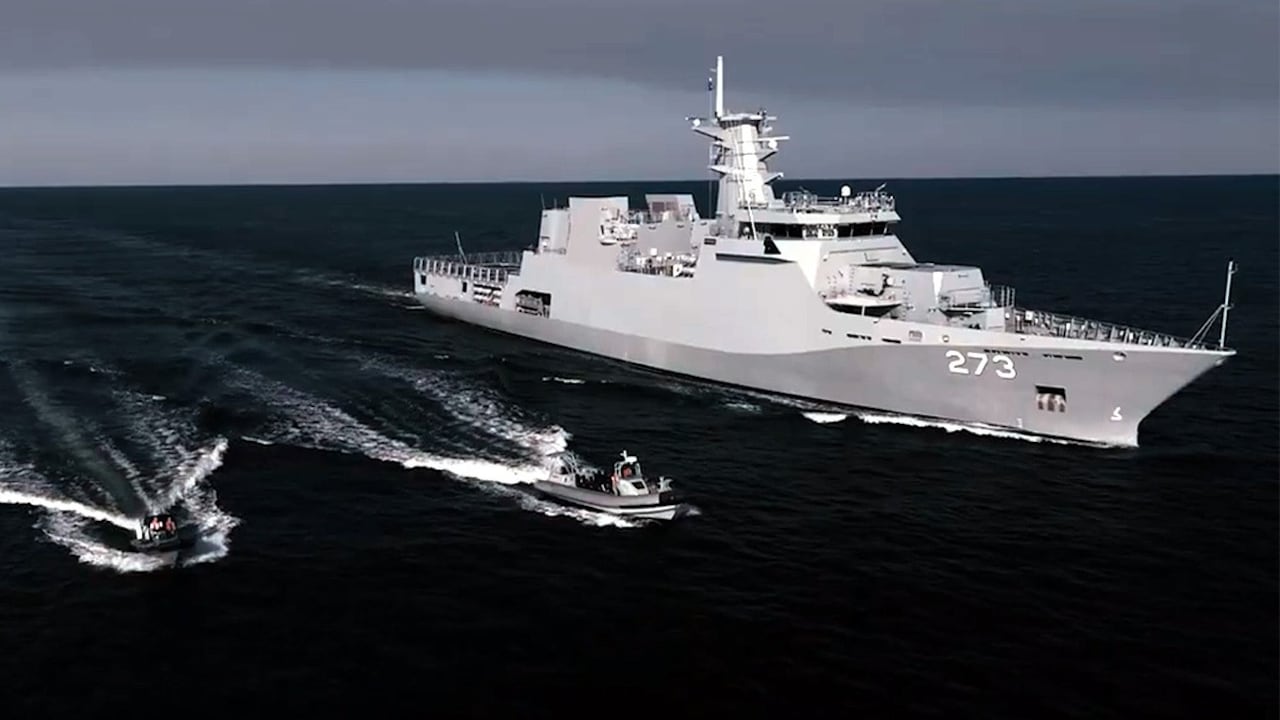
The sea has an unforgiving quality that lands sometimes hide; there is nowhere to pull over. On September 15, an Indian Navy frontline warship and Pakistan Navy’s PNS Hunain came into contact in the northern Arabian Sea, in international waters about 120 nautical miles from the Gulf of Oman.
Indian sources said the Pakistani vessel approached at high speed and maneuvered unsafely, resulting in the collision. The Indian warship suffered no reported structural damage and continued its mission, while Hunain was reported to have sustained damage and returned towards port. India subsequently summoned Pakistan’s Charge d’Affaires and lodged a formal dissent.
Pakistan has presented a different account, calling the incident provocative and unacceptable and disputing India’s version of events. That difference matters because the immediate facts of a collision at sea and the political interpretation of that collision are two different things.
Yet there is something more important than assigning blame before all navigational evidence is examined. Two nuclear-armed neighbors now have another theatre in which miscalculation can acquire strategic consequences. The Arabian Sea is no longer a peripheral space in India-Pakistan security calculations. It is an increasingly busy strategic highway connecting the Indian Ocean with the Gulf, the Strait of Hormuz, energy markets and some of the world’s most important commercial shipping routes.
The Indian Navy has maintained a sustained presence in the northern Arabian Sea in recent months, including missions linked to the security of Indian-flagged merchant shipping amid the wider West Asian conflict. That makes professional conduct at sea more than a matter of naval etiquette.
It becomes a matter of escalation management. There is already a historical warning. In 2011, Pakistan Navy’s PNS Babur came into contact with INS Godavari in the Gulf of Aden while both were involved in the aftermath of the hijacking of the merchant vessel MV Suez. India said Babur had made a dangerous high-speed approach; Pakistan offered its own account of the episode. The incident did not develop into a military confrontation, but it demonstrated how quickly two naval units operating in a crowded maritime environment can create a diplomatic problem.
Fifteen years later, geography has changed, but the lesson has not. The 1991 India-Pakistan agreement on advance notification of military exercises, maneuvers and troop movements was designed precisely because military activity by one side can be misunderstood by the other. Article 10 contains provisions concerning the safe operation of naval vessels and submarines in international waters. India has cited the provision following the latest collision and said the Pakistani conduct was in direct contravention of the agreement.
There is a reason such agreements survive even when political relations are poor. They are not designed for friendship. They are designed for damage control. India and Pakistan have fought wars in 1947-48, 1965, 1971 and 1999, and have repeatedly come close to military confrontation. Yet military-to-military protocols, hotlines and confidence-building measures exist because professional armies and navies understand an uncomfortable truth: not every dangerous encounter is planned, and not every accident remains an accident once national pride enters the room.
At sea, the problem is particularly acute. A warship is not an ordinary vessel. It carries weapons, sensors, communications equipment and an operational mandate. Its maneuvers are watched and interpreted. A change in course can be a navigation decision, a surveillance action, an attempt to shadow another ship—or something more deliberate.
That ambiguity is dangerous. This is where the latest episode deserves to be examined beyond the immediate political rhetoric.
The Indian vessel was reportedly on a routine surveillance mission. PNS Hunain, a Yarmook-class offshore patrol vessel commissioned in 2024, was operating in the same broad maritime environment. According to Indian accounts, it closed in at high speed before the collision.
Reports also indicate that warnings were issued over maritime radio. These details, if established through navigational records, bridge communications and sensor data, will be important in determining exactly what happened. Modern warships leave behind an extraordinary amount of evidence. Automatic Identification System records, radar tracks, bridge logs, electronic communications, electro-optical imagery and other sensor data can reconstruct a maritime encounter almost second by second.
That is why this incident should be investigated professionally rather than converted prematurely into a larger political narrative. But the strategic concern remains even if the collision ultimately proves to have been an accident. An accident between two merchant ships is a maritime incident. An accident between two hostile naval vessels can become a security crisis. That distinction is becoming increasingly relevant across the world’s oceans.
The South China Sea has provided repeated examples of naval and coast guard vessels operating aggressively in proximity. The Eastern Mediterranean, the Persian Gulf and waters around the Korean Peninsula have also demonstrated how crowded military spaces can become. As more states deploy warships, drones, submarines and surveillance platforms, the possibility of unintended contact rises.
The Arabian Sea is no exception. In fact, its importance is increasing. For India, the sea is the country’s strategic depth. It carries energy supplies, commercial traffic and critical trade routes. It is also the operating space through which the Indian Navy seeks to maintain maritime awareness stretching from the western Indian coast towards the Gulf of Oman, the Gulf of Aden and beyond.
Pakistan, meanwhile, has invested significantly in its naval capabilities and continues to develop a fleet with Chinese assistance. Its maritime relationship with China also gives the Arabian Sea a wider geopolitical dimension.
This is where a seemingly small collision acquires a larger meaning. India’s naval presence in the Arabian Sea is not directed exclusively at Pakistan. It is part of a wider maritime-security architecture that includes piracy, protection of merchant shipping, surveillance and India’s expanding role as a security provider in the Indian Ocean.
Pakistan’s navy operates in the same waters. The two therefore need mechanisms that allow ships to operate close to each other without allowing proximity to become provocation. That is what confidence-building measures are supposed to achieve. The latest incident also raises an operational question for both navies: how effectively are their commanders trained to manage encounters with an adversary in real time?
Rules are useful. But rules work only when crews understand them, commanders respect them and communications remain open. Professional seamanship becomes strategic deterrence when the ships involved belong to rival states. The Indian Navy’s response is therefore worth watching. The fact that the Indian warship reportedly continued its mission after the encounter suggests that the immediate operational objective was not disrupted. The diplomatic protest, meanwhile, establishes India’s position through formal channels rather than allowing the incident to be handled merely as an informal maritime disagreement.
Pakistan’s protest is equally significant because it shows that Islamabad intends to contest India’s interpretation rather than accept it. That means the incident will now have two tracks: an operational investigation and a diplomatic argument.
The first should be evidence driven. The second will inevitably be political. India should resist the temptation to allow the second to overwhelm the first. There is a larger lesson here for the Indian Navy as it expands its presence across the Indian Ocean region.
More ships mean more encounters. More surveillance missions mean more shadowing. More military exercises mean more opportunities for ships to operate in proximity. More geopolitical competition means that an ordinary manoeuvre can be interpreted through a strategic lens.
The Navy therefore needs not only stronger ships and better sensors, but also increasingly sophisticated encounter management, the ability to identify, communicate, de-escalate and, if necessary, firmly control a potentially dangerous interaction without surrendering operational freedom.
That is not weakness. It is professional naval power. And in the Arabian Sea, that distance may now be more important than ever.