

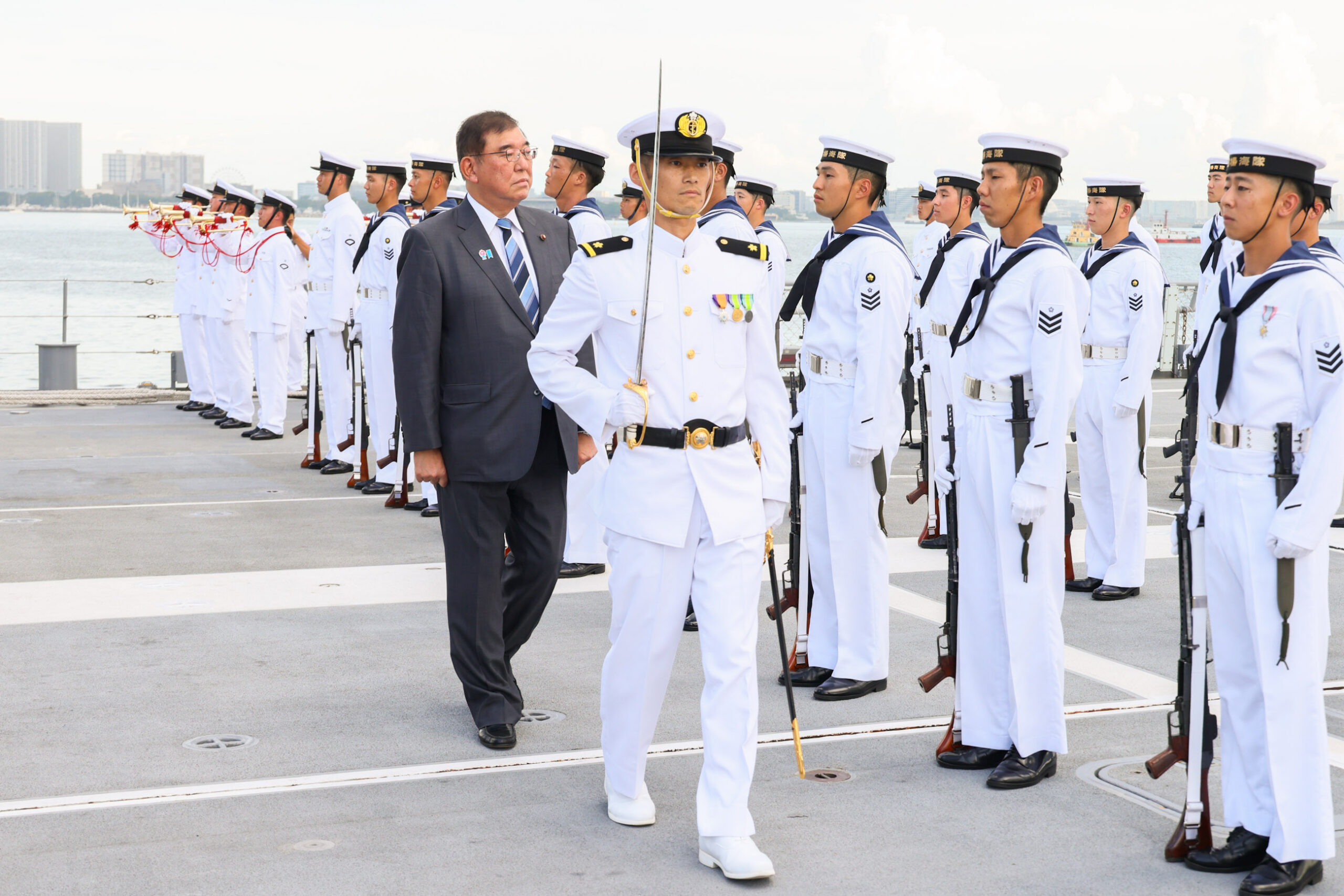
Since the post-war era, Japan kept its military power deliberately restrained. The country that had once built one of Asia’s most formidable naval forces became far more comfortable over the time speaking about economic strength, technology, trade and development than aircraft carriers, long-range missiles and maritime deterrence. That equation is changing.
Japan is once again becoming a serious maritime power, driven less by nostalgia for its pre-1945 military past than by the geography of contemporary Asia. China’s expanding naval reach, its increasingly assertive coast guard and maritime presence, the militarization of disputed features in the South China Sea and the growing strategic importance of Taiwan and the Western Pacific are forcing Tokyo to reconsider what defence must mean in practice.
The question is no longer whether Japan is returning to the sea. It is. The more difficult question is whether this maritime resurgence can help check Chinese influence in the South China Sea.The answer is unlikely to be a simple yes. Japan cannot, by itself, neutralize Chinese power in a maritime theatre where China enjoys enormous geographical, military and economic advantages. But a stronger Japanese maritime force, operating alongside the United States, the Philippines, Australia, India and other regional allies, can make Chinese coercion considerably harder and more expensive.
Japan’s maritime history makes its present transformation particularly striking. The Imperial Japanese Navy became a formidable force during the late 19th and early 20th centuries. Its victory over Russia in 1905 demonstrated that an Asian power could defeat a major European military state. Japan subsequently developed a sophisticated naval-industrial complex, culminating in a fleet that played a central role in the Pacific War.
The trajectory ended catastrophically in 1945. Post-war Japan deliberately moved in another direction. Article 9 of its Constitution renounced war as a sovereign right, while the Self-Defense Forces were created in 1954 in response to the realities of the Cold War. The Maritime Self-Defense Force developed into an exceptionally capable force, particularly in anti-submarine warfare, maritime surveillance, mine countermeasures and protection of sea lanes.
It was a navy designed primarily to defend Japan. China’s rise is now forcing Tokyo to think beyond that traditional perimeter.
The People’s Liberation Army Navy has become the world’s largest navy by number of battle-force ships, while Beijing has developed a much broader maritime ecosystem involving the Navy, China Coast Guard, maritime militia, surveillance networks and military infrastructure on disputed features.
The South China Sea has become the clearest expression of this strategy. China’s reclamation and militarization of disputed features have altered the physical and strategic geography of the waterway. The result is a maritime environment in which military power, coast guard activity, law enforcement and economic influence increasingly overlap.
Japan is not a claimant in the South China Sea. Yet the waterway matters directly to Tokyo. Japan’s economy depends heavily on maritime trade and imported energy. More importantly, the South China Sea connects the western Pacific with the Indian Ocean through some of the world’s most important sea lanes. Any power capable of exercising sustained coercive control over these routes would possess influence extending far beyond Southeast Asia.
That explains Japan’s strategic turn. The 2022 National Security Strategy and associated defence reforms represented a major departure from the cautious post-war approach. Tokyo decided to raise defence spending towards 2 % of GDP and acquire counterstrike capabilities, including longer-range missiles.
The transformation is also changing the character of Japanese maritime aviation. The conversion of the Izumo-class ships to operate F-35B short-take-off-and-vertical-landing aircraft is perhaps the most visible symbol. The ships remain officially classified as destroyers, but their ability to operate F-35Bs gives Japan a form of mobile air power that did not fit comfortably within its traditional post-war military vocabulary.
This is not simply about acquiring aircraft carriers. It is about creating more options in a conflict where fixed airbases could become vulnerable to missile strikes. Dispersed maritime aviation could allow Japan to maintain air power closer to contested areas while complicating an adversary’s targeting calculations.
Japan’s submarine and anti-submarine warfare capabilities add another layer. For decades, the JMSDF has specialized in tracking submarines in the waters surrounding the Japanese archipelago. That expertise becomes increasingly relevant as China’s submarine fleet operates farther from its coastline.
But Japan’s most important maritime capability may ultimately be its network. Tokyo is steadily building a web of security relationships across the Indo-Pacific. The Japan-US alliance remains central, but Japan’s defence diplomacy now extends increasingly to Australia, India, the Philippines and European maritime powers.
Its relationship with the Philippines is particularly significant. Manila sits on the southern flank of the South China Sea, while Japan possesses advanced maritime surveillance, coast guard and defence-industrial capabilities. Greater Japanese access, exercises and security assistance can therefore strengthen the capacity of Southeast Asian states to monitor and resist coercive maritime behaviour.
The emergence of this network changes the strategic calculation. China may be able to concentrate overwhelming force in one location. But imposing pressure across several connected maritime theatres is much harder. This is also where India’s interests intersect with Japan’s maritime resurgence. India and Japan are not geographically adjacent, but their strategic concerns increasingly overlap. Both depend upon secure sea lanes, resilient supply chains and stable maritime order. Both are concerned about unilateral attempts to alter the status quo. Both support a Free and Open Indo-Pacific.
And there is an important economic layer to this relationship that is sometimes overlooked. Lately, in August 2026, Commerce and Industry Minister Piyush Goyal led what was described as India’s largest-ever business delegation to Japan, involving more than 200 Indian business representatives. The engagement focused on investment, manufacturing, technology and next-generation industries.
At first glance, this may seem disconnected from Japan’s maritime transformation. It is not. Modern military power ultimately rests on industrial power. A navy requires shipyards, electronics, sensors, propulsion systems, semiconductors, software, energy security, skilled manpower and resilient supply chains. Japan possesses enormous technological and industrial depth. India offers scale, a growing manufacturing base, a large talent pool and an expanding domestic market.
The convergence between the two therefore has the potential to become more than a defence partnership. It can become an economic-security partnership. That matters in an Indo-Pacific increasingly shaped by supply-chain vulnerabilities and strategic dependence. If India and Japan can deepen cooperation in semiconductors, advanced manufacturing, critical technologies, infrastructure and maritime industries, their combined strategic weight will extend beyond the number of warships they operate.
Japan’s maritime resurgence, consequently, should not be viewed in isolation from its economic relationships. A country cannot sustain a sophisticated navy merely by purchasing platforms. It must possess the industrial ecosystem capable of maintaining and replacing them during a prolonged crisis.
This is where Japan’s strengths become significant. But Tokyo also has serious limitations. Japan faces an ageing and shrinking population. Recruiting and retaining military personnel will become increasingly difficult. Defence expenditure is rising, but sustaining that expansion over decades will require difficult fiscal choices.
Japan’s defence industry is technologically sophisticated, yet it has historically operated on a smaller scale than the industrial mobilisation that a major regional war could require. And there is another constraint, China is not simply a military competitor. It is one of Japan’s largest economic partners.
Tokyo therefore must perform a difficult strategic balancing act, strengthening deterrence without creating an uncontrollable security spiral. This is why describing Japan’s transformation as remilitarization is too simplistic. Japan is not recreating the Imperial Japanese Navy. It is constructing a modern force intended to make coercion against Japan and its partners more difficult. That distinction becomes especially important in the South China Sea.
Japan cannot remove China’s influence from the region. Geography alone prevents such a conclusion. China is a resident power with enormous economic connections to Southeast Asia, a large naval and coast guard presence and physical infrastructure across contested waters.
But the strategic objective does not have to be Chinese exclusion. It can be Chinese restraint. If Japan, the United States, the Philippines, Australia, India and other allies can build sufficient maritime awareness, interoperability and military resilience, Beijing may find unilateral coercion increasingly costly.
This is the essence of deterrence, not necessarily defeating an adversary, but convincing it that changing the status quo by force or intimidation will not produce an easy victory. Japan’s maritime resurgence could therefore alter the balance without a single naval battle. Its submarines can complicate underwater operations. Its maritime patrol aircraft can improve surveillance. Its F-35Bs can provide additional airpower support. Its ships can participate in multinational deployments. Its coast guard can support maritime law enforcement. Its industrial partnerships can strengthen regional resilience.
Individually, none of these changes neutralizes China. Together, they can narrow China’s room for strategic maneuver. There is also historical irony here. Japan once sought influence across Asia through military expansion and ultimately paid an extraordinary price for it. Today’s Japan is attempting to use military power within a very different framework, alliances, international law, economic interdependence and collective deterrence.
The Rising Sun is therefore returning to the sea, but the strategic purpose is fundamentally different. The real test will not be whether Japan can build more ships than China. It cannot. Nor, will it be whether Tokyo can dominate the South China Sea. It cannot and does not need to.
The test is whether Japan can become sufficiently capable, sufficiently connected and sufficiently resilient that coercive maritime expansion becomes harder for any power to achieve. For India, that is an important development, to keep a note of.
A stronger Japan adds another capable maritime actor to the Indo-Pacific. A stronger India-Japan economic and strategic relationship adds depth to that architecture. And a more interconnected network of regional powers makes the maritime order less dependent on the calculations of any single country. Japan’s second maritime age, therefore, is unlikely to be defined by the return of the aircraft carrier alone.
It will be defined by networks, technology, industry, geography and deterrence. China has changed the maritime balance of Asia.
Japan is now changing its response.
And in the South China Sea, the most consequential contest may not be about who controls the water. It may be about whether anyone is allowed to control it alone.