

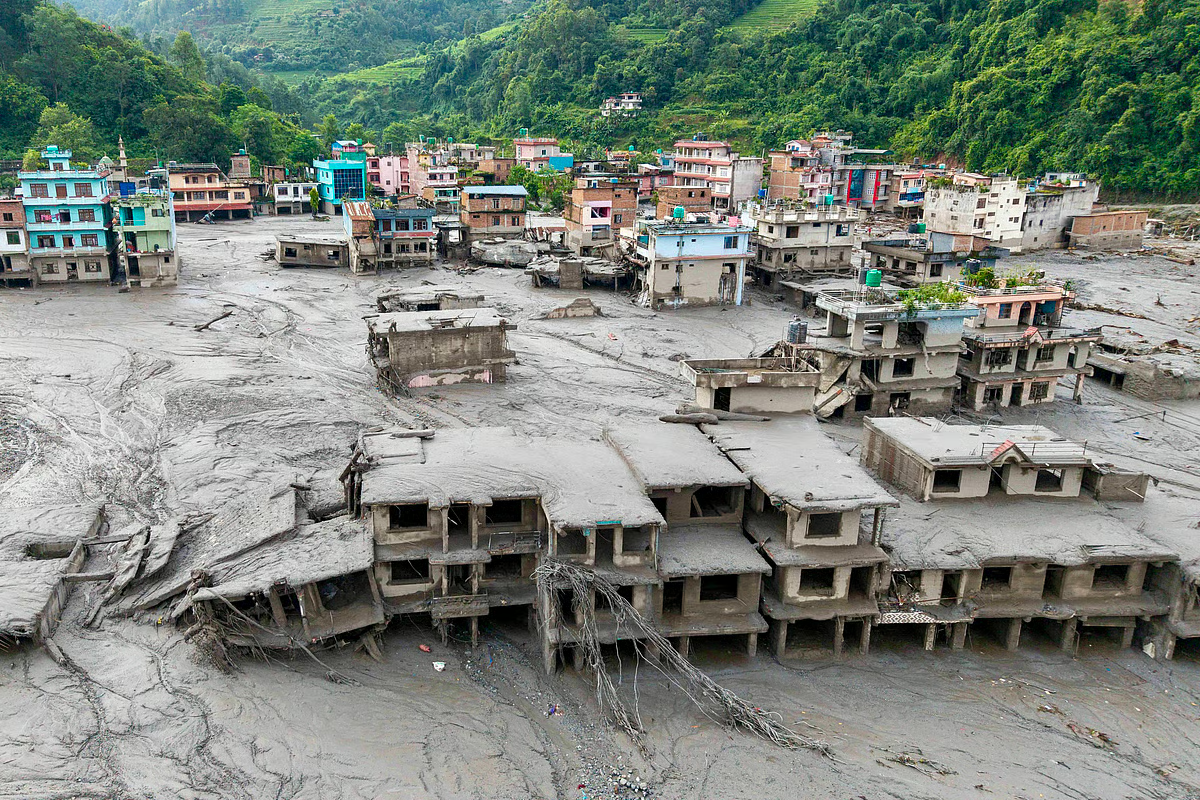
Nepal is facing one of the most severe natural disasters in its recent history. The devastating Bhote Koshi River floods of August 26, 2026, have caused widespread loss of life and destroyed homes, roads, bridges, and critical infrastructure across several districts. According to Nepal’s government, the disaster is estimated to have caused around $1.8 billion in damage and $883 million in economic losses. Its preliminary assessment puts the longer-term reconstruction requirement at approximately $4.78 billion.
Therefore, the crisis has moved beyond rescue and relief. Nepal now needs to rebuild its economy and infrastructure while restoring livelihoods.
This is where India can play a significant role, both in terms of a humanitarian responsibility and a foreign-policy opportunity.
India’s First Response
India responded almost immediately after the disaster. On August 26, Prime Minister Narendra Modi spoke with Nepal’s Prime Minister Balendra Shah and offered India’s support for humanitarian assistance and rescue operations.
Since then, India has sent multiple consignments of relief supplies, including medicines, food, tents, hygiene kits, generators, pumps, and specialised rescue equipment.
By September 10, India had delivered more than 130 tonnes of relief material and deployed 54 personnel for rescue, forensic, and related operations. Indian teams also assisted the Nepali Army in difficult rescue operations.
India’s assistance has continued even as the immediate emergency has evolved into a reconstruction challenge. On September 18, Nepal’s Finance Minister Swarnim Wagle thanked India for its relief supplies and technical support during a meeting with Finance Minister Nirmala Sitharaman. The two sides also discussed Nepal’s reconstruction priorities and broader economic cooperation.
This creates an opportunity for India to move from disaster relief to reconstruction partnership.
Rebuilding Nepal’s Critical Infrastructure
The next phase of disaster management will require more than emergency supplies. Nepal will need to restore the infrastructure that keeps its economy and communities connected, while making that infrastructure more capable of withstanding future natural disasters.
Here’s where India can make a long-term contribution:
Restoring Power
One of the biggest challenges of the floods is damage to Nepal’s hydropower infrastructure.
Hydropower is vital for Nepal’s electricity system and has also become an important source of export revenue. The floods damaged more than a dozen hydropower projects, severely affecting Nepal’s generation capacity.
India has responded by approving the export of up to 654 MW of electricity to Nepal for 18 hours a day until December 31, 2026. This can help Nepal manage electricity shortages while damaged generation facilities are being repaired.
This is important because reconstruction cannot proceed effectively without reliable power. The assistance would address an immediate need while also strengthening one of the most important areas of India-Nepal economic cooperation.
Rebuilding Roads, Bridges, and Communities
The floods have damaged roads, bridges, and transport links across affected areas. As a result, Nepal’s government has identified infrastructure reconstruction as a major requirement.
For India, helping rebuild this infrastructure would have significance beyond humanitarian assistance.
India and Nepal share an open border and extensive economic, social, and cultural connections. Therefore, disruptions in Nepal’s transport network can affect cross-border trade, tourism, supply chains, and movement of people.
India could contribute to this through engineering expertise, construction support, and concessional financing for critical infrastructure. Temporary structures, such as modular bridges, can be built to restore connectivity quickly, while permanent bridges and roads can subsequently be built to withstand extreme weather.
The emphasis should be on resilient reconstruction rather than simply replacing what was destroyed.
What Does This Mean for India’s Neighbourhood First Approach?
The disaster is practically testing India’s Neighbourhood First approach.
For Nepal, assistance from its immediate neighbours is extremely valuable because geographical proximity allows resources, equipment, and personnel to reach affected areas faster.
Here, India offers several advantages. It has extensive disaster-response experience, a large pool of engineering and medical expertise, established connectivity with Nepal, and an existing institutional framework for bilateral cooperation.
Moreover, the relationship between the two countries isn’t just about the two governments. Many people on both sides of the India-Nepal border share family, cultural, religious, and economic connections.
Therefore, India’s support for Nepal’s recovery can be seen not only as foreign aid but as part of a broader neighbourhood relationship.
Can Nepal’s Reconstruction Depend Only On One Source of Assistance?
Nepal’s reconstruction needs are too large for any single country to meet. The country itself has indicated that it will require international assistance. Therefore, its government has already been coordinating with multiple countries and international organisations.
This makes a diversified reconstruction strategy important.
Rescue and forensic teams have been received from India, China, South Korea, Australia, Malaysia, and other countries.
While Nepal can seek grants, concessional financing, technical assistance, and private investment from India, China, and other international partners, the terms of reconstruction financing matter as much as the amount of money received.
Is Seeking Assistance from China a Good Idea?
China is also an important player in Nepal, and it has already contributed to the disaster response. The government of Nepal has acknowledged China’s assistance, including equipment and support for rescue operations.
Accepting humanitarian assistance is one part of the response. During a disaster of this level, international assistance can save lives and restore essential services.
However, the bigger issue is what happens when emergency assistance becomes large-scale, debt-funded reconstruction.
China’s lending mechanisms to developing countries make caution essential, although circumstances vary from country to country. In Sri Lanka, for example, Chinese lenders became part of the country’s wider sovereign-debt restructuring process after its economic crisis. China Exim Bank finally agreed to restructure facilities in 2023–24.
Pakistan’s debt problems stem from multiple causes, including repeated balance-of-payments crises, external shocks, and broader structural weaknesses. Its financial relationship with China, particularly through the China-Pakistan Economic Corridor, has nevertheless become an important part of discussions surrounding its external debt.
The picture is similarly complex across Africa. China has offered monetary assistance to help rebuild major infrastructure, but research points to opaque loan terms and cases where lending increased debt-distress risks in vulnerable economies.
Therefore, Nepal must not reject Chinese assistance, but it should carefully examine the financial terms of every major reconstruction project. This is regardless of the lender.
How Can India Use Opportunity: Partnership Over Competition?
At this time, India can play a constructive role. Instead of competing with China for geopolitical influence, the country can highlight the importance of transparent, sustainable, and locally useful reconstruction partnerships.
India could focus on projects where its geographic proximity and existing relationships provide a natural advantage. These include electricity, roads, bridges, border connectivity, disaster-management systems, healthcare, digital infrastructure, and hydropower.
It could also work with Nepal and multilateral institutions so that reconstruction does not become dependent on a single external creditor.
Final Thoughts
Nepal’s flood disaster has led to enormous damage. But it has also created an opportunity to strengthen international relationships.
With India offering immediate relief efforts, it is evident that the country is prepared to respond quickly during a crisis. The next step is to translate that emergency response into long-term cooperation.
Nepal will need billions of dollars, technical expertise, and years of work to rebuild. Therefore, India’s role must extend from relief to recovery, reconstruction, and resilience.
The most meaningful assistance will not simply rebuild the bridges and power plants the floods destroyed. It will help Nepal build infrastructure capable of withstanding the next disaster while maintaining its economic and strategic autonomy.
For India, helping Nepal rebuild is more than an act of neighbourhood solidarity. It is an opportunity to demonstrate what a stable, sustainable, and mutually beneficial partnership in South Asia can look like.