

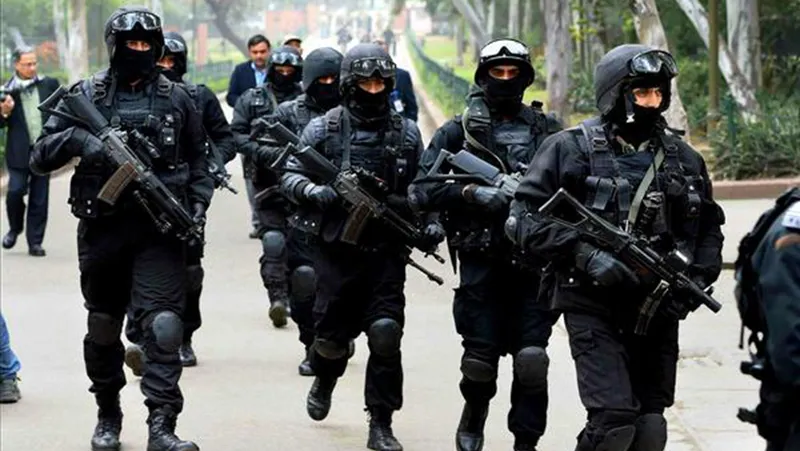
On 16 October 2026, the National Security Guard (NSG) marks its 42nd Raising Day under a motto that captures both its mission and its burden: Sarvatra Sarvottam Suraksha—security everywhere, of the highest order. For four decades, the Black Cats have represented a specialised national capability: the ability to respond with speed, precision and discipline when terrorism threatens lives, critical infrastructure and the authority of the Indian state. Yet this anniversary must be more than a tribute to courage. It should also be an occasion to ask whether India’s counter-terrorism architecture is adapting quickly enough to the threats ahead.
The NSG emerged from a period when India confronted grave internal-security challenges and the limitations of conventional responses to highly specialised terrorist threats. The decision to establish a dedicated federal counter-terrorism force followed the security upheaval of 1984. The organisation was formally established under law in 1986, drawing on specialised models such as Germany’s GSG 9 and Britain’s Special Air Service. Its structure brought together Army personnel in the Special Action Group and personnel from the Central Armed Police Forces and state police in the Special Ranger Groups. The underlying idea was straightforward: certain crises demand a force trained, equipped and prepared for tasks that ordinary policing cannot safely or effectively undertake.
The NSG’s operational history demonstrates why precision matters. Operation Black Thunder in 1988, conducted at the Golden Temple complex in Amritsar, remains a significant example of disciplined counter-terrorism. The operation involved carefully positioned snipers, sustained pressure and the eventual surrender of 146 extremists. Its importance lies not merely in the outcome, but in the lesson that operational success must be measured by the mission achieved and the lives protected, not simply by firepower deployed. In sensitive environments, restraint and tactical control can be as consequential as the ability to strike.
The November 2008 Mumbai attacks, however, exposed the cost of delayed coordination in a fast-moving terrorist crisis. The NSG’s Operation Black Tornado became part of India’s response to the siege of the Taj Mahal Palace Hotel, Oberoi-Trident and Nariman House. The attacks demonstrated that a relatively small terrorist team could exploit open urban spaces, strike several locations and hold a major city in a prolonged emergency. They also forced India to confront difficult questions about intelligence sharing, the movement of specialised forces, local police preparedness and the coordination of multiple agencies under pressure.
The creation of regional NSG hubs after 26/11 was an important institutional response intended to reduce deployment time. But a lesson from Mumbai must not become a permanent assumption that the next attack will resemble the last one. Terrorist methods evolve. A future crisis could involve coordinated attacks across several cities, drones used for surveillance or disruption, cyber interference, improvised explosive devices, or attempts to target crowded public spaces and critical infrastructure simultaneously. The boundaries between physical terrorism, digital disruption and information warfare are becoming harder to separate.
This is the wider strategic challenge confronting India. Across the world, terrorist organisations and violent networks have demonstrated an ability to exploit inexpensive technology, encrypted communications, online propaganda and transnational connections. The threat is not always a spectacular assault. It may begin with reconnaissance, the acquisition of materials, a compromised digital system or the movement of suspicious funds. By the time commandos enter a building, the decisive opportunities to prevent the attack may already have passed.
That is why the NSG must be understood as one critical component of a much larger national-security system, rather than as a substitute for its weaknesses. Its effectiveness depends on timely intelligence, capable local police, clear command arrangements, rapid medical support and secure communications. State police forces are often the first responders. Intelligence agencies must identify threats before they become emergencies. Central and state authorities must be able to share information without jurisdictional confusion. The NSG’s specialist capability can then be deployed where its training and equipment offer the greatest advantage.
Technology will shape the next phase of this mission. Better surveillance, real-time information fusion, robotics, counter-drone systems, advanced protective equipment and secure digital communications can improve situational awareness and reduce risks to personnel and civilians. But technology cannot compensate for poor intelligence, inadequate training or unclear responsibility. Equipment must be tested under realistic conditions, personnel must train for unfamiliar scenarios, and lessons from exercises and actual operations must feed into doctrine. An elite force cannot afford to be excellent only at the threats it already knows.
India must also take a broader view of resilience. Terrorism seeks to produce fear beyond the immediate scene of an attack. Public preparedness, emergency medical capacity, credible communication and continuity of essential services can limit that effect. The public should neither be frightened into complacency nor persuaded that specialist forces alone can guarantee security. A mature counter-terrorism system prevents where possible, responds decisively when necessary and recovers quickly afterwards.
On its 42nd Raising Day, the NSG deserves recognition for the discipline, sacrifice and professionalism of its personnel, including those who have lost their lives in service. But the highest tribute to the Black Cats is not ceremonial applause. It is an institutional commitment to give them sound intelligence, reliable equipment, rigorous training and an integrated response system worthy of their responsibilities.
‘Sarvatra-Sarvottam-Suraksha’ must remain more than a motto. It must be reflected in how India prepares, how its agencies cooperate and how quickly its security system learns. The NSG may be called upon when a crisis reaches its most dangerous point. The national objective, however, should be to ensure that fewer crises ever reach that point. At 42, the Black Cats’ legacy is not only their ability to confront terror at close quarters; it is the reminder that the strongest security response begins long before the first shot is fired.