

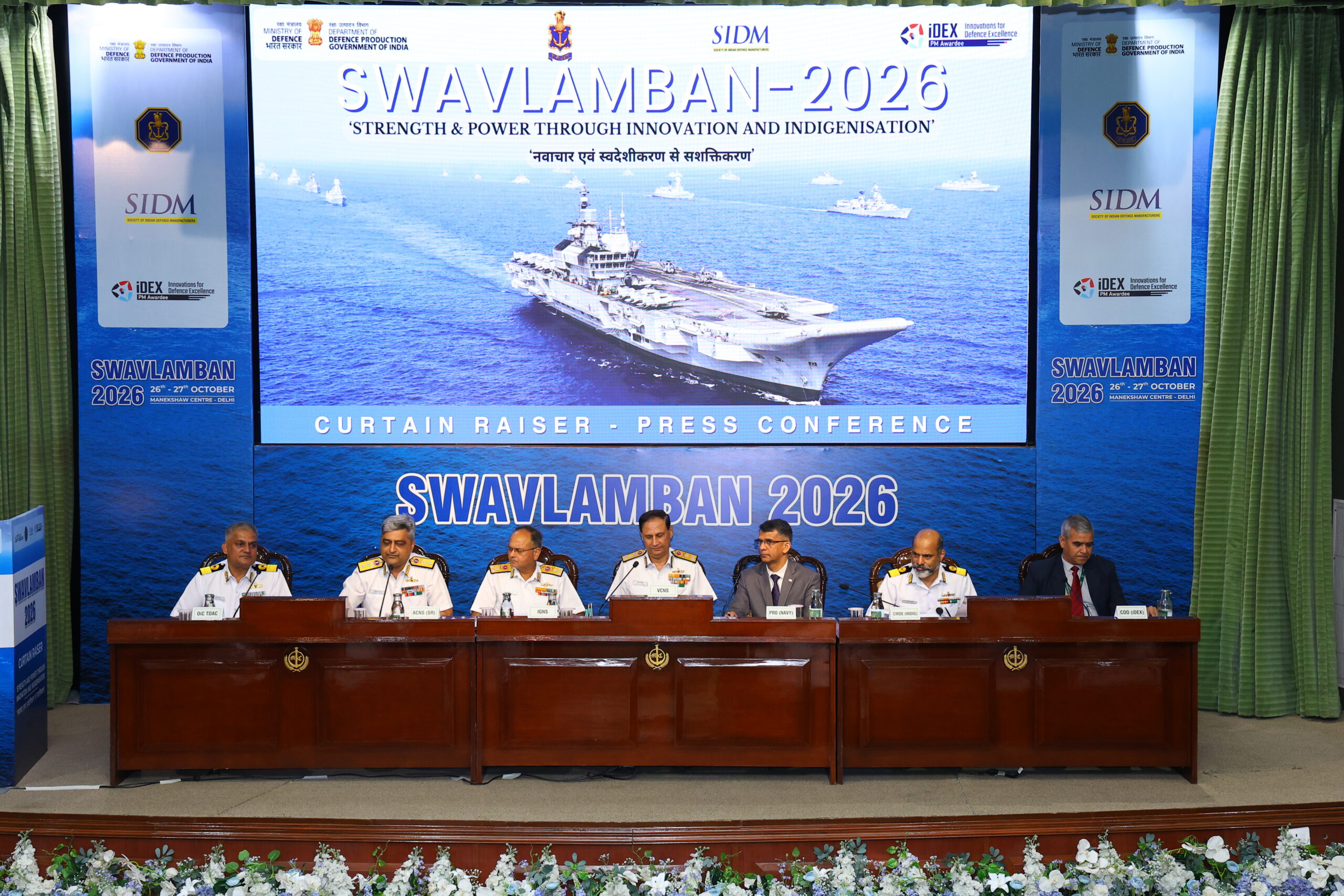
New Delhi, October 19: The Indian Navy’s flagship innovation and indigenisation initiative is entering a new phase, with the fifth edition of Swavlamban set to focus on a central challenge facing India’s defence establishment: how to move promising indigenous technologies from prototypes and trials into reliable systems that can be deployed at sea.
Scheduled for October 26–27 at the Manekshaw Centre in New Delhi, Swavlamban 2026 will bring together the Navy, other armed forces, defence industry, start-ups, MSMEs, academia and investors to examine technologies that could shape future maritime operations.
At a curtain-raiser press conference on Monday, Vice Admiral Ajay Kochhar, Vice Chief of the Naval Staff, said the objective remained to connect India’s technological talent directly with the Navy’s operational requirements and translate domestic innovation into practical capability.
The scale of the initiative has grown significantly since its first edition in 2022. Participation has increased from around 800 people at the inaugural seminar to nearly 3,000 at last year’s edition. More than 100 + stalls are expected at Swavlamban 2026, reflecting the expanding role of Indian industry and research institutions in defence technology development. The growth, however, will be judged not simply by attendance or the number of products on display, but by how many solutions progress towards induction, production and sustained operational use.
The figures outlined by Vice Admiral Kochhar provide a measure of that ambition. Under the Innovations for Defence Excellence (iDEX) framework, more than 4,000 proposals have been received from Indian innovators, with around 150 MSMEs and start-ups participating. Projects worth more than ₹3,500 crore have received Acceptance of Necessity, while contracts exceeding ₹1,900 crore have been concluded. These milestones indicate the scale of the opportunity available to domestic enterprises, while highlighting the need to convert early-stage ideas into dependable equipment.
“The strength of self-reliance rests on our collective ability to design, manufacture, sustain and continuously improve critical technologies within the country,” Vice Admiral Kochhar further added in his address. He called for disruptive solutions grounded in operational understanding, sound engineering and reliable delivery, underscoring that indigenous development must extend beyond the initial design to encompass production, maintenance and upgrades.
That distinction is particularly important for a Navy operating across large maritime distances and undertaking prolonged mission-based deployments. A system that performs well during a demonstration but cannot withstand harsh marine conditions, integrate with existing platforms or be supported through a dependable domestic supply chain offers limited operational value. For naval planners, self-reliance must therefore mean not only the ability to manufacture equipment at home, but also the ability to keep it available and effective throughout its service life.
Swavlamban 2026 will showcase indigenous work across maritime surveillance, counter-unmanned aerial systems, artificial intelligence, quantum technologies, nuclear, biological and chemical defence, and safety and efficiency enhancements. The seminar will also examine technologies with potential to change the way naval forces navigate, detect threats, protect platforms and operate in contested environments.
Among the more advanced challenges emphasized by Vice Admiral Kochhar are quantum positioning systems, high-power microwave directed-energy systems, extra-large autonomous underwater vehicles and indigenous ramjet engines for fixed-wing aerial platforms. These technologies span different stages of development and carry distinct technical risks, but together illustrate the breadth of the Navy’s ambition. Quantum-based navigation could help address vulnerabilities associated with dependence on satellite navigation; directed-energy systems may offer additional options against suitable threats; autonomous underwater vehicles could extend surveillance and underwater mission capabilities; and indigenous propulsion research could support future aerial platforms. Their eventual military value will depend on testing, integration, reliability and operational performance rather than promise alone.
The push comes as maritime warfare is being reshaped by unmanned systems, artificial intelligence, advanced sensors and networked capabilities. Navies increasingly require faster access to information, the ability to make decisions across connected platforms and greater resilience against electronic and cyber disruption. For India, which has extensive maritime interests across the Indian Ocean, the capacity to develop and sustain such technologies domestically is closely linked to operational readiness and strategic autonomy.
Vice Admiral Kochhar, identified four guiding principles for the Navy’s technology effort: scale, sophistication, speed and spiral development. Speed, he explained, means creating more efficient pathways for promising ideas to move from concept and prototype towards testing, production and operational deployment. Spiral development involves continuously improving systems through user feedback, trial results and advances in technology. The two are closely connected: faster induction is valuable only if it is accompanied by the ability to correct weaknesses and upgrade capability as operational requirements change.
The previous edition of Swavlamban offered examples of how this ecosystem can develop beyond a technology exhibition. At the 2025 seminar, the Navy, IIT Madras and Apollo Micro Systems signed an agreement aimed at combining academic research, operational expertise and industrial manufacturing for indigenous armament systems. The event also saw the launch of SARATHI, a digital tool developed by C-DAC Chennai to support naval armament inspection and quality-assurance processes, alongside an Innovathon intended to draw students and researchers into solving maritime operational problems. Such initiatives show how collaboration can connect research, engineering and user requirements.
Funding and industrial scale will be another important part of the discussion this year. Engagements with venture capitalists and investors are intended to examine how promising enterprises can secure the resources needed for development, production and commercialization. Panel discussions will address self-reliance, the iDEX ecosystem, academic entrepreneurship and resilient supply chains, while the Navy and other security agencies will have opportunities to assess technologies directly with their developers. Cybersecurity and supply-chain vulnerabilities will also feature in the deliberations.
Three key documents are scheduled for release: the Swavlamban 5.0 Document, the Compendium on Technology Imperatives, and the Naval Unified Systems, Ethernet and Tactical Utilisation (NAUSETU) Interface Standards. Together, they intend to provide direction for future technology development and greater consistency in the way systems connect and operate. Common interface standards are particularly relevant as naval platforms become increasingly networked and rely on equipment supplied by multiple developers.
Swavlamban’s wider significance lies in its effort to make defence innovation a whole-of-nation undertaking, with the Navy, government institutions, industry, start-ups and academia working towards shared operational goals. Yet the real test will remain demanding: prototypes must survive trials, systems must meet military standards, manufacturers must deliver on time, and domestic supply chains must remain dependable under pressure.
As Swavlamban 2026 approaches, the Indian Navy is signalling that innovation must be measured by what reaches the fleet and continues to work there. The next phase of Aatmanirbharta will depend not only on how many ideas India can generate, but on how quickly and consistently it can turn them into trusted maritime capability.