

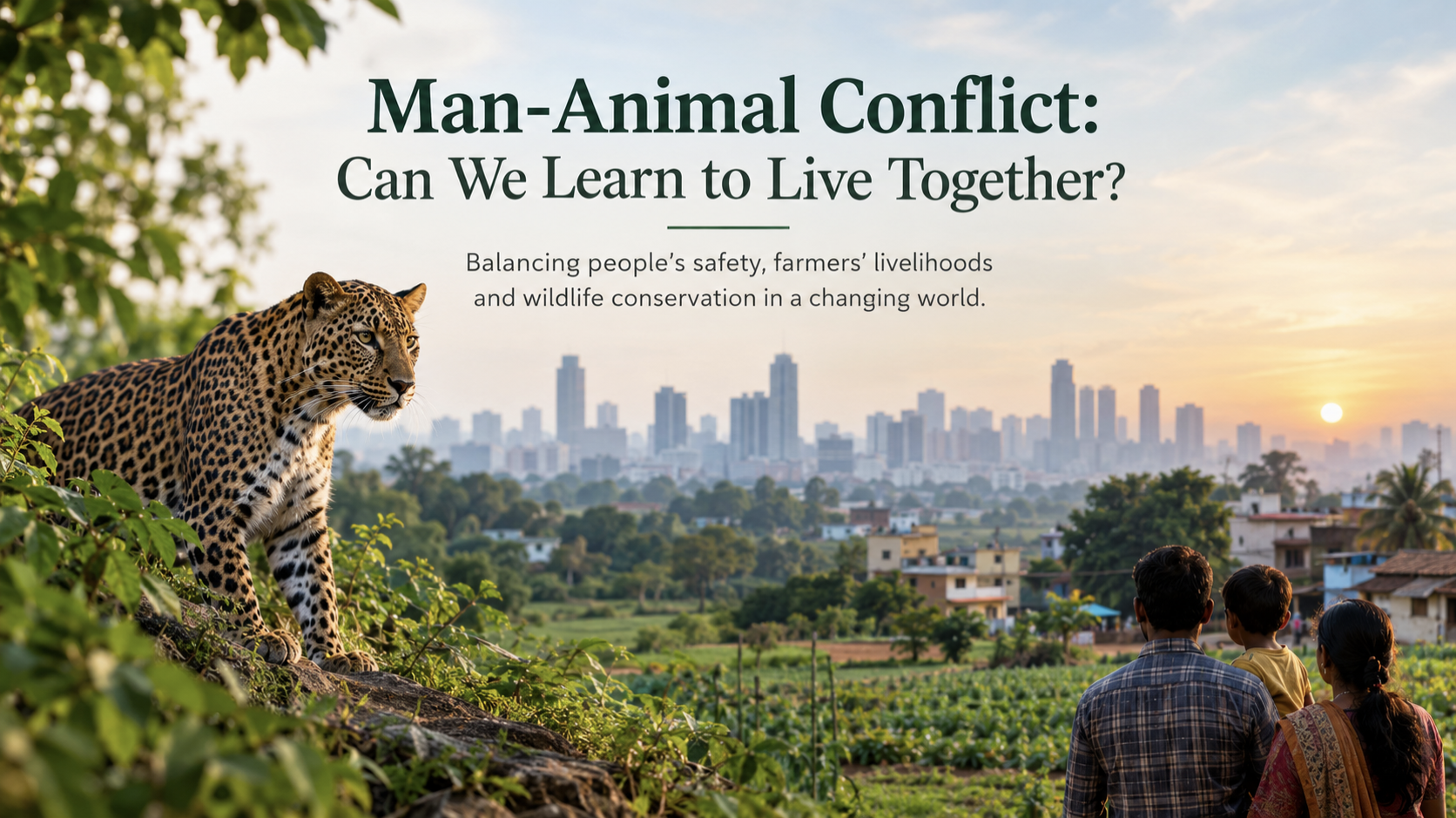
When a leopard attacks a child, nobody is thinking about wildlife conservation. Parents are thinking about their children. Neighbours want the animal caught, and some may even want it killed. In that moment, asking people to protect wildlife can sound unreasonable.
I understand that.
In September 2021, a four-year-old boy was attacked by a leopard in Mumbai’s Aarey Colony. Neighbors rushed to help after hearing his screams, and the boy survived. For his family, this was not a debate about forests, development, or environmental policy. It was a frightening experience that could have ended in tragedy.
But once the immediate danger passes, there is another question worth asking: how did a leopard end up so close to a child’s home, and what can we do to prevent the next attack?
We often talk about human-animal conflict as though wild animals are entering places where they do not belong. That explanation is convenient, but it leaves out an important part of the story. Human beings have changed the landscape too.
If we are going to talk about responsibility, we need to look at both sides.
A Farmer Cannot Live on Conservation Advice
Imagine being a farmer whose field is damaged by wild boars or elephants just before harvest. Months of hard work can be lost in a night. The farmer still has to pay for seeds, fertilizers, labor, and household expenses. The animal does not destroy all those.
What happens next matters.
A July 2025 report by the Centre for Sustainable Development at the Gokhale Institute of Politics and Economics examined the agricultural losses caused by wild animals in Maharashtra. The researchers also examined the indirect costs that farmers often face along with the crop damage. The report highlights why the financial impact of wildlife conflict can be much greater than the normal damage to fields. Read the research report.
This is an important part of the debate.
When people in cities discuss wildlife protection, they basically want society to preserve. For a farmer living near a forest, it can also represent a recurring threat to income as well as security.
Both the experiences are real.
I do not think it is fair to expect a farmer to tolerate losses simply because protecting wildlife benefits the country. Conservation has a public value, so its price should not fall disproportionately on those who are living closest to wild animals.
A fair system should make compensation timely and easily accessible. It should also invest in those areas that reduce crop losses before happens.
If we want people to support wildlife conservation, we cannot ignore what conservation costs them.
When Development Cuts Across an Animal’s Path
There is another problem that deserves attention: the way we build roads, expand cities and use land.
In December 2023, the Ministry of Environment, Forest and Climate Change reported that 150 elephant corridors had been ground-validated across 15 elephant-range states in India. These corridors allow elephants to move towards habitats. The government also asked state authorities to take all measurable steps to protect them. Read the government announcement.
Think about what a corridor means in practice. An elephant needs room to move between areas where it finds food, water, and shelter. A forest may be protected on a map, but that protection has limits if the animal cannot safely travel between habitats.
Railway lines, roads, farms, and electricity infrastructure can make these journeys dangerous.
The problem is not limited to elephants. Research published in Frontiers in Conservation Science in 2022 examined leopard populations in and around Mumbai’s Sanjay Gandhi National Park and Tungareshwar Wildlife Sanctuary. The researchers studied how leopards survive in landscapes where protected areas sit alongside densely populated urban and rural settlements. Read the research paper.
This research helps explain why wildlife encounters cannot be understood simply as animals wandering into human territory. Leopards can adapt to human-modified landscapes, and the availability of food and shelter can influence where they live.
Wildlife behavior is complicated, and individual incidents need proper investigation. But we cannot assume that removing one animal will solve this problem; the surrounding conditions continue to create.
We cannot keep changing the landscape and then treat every consequence as an unexpected act of nature.
Why Does the Debate Always Become People Versus Animals?
A child should be safe from leopard attacks. Farmers should not lose their income to crop damage. Elephants should not die because of electric fences or railway accidents.
In 2024, government data showed that 528 elephants died from unnatural causes over five years. Of these, 392 died from electrocution and 73 in train accidents.
India needs roads, homes, and electricity, but development should also protect wildlife. At the same time, people living near forests need proper support and fair compensation.
Protecting people and wildlife should go hand in hand.
What Needs to Change?
I would begin with three priorities.
First, make the response fair to the people affected.
When wildlife damages crops or injures someone, reporting the incident and seeking compensation should not become a long, uncertain struggle. People are unlikely to trust conservation policies that offer them little protection when things go wrong.
Second, consider wildlife before expanding infrastructure.
Elephant corridors and other important habitats should be considered when roads, railways, and settlements are planned. It is better to prevent dangerous crossings and habitat fragmentation than to manage repeated accidents afterwards.
Third, treat every encounter according to its actual risk.
A leopard passing through an area, an elephant damaging a crop, and an animal repeatedly attacking people require different responses. Authorities should investigate the circumstances, assess the danger, and choose measures appropriate to each situation. Where human life is at immediate risk, decisive action may be necessary.
These measures are not dramatic. They require funding, coordination, monitoring, and patience. But they address the conditions that make conflict more likely instead of waiting for another incident to force the issue into public attention.
Coexistence Must Be Fair to People and Wildlife
I do not think every human-wildlife conflict has an easy solution. Some animals may still be dangerous, and people may suffer losses even after safety measures are taken.
Sometimes, a dangerous animal may need to be captured or moved to protect human lives. We must accept this reality instead of ignoring it.
But we can take steps to reduce these conflicts and handle them better when they happen.
Conservation is not just about asking people to protect wildlife. It is also about making sure they can live safely near wild animals.
Families living near forests need safety information and quick help during emergencies. Farmers need fair compensation when animals damage their crops. Wildlife needs safe habitats and enough space to move freely.
We should take all these needs seriously.
We often say that humans and animals must learn to live together. But perhaps we should also ask what we, as humans, can change to make this possible.
Wild animals cannot build safer roads, manage waste, or create fair compensation systems. Humans can. This gives us a responsibility to act, while also protecting the people who face the greatest risks.
Living alongside wildlife should not mean asking people to suffer silently or expecting animals to disappear whenever they become inconvenient. It should mean building a system that takes both seriously.
That is the kind of coexistence worth working towards.
Sources
- Gokhale Institute of Politics and Economics, Centre for Sustainable Development. Human-Wildlife Conflicts: An Estimation of Net Agricultural Losses in Maharashtra (July 2025). Read the research report.
- Ministry of Environment, Forest and Climate Change, Government of India. 33 Elephant Reserves Established in 14 Major Elephant States (December 14, 2023). Read the government announcement.
- Surve, N. S., et al. Leopards in the City: The Tale of Sanjay Gandhi National Park and Tungareshwar Wildlife Sanctuary, Two Protected Areas in and Adjacent to Mumbai, India. Frontiers in Conservation Science (March 10, 2022). Read the peer-reviewed research.
- Wildlife Conservation Society. New Video Shows Reduction in Leopard/Human Conflict in Mumbai’s Sanjay Gandhi National Park (June 7, 2016). Read the research summary.
- University of Queensland. Leopards Provide Public Health Benefits in Mumbai, India (March 8, 2018). Read the research summary.