

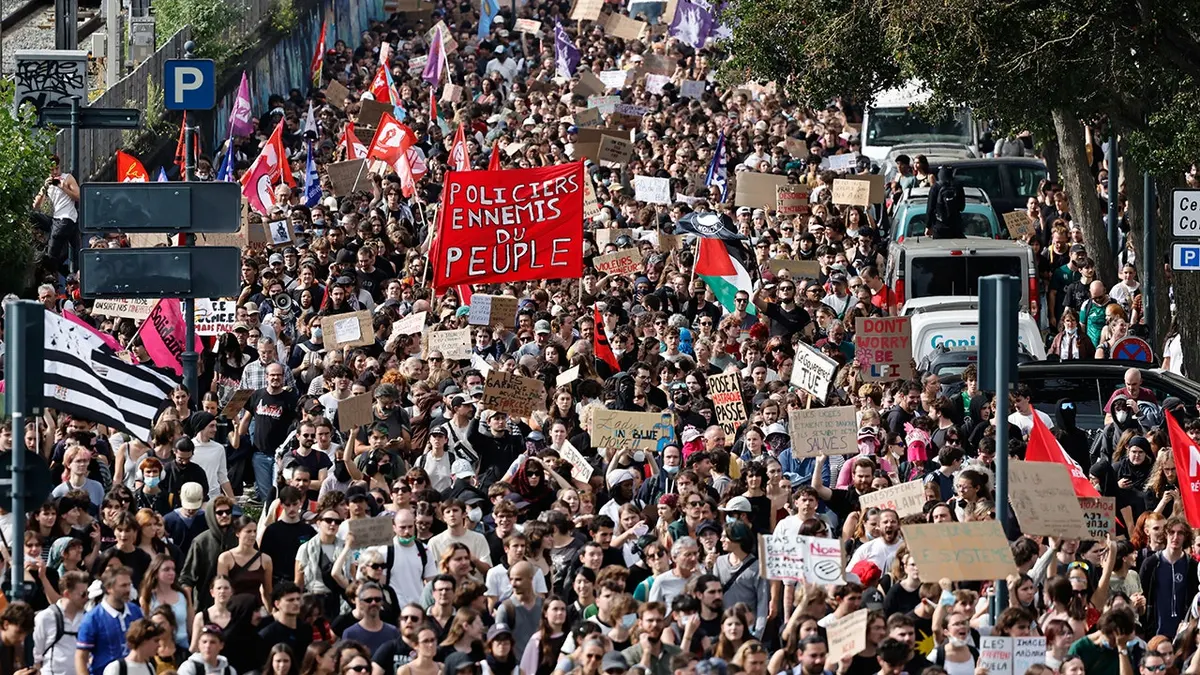
Students around the world are increasingly willing to take the streets in order to oppose governments and institutions. Be it the universities of India and France or the universities of the U.S., Brazil and Germany, protests raise concerns about education, job opportunities, political decisions, civil rights and the rule of law.
But what makes student protests noteworthy is the question whether they are the spontaneous reaction of the public or have been incited by organisations that aim to promote their own interests. Student protests can be both, depending on the situation. There are cases where events occurred following a particular incident but had been planned by student unions, activist groups or political parties. There are also instances where a group of students voiced a public concern that resonated with many, and organisations have used the popularity of the movement to promote their goals.
India is of particular interest in this context because its huge pool of students, fierce competition for jobs and the complicated political landscape create the perfect conditions for student protests to erupt against perceived injustices.
1. The Global Picture: Different Countries, Similar Frustrations
It may seem that student protests have similar causes worldwide, but there is often much to distinguish them. Student protests in the U.S. have raised awareness of international conflicts, immigration, freedom of speech and university misbehavior. With regards to the latter, the recent demonstrations in Cornell University, which involves seven students accused of sexual assault in a civil suit, show a concern for institutional injustice.
However, these allegations should be viewed with caution as they are currently being investigated in court. The protests in favor of Palestine and against their university’s stance in the Israel-Hamas conflict are also concerned with freedom of speech and action on campuses.
Student protests in Brazil are closely related to the country’s political situation, as the demonstrators fear a far-right return to power. Demonstrations took place nationwide to voice concerns with democratic rules of law, citizen rights and freedoms and the legacy of far-right President Jair Messias Bolsonaro.
Finally, in France, CNN’s October 6, 2026 report describes how a student complaint about staff shortages at a Parisian school developed into nationwide protests. Students expressed their concerns with class sizes, the state of the school buildings and the education system. However, the involvement of teachers, parents and trade unions in the wave of demonstrations transformed it into a popular movement.
The issue with military service in Germany, which is the reason behind recent student protests, is also of a particular nature. Due to a new voluntary military-service program, many fear that compulsory service will return in the near future. In this light, the concerns raised by the German students are indeed worth consideration.
2. India: From Examination Fairness to Democratic Accountability
India is a particularly interesting case in terms of understanding the relationship between students and authorities. More often than not, Indian student protests begin with a complaint about the examination system. Due to the fierce competition, exams are the way to differentiation, and many families’ destinies are dependent on whether a student passes an exam and which educational institution they get admitted to.
Therefore, concerns about the fairness of the grading system and any disruptions to the examination process can resonate strongly with millions of students and their families. Furthermore, examination irregularities can lead to nationwide protests and force political figures to resign. In fact, the youth-led Cockroach Janata Party (CJP) movement’s allegations against the government’s interference in the grading process eventually led to the resignation of the Union Education Minister Dharmendra Pradhan.
The CJP’s protests initially targeted the New National Eligibility cum Entrance Test and other competitive examinations, complaining of irregularities in the grading system. However, the movement eventually evolved toward making political claims, such as the need for electoral reforms. Therefore, it is reasonable to question whether the CJP protests had been taken over by political figures who seek to benefit from the popularity of the movement.
It is also worth remembering that the problems with the competitive examination system are not limited to the unfair grading process – they also include the corruption allegations regarding staff recruitment and students’ admission to government jobs. Hence, while the CJP protests may have indeed been incited by opportunistic politicians, the movement has the potential to develop further and voice more criticism.
3. India’s Campus Protests: Student Welfare and Institutional Accountability
Not all student protests in India are related to the examination system or the government. For example, the August 2026 IIT Delhi student protests were prompted by the death of an MSc Physics student, Rishikesh Kumar. The students demanded a more independent investigation into the circumstances of the death, which the institute’s management refused. Later, the institute informed the students that the external inquiry committee will be reconstituted, with retired Delhi High Court judge Justice Mukta Gupta as the chairperson.
Other student protests can be prompted by less serious issues. For instance, an incident that occurred at IIT Bombay in September resulted in the institute promising to provide better counselling services for students. After the September death of the BTech student Sahil Wakode, multiple protests occurred to demand institutional changes.
When students lose a classmate or experience discrimination on campus, it is natural for them to seek institutional changes. It is also important to distinguish between demands for greater transparency in institutional decision-making and accusations of intentional victimization. While the death of a student cannot be confirmed as a fact unless an inquiry has found it to be so, students still have a right to demand institutional accountability. Similarly, the IIT Delhi student protests and the IIT Bombay incident illustrate the concerns of students for their peers.
Furthermore, the student protests at the Satyajit Ray Film and Television Institute (SRFTI) in Kolkata are a notable example of students demanding greater campus security. After the September 27 altercation with the Akhil Bharatiya Grahak Panchayat, students began boycotting classes and demanding security measures. Given that both sides accused the other of assault, an independent inquiry into the incident is necessary. The boycott continued in October as students demanded greater security.
4. Delhi: Youth Movements and Electoral Accountability
The CJP protests in October 2026, which began as the youth movement demanding electoral reforms, eventually turned to the Chief Election Commissioner Gyanesh Kumar. The accusations range from voter-list irregularities to the deliberate suppression of votes. The Election Commission and the ruling Bharatiya Janata Party rejected these allegations, claiming that the voter-list revisions had a purely administrative nature.
The October 5 incident in Delhi and the ensuing protests resulted in numerous detentions of the CJP members. On October 10, the authorities imposed extensive security measures to prevent a rally. Nevertheless, the CJP leaders were released later that day, vowing to continue their campaign. Once again, the CJP members were arrested on October 13 during the Jantar Mantar demonstration.
The events in Delhi and Kolkata illustrate the evolution of a youth movement into a nationwide campaign. As the CJP protesters moved from allegations of governmental interference in the examination system to accusations of vote suppression, their concerns became intertwined with democratic principles. It is also essential to distinguish between allegations and realities, as both sides may have exaggerated the seriousness of the other’s violations.
The involvement of political figures in student protests is always a matter of controversy. Although the CJP protests are undeniably popular among students, they have been accused of having a separatist nature. On the other hand, the democratic principles voiced by the CJP protesters contradict the accusations of separatism and nepotism. Therefore, the increased presence of political figures in student protests does not necessarily indicate their responsibility for the movement’s emergence.
5. Spontaneous or Incited? Five Questions That Matter
When determining whether a student movement has been spontaneous or incited, it is important to keep few aspects in mind.
- First, it is essential to identify what caused the initial wave of protests. If the students had a legitimate grievance, such as examination irregularities, or even a concern limited to their institution, such as insufficient campus security, then it is safe to assume that the movement began spontaneously.
- Second, it is important to determine how the movement grew so large and what caused it to gain national attention. The role of social media in fueling the protests cannot be underestimated. Therefore, the virality of the movement’s claims and whether they had been substantiated are also worth consideration.
- Third, the organizations that contributed to the growth of the movement and benefited from it should be identified. Student unions, civil society organisations and political parties have the resources to help a movement grow. Their involvement is not suspicious per se, but it can be used to confirm whether the movement was indeed incited.
- Fourth, it is worth distinguishing between the parties that benefit from the movement and those that are merely accused of initiating it. If there are no grounds for believing that a particular political figure or organisation had been responsible for the emergence of a student movement, then their involvement should not be overestimated.
- Finally, the responses of the authorities are always telling. If the government investigates the movement’s allegations, this serves as a confirmation of their validity. At the same time, the reaction of the protesters is also important, for a movement that employs violent methods or disseminates unsubstantiated allegations can be as misleading as an authoritarian government suppressing free speech.
By weighing the evidence presented by both sides, it becomes possible to determine whether a student movement is spontaneous or incited.
Conclusion: Genuine Anger Can Coexist with Political Influence
Student protests in India, the U.S., Brazil, France, Germany, show that young people are increasingly willing to hold institutions accountable for their actions. The reasons for these movements range from concerns about the examination systems and campus safety to the democratic principles of the country.
The student protests in India have been particularly prominent in the recent months and have targeted several aspects of the country’s governance. While some of these movements, such as the CJP protests, are concerned with the electoral system, others, such as the IIT Delhi protests, are the result of the death of a classmate.
The role of India’s political parties in the student protests is hard to ignore, given their active involvement. Nevertheless, their involvement should be viewed within the context of the general atmosphere of dissatisfaction with the authorities. The same can be said about the role of social media in fueling the protests.
The events of recent months show that the dissatisfaction of India’s youth with the grading system, student union leadership, institutional discrimination and even national security are not confined to their institutions – they resonate on a nationwide scale. It is not entirely clear whose interests are being protected by the accusations of nepotism and vote suppression, but the popularity of the movement indicates that it has struck a chord with the general public.