

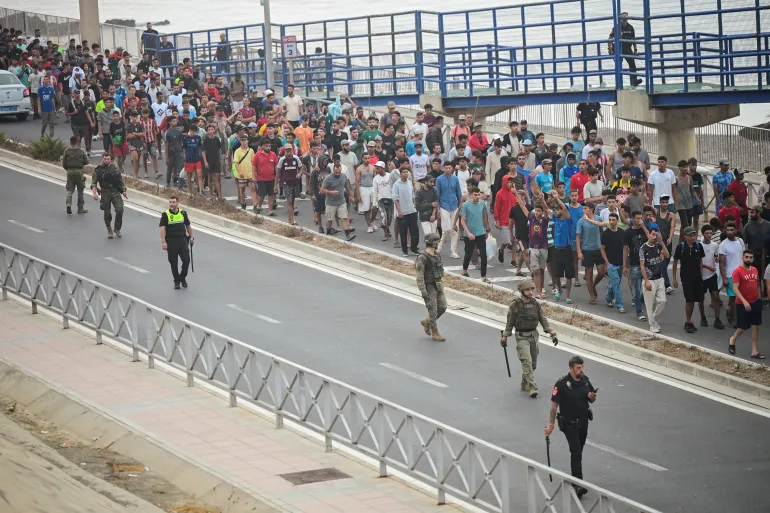
The recent surge of migrants making an attempt to enter Ceuta from Morocco has once again brought Europe’s migration predicament thrust into the spotlight. In the last few days, tens of thousands of migrants have deliberatedly attempted to cross into Ceuta, a Spanish territory located on the northern coast of Africa. The sudden influx has overstretched local authorities, thereby compelling Spain to deploy additional police and military personnel to stabilise the order. While reports differ on the exact number of casualties, there is broad agreement that the mass crossings have resulted in significant loss of life, thereby transforming what began as a border incident into a critical issue of international concern.
In order to gain an understanding of the causes why this crisis has attracted global attention, it is very important to first interpret Ceuta’s unique geography. Although Ceuta is geographically situated in North Africa and is surrounded by Morocco, it is a Spanish territory and therefore it forms a part of the European Union. Consequently, anyone who successfully reaches Ceuta has legally entered the European Union territory, even though they remain geographically within the African continent. This exceptional position makes Ceuta one of the EU’s most crucially sensitive external borders.
For many migrants, Ceuta demonstrates more than a city; it is primarily viewed as a gateway to the continent of Europe. People arriving there are often driven by a blend of poverty, unemployment, political instability, conflict, and the hope of obtaining a safer and more affluent future. Many travel through Morocco because it subsequently shares a land border with Ceuta. However, just reaching Ceuta does not automatically grant them free movement into the mainland of Spain or the rest of the European Union. Despite this, for many facing precarious living conditions, reaching Ceuta evidently symbolizes the possibility of having a better life.
The recent crisis significantly worsened as large numbers of migrants have attempted to cross simultaneously. Several reports indicate that rumours propagated on social media, paired with the activities of human-smuggling networks, persuaded thousands of people to seek the crossing at once. Many tried to swim around the border barriers, climb high security fences, or cross in large groups. The sheer scale of the movement taxed the existing border controls, creating dangerous conditions that resulted in multiple fatalities.
These deaths were not simply the consequence of crossing an international border. Many migrants have perished in strong currents, became trapped in overcrowded areas, or have suffered fatal injuries amid the ongoing chaos. The humanitarian tragedy clearly demonstrates the immense risks associated with irregular migration, particularly when thousands attempt dangerous crossings at the same time.
Spain’s decision to deploy military personnel and consolidate the border security has underscored the unprecedented nature of the current situation. Like every other sovereign state, Spain possesses the right and responsibility to regulate entry into its territory and maintain public order. When thousands attempt to enter without authorization, governments are generally expected to secure their borders, verify their real identities, and process individuals according to their respective national and international law.
Yet the Ceuta crisis extends far beyond the questions of border enforcement. It critically highlights one of the most difficult policy dilemmas confronting Europe today: how to control irregular migration while preserving the fundamental human rights.
On one hand, states have the sovereign right to protect their territorial integrity, regulate the immigration, and completely dismantle criminal smuggling networks that aim to exploit the vulnerable people. Effective border management is indispensable for maintaining public security and safeguarding that migration remains governed by legal procedures.
At the same time, it is equally important to note that migrants do remain human beings regardless of their immigration status. Many are seeking refuge from conflict, persecution, political instability, or extreme poverty. International law guarantees the right of individuals to seek asylum when they face persecution, while humanitarian ethos require that people in life-threatening situations should immediately receive rescue measures, medical assistance, and fair legal procedures. This eventually creates a complex balancing act between maintaining border security and shielding human dignity.
This tension clearly explains why the Ceuta crisis has generated such widespread international debate. Some policymakers strongly argue that stricter border enforcement is necessary to discourage dangerous crossings and disrupt the rapid smuggling networks. Others often contend that enforcement must always be accompanied by safe and lawful procedures for people seeking protection, ensuring that humanitarian obligations are not jeopardized. Neither perspective wholly resolves the problem, thereby illustrating why migration remains one of the most intricate issues in contemporary international politics.
The crisis also underlines the importance of cooperation between Spain and Morocco. No single country can effectively address irregular migration independently. Spain must continue securing its borders and processing asylum claims in accordance with the domestic and international law, while Morocco plays a pivotal role in preventing dangerous crossings, strengthening border management, and taking action against human-smuggling networks operating within its territory. Beyond border enforcement, both countries must strengthen intelligence-sharing, coordinate patrols, exchange information during sudden migration surges, and cooperate on long-term development initiatives that address some of the economic pressures encouraging migration. Without persistent bilateral cooperation, dangerous crossings are anticipated to continue further.
The contemporary events in Ceuta also reveal broader lessons for Europe as well. Physical barriers alone cannot eliminate migration if poverty, conflict, and instability continue to push people from their home countries. Migration is not solely a border-security issue; it is also intertwined with various economic development goals and initiatives too, political stability, humanitarian responsibility, and international cooperation. Furthermore, because Spain forms part of the European Union, migration pressures experienced by one member state necessarily affects the wider bloc, thus reinforcing the need for a coordinated European response.
Preventing further loss of life must remain one of the central objectives. Governments and international organisations continue to explore measures such as expanding search-and-rescue operations, neutralising human-smuggling networks, creating clearer legal migration pathways where appropriate, and addressing the root causes of migration in countries of origin. While none of these measures alone offers a complete solution, together they represent efforts to reduce both irregular migration and the human suffering associated with it.
In conclusion, the Ceuta crisis is not merely a local border dispute or an isolated migration tragedy. It certainly represents a collision between three fundamental realities: a state’s legitimate responsibility to protect its borders, people’s desperate search for safety and opportunity, and the international obligation to preserve human life. As Europe continues to confront the growing migration pressures, the challenge will not simply be deciding whether borders should remain open or closed, but assessing how security, sovereignty, and humanitarian responsibility can be equally balanced in a manner that is both compassionate and pragmatic.
Article by Sruti Bhaumik