

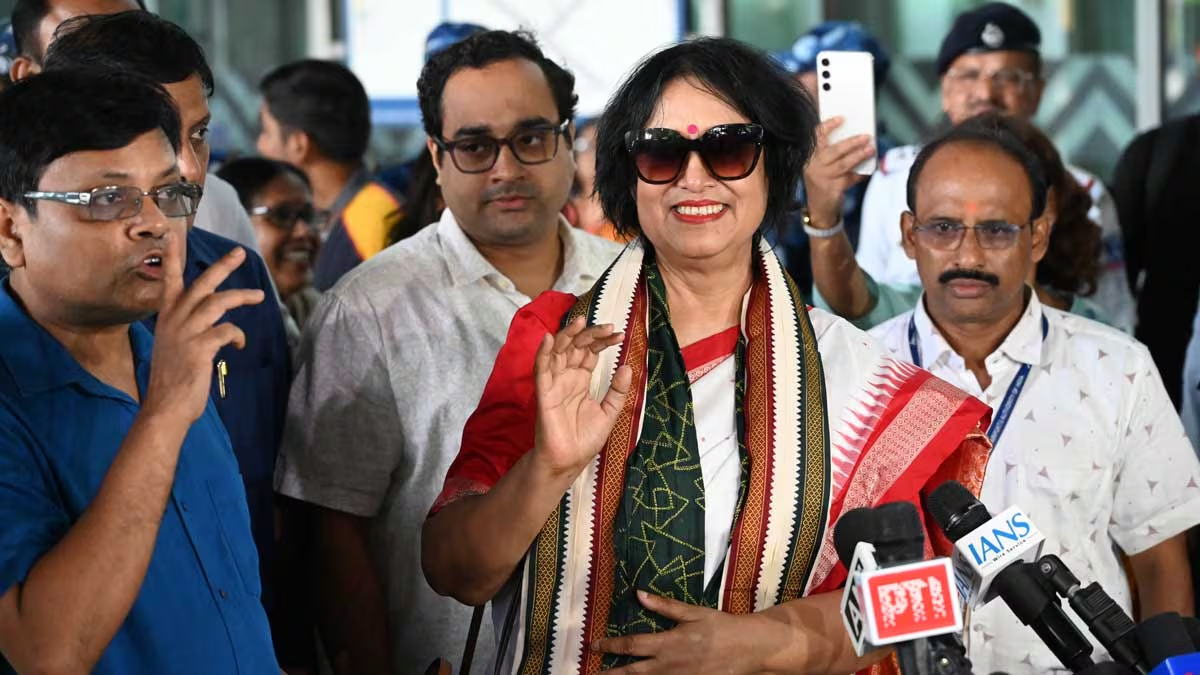
Nearly two decades after leaving Kolkata, Taslima Nasrin’s return has reignited a conversation that broadens far beyond the homecoming of a celebrated writer. It has once again brought into emphasis perennial questions surrounding the freedom of expression, religious fundamentalism, exile, feminism, and the place of oppositional voices in South Asia. Her visit is not merely a personal milestone; but it also reminds us how literature, politics, and identity often intertwine in several ways that continue to shape public discourse even many decades later.
Born in Mymensingh, Bangladesh, Taslima Nasrin was a trained physician before becoming a full-time writer. During her years as a doctor, particularly while treating women who were constantly facing domestic violence, sexual abuse, and deep-rooted gender discrimination, she became increasingly convinced that many of these injustices were sustained by culture preached by the staunch patriarchal social structures. Hence, writing gradually became her medium of resilience thereby empowering her to give voice to the experiences that often remained neglected.
Although she began her literary career with poetry, she soon journeyed into essays, novels, memoirs, and newspaper columns. While Lajja brought her international recognition, it was only one chapter in a much larger literary journey that eventually established her as one of South Asia’s most prominent exiled public intellectuals.
Published in 1993, Lajja was written in the aftermath of the demolition of the Babri Masjid. The novel follows the fictional Dutta family, a Hindu family in Bangladesh whose lives are shattered by communal violence. The work was never intended to scale down the conflict to Hindus versus Muslims. Rather, its main premise is that communal hatred terribly shatters humanity irrespective of religion. By evoking the vulnerability of minorities caught in political and religious conflicts, Taslima Nasrin challenged religious extremism rather than ordinary religious belief.
The controversy that occurred subsequently was not limited to a single novel. Her more comprehensive criticism of religious fundamentalism and patriarchal assessments of religion garnered severe opposition. Some Islamist groups immediately imposed fatwas against her, she also received death threats, and Lajja was banned in Bangladesh. In 1994 she sought refuge outside the country and has lived in exile ever since.
Exile, on the other hand, is not merely geographical. It is rather intellectual, political, and literary. It illustrates the condition of being unable to return safely to one’s homeland while continuing to carry its memories, language, and cultural identity. Taslima Nasrin’s experience clearly deciphers that exile is not primarily the loss of a place but also a continuous reconciliation with belonging and identity.
The Journey Through Her Books
Her literary works echo different stages of both her personal and political journey. While Lajja marked the watershed moment that brought her international attention, the work; French Lover further expanded her feminist concerns beyond the periphery of South Asia by exemplifying that migration alone does not merely guarantee freedom for women. Amar Meyebela (My Girlhood) reflected upon her childhood and early experiences of gender discrimination, while Ulta Hawa (Wild Wind) minutely catalogues her growing literary identity and the controversies surrounding her work. Dwikhandita (Split) became fundamental to the protests that later started unfolding in various regions of Kolkata because of its unflinching reflections on public life. Finally, Nirbasan (Exile) metamorphosed the displacement itself into literature, exploring the vivid memories, belongingness, and the emotional consequences of living away from one’s homeland. Together these works unveil how her literary concerns gradually shifted from majorly documenting women’s struggles to further examining exile, identity, and the meaning of a true home.
The Evolution of Taslima Nasrin’s Literary Career
In order to comprehend Taslima Nasrin solely through Lajja would be to overlook the profound evolution of her literary career. She simply began as a poet, writing about loneliness, women’s experiences, freedom, and emotional isolation. She later turned her poetry into critical essays that openly criticised patriarchy, religious orthodoxy, gender discrimination, and social hypocrisy. And fiction allowed her to interweave politics, identity, religion, and women’s lived realities, while her memoirs became increasingly candid reflections on autobiographical experience and public life. This trajectory poignantly demonstrates how her writing continuously evolved parallel to the political and social realities she bore witness to.
Her relationship with Kolkata also reflects this complexity. Bangladesh and West Bengal share a common Bengali linguistic and literary heritage, and Kolkata has long been widely acknowledged as one of the cultural capitals of Bengali literature. When India granted her a residence permit in 2004, she relocated to Kolkata and repeatedly described the city as a place where she felt culturally and linguistically at home. For her, Kolkata became more than a place of residence; it became an embodiment of a chosen cultural home.
The Bengali idea of পিছুটান (pichhutan), an enduring emotional pull towards one’s homeland, captures this experience with remarkable precision. Diasporic writers often continue to carry their homeland within them even while living elsewhere. Their memories, language, and literary imagination often remain connected to places they can no longer be anchored in the same way. The challenge is therefore not simply whether a writer can live outside the country of birth, but whether home is distinguished only by geography or also by language, culture, and memory.
Taslima Nasrin’s life gives a subtle reminder to us that literature is perhaps humanity’s oldest as well as its most enduring form of resistance. Writers have time and again transformed lived realities into narratives that question authority, expose injustice, and challenge accepted social norms. Rather than purely responding to violence with violence, literature does teach us to resist through memory, testimony, and artistic vision.
In 2007, protests erupted in Kolkata against some of Taslima Nasrin’s writings, particularly her memoirs and public statements. The West Bengal government argued that it could not ensure public order and relocated her from the city. Critics viewed this as a setback for freedom of expression, insisting that a democratic state should protect writers rather than remove them in response to threats. Supporters of the government’s decision maintained that preventing communal violence required prompt administrative action.
Paradoxically, exile also transformed Taslima Nasrin’s literary identity. While she was initially recognised primarily as a Bangladeshi writer, years spent in exile expanded her readership across Europe, North America, and South Asia. She continued to publish novels, memoirs, essays, and poetry while participating in literary festivals, human-rights conferences, and international forums. Exile curtailed her ability to return home, yet it also simultaneously elevated her into an internationally recognised advocate of secularism, women’s rights, and freedom of expression.
Her return to Kolkata therefore represents far more than an emotional reunion with a familiar city. Writers often transform lived realities into narratives that generally compel societies to navigate certain uncomfortable truths. Whether one agrees with Taslima Nasrin‘s views or not, her life still continues to raise an enduring question: How should democratic societies respond when literature challenges prevailing orthodoxies? Perhaps that is why her return resonates so deeply today.
Bangladesh remained her birthplace, but Kolkata gradually became her chosen cultural home. Her return subsequently signifies not merely a geographical journey but the enduring search for belonging that accompanies every diasporic writer.
~ Sruti Bhaumik