

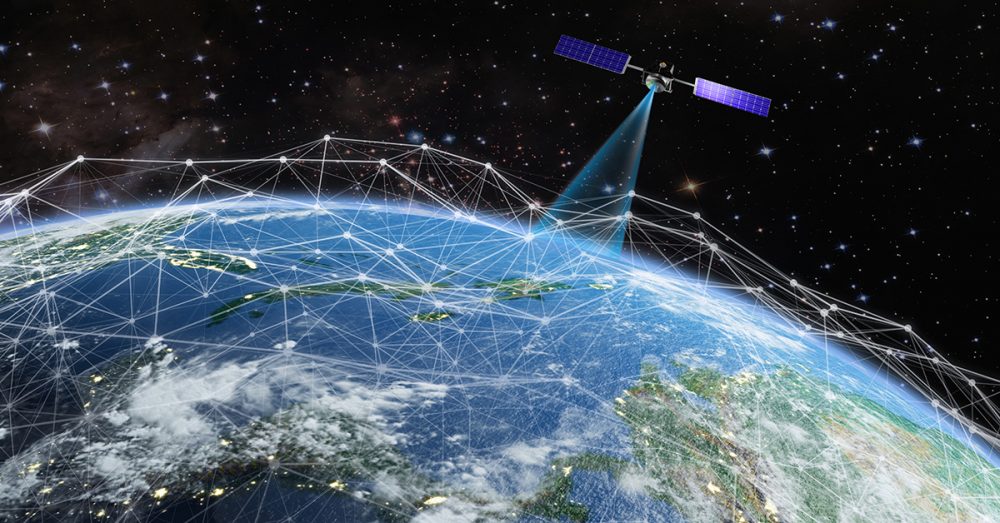
For decades, humanity has frequently envisioned outer space as a symbol of scientific discovery, technological ambition, and collective human progress. Space exploration has been an embodiment of curiosity beyond borders, a frontier associated with astronauts, Moon missions, and the possibility of understanding realities beyond Earth itself. However, in the contemporary era outer space is gradually developing into something far more strategic and politically impactful. What was once viewed predominantly as a scientific frontier is rapidly becoming a geopolitical domain known as the Geopolitics of Space Militarisation, shaped by military rivalry, surveillance systems, artificial intelligence, satellite infrastructures, corporate competition, and strategic dominance.
The militarisation of space refers to the increasing use of outer space for military and strategic operations. Contrary to popular imagination, this does not immediately imply cinematic “space wars” fought through futuristic weapons in the existing orbit. Rather, the Space Militarisation manifests through military satellites, missile tracking systems, cyber warfare infrastructures, anti-satellite weapons, AI-supported communication technologies, surveillance networks, and strategic orbital systems. ‘Space’ is therefore no longer confined merely to scientific exploration or astronomical curiosity; it is increasingly emerging as one of the most important geopolitical spheres of the twenty-first century.
Earlier, space pursuit was largely aligned within the periphery of scientific curiosity, Moon missions, astronauts, and Cold War prestige. Humanity often viewed outer space as a symbol of discovery, scientific ambition, and collective progress. In many ways, this resembles the intellectual ambition reflected in Christopher Marlowe’s Doctor Faustus, where the endless pursuit of knowledge ultimately leads toward dangerous consequences beyond ethical control. Faustus’s desire for limitless power and mastery, reflected in the line, “O, what a world of profit and delight, of power, of honour, of omnipotence,” symbolically mirrors humanity’s modern obsession with technological and geopolitical dominance beyond Earth itself.
The modern geopolitics of space can predominantly be tracked back to the Cold War period.
The United States and the Soviet Union competed intensely to establish whose ideology, science, military capability, and technological vision would maintain supremacy over the world. The launch of Sputnik by the USSR in 1957 fundamentally evolved international politics. The world suddenly reflected the thought that if a country possessed the capability to launch satellites into orbit, it could also develop long-range missile systems capable of carrying nuclear weapons. From the very beginning, therefore, space science and military strategy remained deeply intertwined.
The ColdWar was not merely about war; it was fundamentally about proving superiority.
Space became a manifestation of “symbolic power”.
Why Has Space Become Geopolitically Important?
One of the most crucial reasons why space has become geopolitically important is the increasing dependence of modern civilization upon the usage of satellites. Earlier wars largely involved direct battlefield confrontations. However, modern warfare techniques increasingly rely upon
satellite systems that monitor territories, collect intelligence, coordinate military operations, support drone technologies, and enable surveillance infrastructures. Satellites today support GPS navigation, internet connectivity, weather forecasting, missile tracking, banking systems, military communication, cyber infrastructures, and strategic defense networks. Consequently, whoever controls critical space infrastructure may indirectly influence global power structures on Earth itself.
This dependence has completely transformed satellites into the most important component of modern warfare. If satellite systems are disrupted or destroyed, communication systems, military
coordination, navigation networks, and economic infrastructures could suffer severe consequences. As a result, countries are heavily investing in military space programs and anti-satellite technologies.
Anti-satellite weapons, commonly known as ASATtechnologies, are designed to disable or dismantle satellites. Countries such as the United States, Russia, China, and India have all tested such systems. While these technologies may offer military advantages, they also initiate
enormous risks. Destroyed satellites generate orbital debris, often referred to as “spacejunk,” which can damage other satellites, spacecraft, and future missions. Scientists fear a phenomenon known as the Kessler Syndrome, where collisions between debris fragments could create sequential chain reactions, ultimately over time making parts of Earth’s orbit unusable for future space operations. Unlike terrestrial waste, orbital debris cannot be easily removed or managed, making long-term accumulation extremely dangerous.
The United States and China currently represent the most significant space rivalry of the contemporary era. The United States continues to dominate many aspects of global space infrastructure through NASA, SpaceX, advanced satellite systems, and military technologies. China, however, is rapidly expanding its capabilities through lunar missions, military satellites, AI-integrated systems, anti-satellite technologies, and independent space stations. China increasingly views space as a source of technological prestige, economic influence, military advantage, and strategic dominance. This has generated significant geopolitical anxiety within Western powers that fear losing strategic control over emerging orbital infrastructures.
The creation of the United States Space Force in 2019 further proved that space is no longer treated solely as a scientific domain. Much like land, sea, air, and cyberspace, outer space is increasingly recognized as a military sphere. From a historical perspective whenever military institutions enter a strategic region, geopolitical competition tends to worsen further.
The Rise of ‘Corporate’ Space Power
Another major redefinition in contemporary geopolitics is the rise of private space capitalism. Earlier, governments used to entirely control space exploration due to enormous technological and financial requirements. Today, however, private corporations such as SpaceX, Blue Origin, RocketLab, and Amazon satellite systems are playing a pivotal role in the arena of geopolitics.
Earlier, rocket launches were extraordinarily expensive. However, modern private companies developed reusable rockets, cheaper launch systems, and extensive private satellite networks. As competition increased, governments increasingly began depending upon private corporations for launches, communication systems, surveillance technologies, and orbital infrastructure. This process is commonly described as the privatization of space.
Yet this conversion also raises some serious ethical and geopolitical concerns. During the Russia–Ukraine conflict, Starlink satellite systems became strategically important, portraying how private corporations may now influence international conflicts and national security infrastructures. Governments increasingly fear that corporations could become too powerful in areas traditionally controlled by sovereign states.
This concern is especially important because many space activities are no longer legally considered “inherently governmental functions.”
A significant example of this transformation can be observed in Rocket Lab’s acquisition of the German company Mynaric, which develops laser optical communication systems. Instead of relying solely upon traditional radio signals, these technologies allow satellites to communicate through laser beams, enabling faster, more secure, and more difficult-to-intercept communication networks. Rocket Lab realized that future space competition is no longer confined to rockets alone; rather, it increasingly depends upon communication systems, surveillance infrastructures, AI-supported technologies, and orbital data networks.
This also incorporates the concept of vertical integration, where corporations attempt to control multiple stages of technological production rather than depending upon external systems. Instead
of simply launching satellites, companies increasingly seek control over satellite manufacturing, laser communication technologies, data infrastructures, and AI-supported orbital systems.
Consequently, space technology is no longer merely national; it is increasingly shaped by corporate geopolitics.
Another major debate has emerged regarding whether governments should own space systems themselves or increasingly purchase “space-as-a-service” from private corporations. Earlier, governments would build satellites, permanently own them, control operations, and maintain independent infrastructures. Today, however, governments increasingly pay private corporations for communication systems, launches, surveillance technologies, and orbital services, much like how the modern consumers often constantly rely upon digital service platforms rather than directly owning infrastructure themselves.
Orbital Data Centers and the Future of Digital Power
Another major drastic change appears through the emergence of orbital data centers. Companies such as Phantom Space are now developing plans for orbital computing infrastructures capable of processing enormous quantities of satellite-generated data directly in space itself.
Traditionally, satellites conveyed raw information back to Earth-based data centers for processing. However, modern orbital computing systems seek to process data directly in orbit, a concept often referred to as edge computing in space.
Phantom Space’s acquisition of Thermal Management Technologies mirrors this larger progression. Since advanced orbital computing systems generate excessive amounts of heat, cooling technologies become critically important. Unlike Earth, outer space lacks a normal atmosphere capable of supporting conventional cooling systems. Consequently, thermal management becomes a major engineering challenge for future orbital computing infrastructures.
The idea of orbital data centers demonstrates how space is gradually transforming from a purely scientific frontier into a militarised, commercial, computational, and strategic infrastructure zone.
Space Law, Environmental Concerns, and Orbital Debris
Despite the growing geopolitical competition, international legal frameworks regarding space governance do exist. The Outer Space Treaty of 1967 declared that outer space should remain harmonious, restricted nuclear weapons in orbit, and emphasised that celestial bodies belong collectively to humanity rather than individual states. Yet this treaty came into existence long before AI warfare, cyber infrastructures, private space corporations, orbital capitalism, and modern surveillance systems existed. Many experts therefore perceive that contemporary geopolitics is advancing far more rapidly than international space law itself.
Scientists increasingly warn against the weaponisation of space, uncontrolled orbital congestion, militarised satellites, and ecological disruption beyond Earth. Many people conclude that outer space is infinite and therefore immune to environmental crises. However, strategically useful orbital regions are actually limited. Excessive accumulation of debris may therefore pose a threat to future space missions and long-term orbital endurance.
Astropolitics and the Future of Global Rivalry
The emergence of astropolitics or extraterrestrial geopolitics further demonstrates how space is becoming a new strategic domain where science, technology, capitalism, military systems, security concerns, and geopolitical rivalries increasingly intersect. Historically, colonial powers expanded into oceans, foreign territories, and strategic routes in pursuit of influence and resources. Today, similar fears emerge regarding lunar mining, asteroid extraction, helium-3 resources, and commercial domination of orbital infrastructures. Critics argue that humanity risks transforming outer space into yet another extractive economic frontier.
The Moon itself is increasingly viewed as strategically valuable because it may contain rare minerals, future energy possibilities, and locations for permanent lunar stations. Consequently, many countries are now investing in lunar programs and future space settlements. This raises a profound geopolitical and ethical question: if humanity could not peacefully manage Earth itself, can it peacefully manage outer space? Humanity does not merely explore new frontiers; it often reproduces existing structures of rivalry within them.
Science, Ethics, and the Future of Humanity
Despite the dangers associated with space militarisation, the positive dimensions of space development cannot be totally ignored. Satellites keep assisting in climate monitoring, disaster forecasting, communication systems, navigation networks, and scientific research. International cooperation through institutions such as the International Space Station demonstrates that scientific collaboration beyond politics remains possible. Space exploration continues to generate technological innovation, strategic communication systems, and advancements in scientific understanding.
India itself increasingly occupies an important position within contemporary space geopolitics. Through ISRO, Chandrayaan missions, Gaganyaan, Mission Shakti, and strategic satellite systems, India has emerged as a major space power. While India officially supports peaceful space cooperation, it simultaneously recognizes the strategic significance of space security and orbital infrastructures. Consequently, India attempts to maintain a balanced position between scientific advancement and geopolitical caution.
‘Science itself is not the enemy!’. Humanity undeniably requires space science, satellite systems, climate monitoring technologies, communication infrastructures, and scientific advancement. The real challenge emerges from uncontrolled competition, militarisation, exploitation, and the absence of effective ethical regulation. Consequently, experts increasingly argue for stronger international space laws and forms of “space diplomacy” capable of balancing scientific progress with ethical responsibility.
Outer space therefore no longer exists merely as a distant scientific frontier. It is gradually becoming one of the most significant geopolitical arenas of the twenty-first century. The final frontier may no longer symbolise only discovery and curiosity; it may also become humanity’s next battlefield. The future of outer space will therefore depend not only upon technological advancement, but also upon humanity’s ability to develop ethical, cooperative, and sustainable forms of global governance.
By Sruti Bhaumik.