

Over the past few years, defence relations between India and Australia have steadily strengthened. The two countries have emerged as important strategic partners in the Indo-Pacific region. They have conducted joint military exercises and even increased maritime cooperation and defence dialogues.
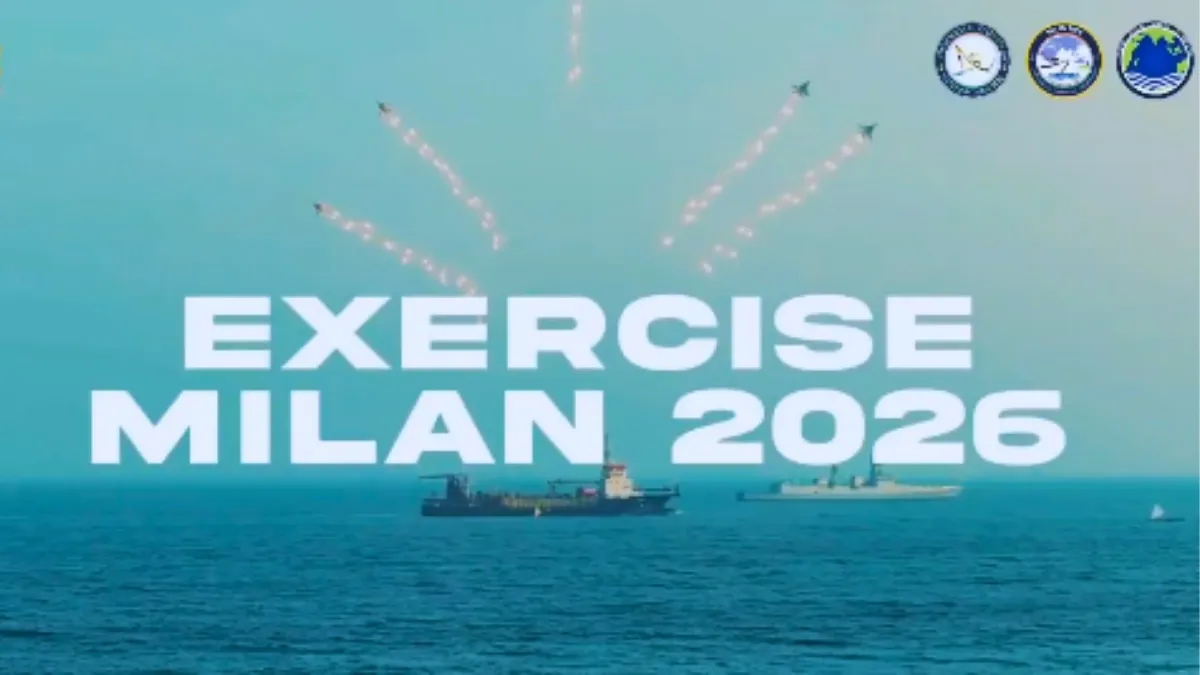
Recently, the partnership grew even further with Australia participating in Exercise MILAN 2026, one of the Indian Navy’s largest multinational maritime exercises. Shortly after the exercise, senior leaders from both countries met in New Delhi for the second India-Australia Defence Ministers’ Dialogue to discuss ways to deepen defence cooperation and enhance regional security.
These developments together highlight the growing importance of India-Australia defence ties and their shared commitment to maintaining a secure, stable, and rules-based Indo-Pacific region.
In this article, we explore Australia’s participation in India’s Exercise MILAN 2026 and the efforts taken by both countries to strengthen their defence ties.
What is Exercise MILAN?
Exercise MILAN is the Indian Navy’s flagship multinational naval exercise. It was first organised in 1995, with the objective of bringing together friendly navies from around the world and strengthening maritime cooperation.
Over the years, MILAN has become a significant event. From a participation of four countries, including Indonesia, Singapore, Sri Lanka, and Thailand, in 1995, it grew to a participation of over 75 countries in 2026. Exercise MILAN is now one of the largest naval exercises in the Indo-Pacific. The exercise allows participating countries to improve coordination, share operational experiences, and build professional relationships.
MILAN 2026 was held in February 2026 in Visakhapatnam on India’s eastern coast. The exercise was conducted under the theme “Camaraderie, Cooperation, Collaboration,” reflecting the spirit of partnership among participating nations.
The exercise has two phases – the harbour phase and the sea phase. During the harbour phase, naval personnel attended seminars, professional discussions, planning sessions, and cultural events. When the sea phase began, there were operational activities, such as maritime patrols, anti-submarine warfare drills, air-defence exercises, search-and-rescue operations, and coordinated naval manoeuvres.
Australia’s Participation in Exercise MILAN 2026
In Exercise MILAN 2026, Australia was one of the major participants. The Royal Australian Navy deployed HMAS Warramunga, an Anzac-class frigate, to take part in the multinational exercise. The deployment highlighted Australia’s commitment to working closely with India and other regional partners to promote maritime security and stability.
The Royal Australian Navy has consistently supported the MILAN exercise, which has made Australia’s participation even more significant. Its continued involvement reflects the growing trust and cooperation between Canberra and New Delhi.
Australia’s Showcase at Exercise MILAN 2026
Australia showcased several important operational capabilities during MILAN 2026. It closely worked with the Indian Navy and other participating forces.
One of the most notable achievements was the conduct of cross-deck helicopter operations between Australian and Indian naval platforms. Australian helicopters operated from Indian naval vessels, while Indian helicopters landed on Australian ships. Such activities require a high level of coordination and demonstrate increasing interoperability between the two navies.
Another major milestone was the Australian naval helicopter landing on India’s indigenous aircraft carrier, INS Vikrant. The event was widely viewed as a symbol of the growing operational compatibility and trust between the two countries.
There was also participation from Australian naval personnel in complex maritime drills that included anti-air warfare, maritime surveillance, coordinated manoeuvring, communication exercises, and replenishment-at-sea operations. Through these activities, Australian forces were able to train alongside some of the world’s leading navies while enhancing their ability to operate in multinational environments.
Apart from the military activities, Australian personnel participated in professional exchanges and discussions with naval officers from different countries. This helped strengthen people-to-people connections and military-to-military relationships.
The Significance of MILAN 2026 for India and Australia
MILAN is important for India and Australia beyond military exercises. The event serves as a practical platform to help both countries strengthen defence cooperation and address shared maritime challenges.
The two countries heavily depend on secure sea routes for trade and economic growth. The Indian Ocean and surrounding waters carry a large portion of global shipping traffic, making maritime security a critical concern.
With participation in exercises such as MILAN, India and Australia improve their ability to work together during emergencies, humanitarian missions, disaster-relief operations, and maritime security challenges.
The exercise also reinforces their shared commitment to freedom of navigation, respect for international law, and a stable Indo-Pacific region.
The Second India-Australia Defence Ministers’ Dialogue
The strength of India-Australia’s defence relationship was further highlighted during the second India-Australia Defence Ministers’ Dialogue held in New Delhi on June 1, 2026.
The meeting was co-chaired by Indian Defence Minister Shri Rajnath Singh and Australia’s Deputy Prime Minister and Minister of Defence, Richard Marles. The dialogue was in continuation with the inaugural Defence Ministers’ Dialogue held in Canberra in October 2025.
The annual dialogue serves as an important platform for reviewing progress in bilateral defence cooperation and identifying new areas for collaboration. Both leaders welcomed the significant progress they have made since their first meeting and emphasised the importance of maintaining regular high-level engagement between the two countries.
What Were the Key Issues Discussed During the Dialogue?
The two ministers discussed several issues during the dialogue, with the topmost being:
- Maritime Security Cooperation
The ongoing efforts to develop a Joint Maritime Security Collaboration Roadmap were reviewed. Discussions around ways to enhance maritime domain awareness, including cooperation through maritime patrol aircraft and efforts to improve undersea domain awareness, were also held. Both sides explored greater cooperation between the Indian Coast Guard and Australia’s Maritime Border Command.
- Interoperability Between the Two Armed Forces
This was another key area of discussion. The ministers agreed to explore new arrangements to enable both militaries to operate together more effectively during exercises and operations. This builds upon the Mutual Logistics Support Arrangement signed in 2020, which enables both countries to provide logistical support to each other’s forces.
- Defence Industry Cooperation
One of the most significant outcomes of the dialogue was the decision to begin developing a Memorandum of Understanding (MOU) on the Provision of Defence Articles and Defence Services. This initiative aims to strengthen defence industrial collaboration and create new opportunities for cooperation between Indian and Australian defence companies.
Australia to Participate in India’s Exercise MILAN 2026
Australia’s participation in Exercise MILAN 2026 and the successful conduct of the second India-Australia Defence Ministers’ Dialogue represent important milestones in the growing defence partnership between the two nations. India and Australia are strengthening their ability to work together in support of regional peace and security through advanced naval exercises, maritime cooperation, and high-level strategic discussions.
The discussions in New Delhi and the operational cooperation demonstrated during MILAN 2026 show that the relationship is becoming deeper, broader, and more practical. As both countries continue to expand defence engagement, their partnership is expected to play an increasingly important role in shaping the future security landscape of the Indo-Pacific region.
Article by Gayatri Sarin
List of references:
https://www.miragenews.com/india-australia-defence-ministers-dialogue-1683902
https://www.pib.gov.in/PressReleasePage.aspx?PRID=2267486®=48&lang=2