

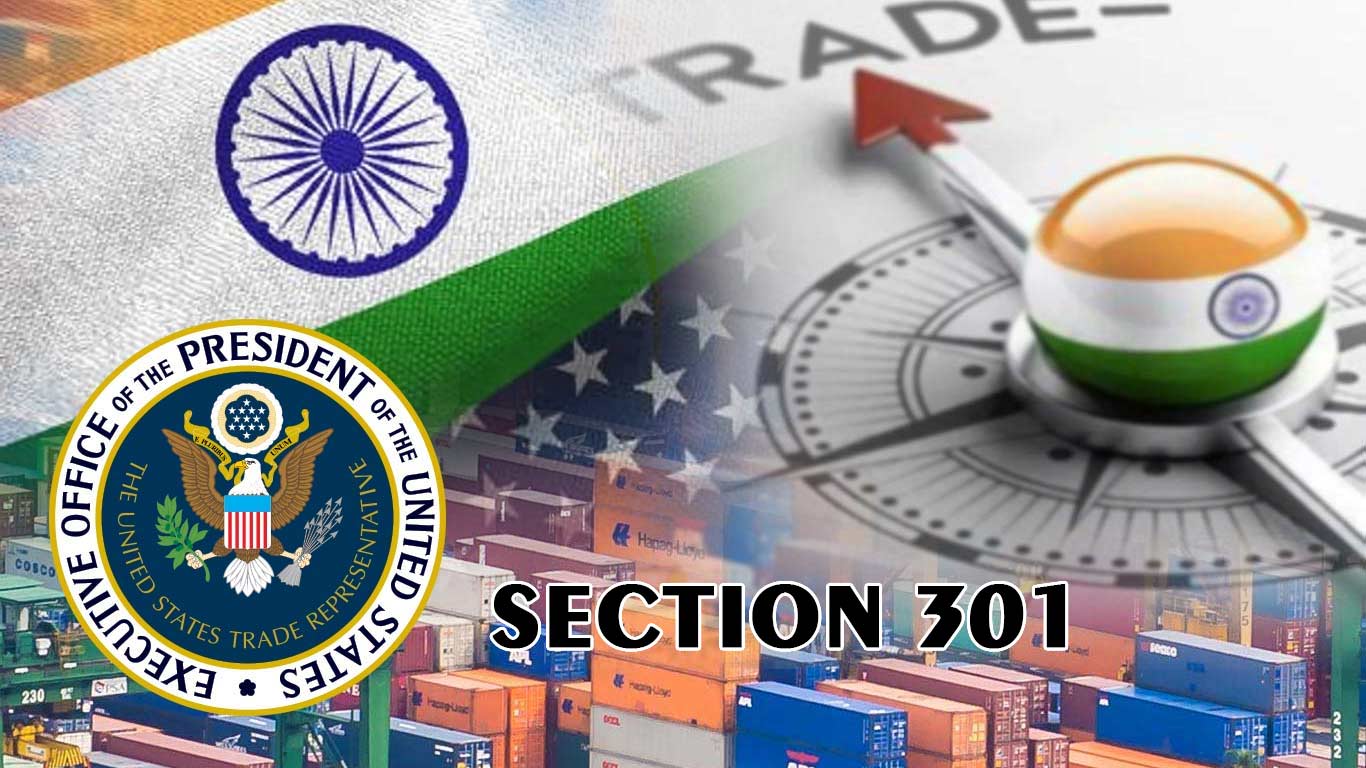
The United States Trade Representative (USTR) has proposed additional tariffs on imports from a number of economies, including India, under Section 301 of the U.S. Trade Act of 1974. The proposal has triggered debate not only because of its economic implications but also because it brings forth broader questions about labour rights, global governance, and the authority to define ethical trade. Who has the right to decide about the ethics of International Trade?
Section 301 allows the United States to scrutinize foreign policies or practices that it considers unfair, unreasonable, discriminatory, or harmful to American commerce. If such practices are found, the United States may levy heavy tariffs or other trade restrictions. In the recent few years, this statutory provision has become one of Washington’s most significant economic tools, providing the means to exert influence through markets rather than military power.
It is important to note that India is not the sole target of the proposed investigation. The USTR’s action extends to approximately sixty economies, including China, Canada, Japan, Indonesia, Malaysia, Thailand, Vietnam, the European Union, and the United Kingdom. This broader scope suggests that the controversy cannot be understood singularly as a bilateral dispute between India and the United States. Rather, it forms part of a larger debate regarding supply-chain governance, labour standards, and the regulation of global trade.
At the centre of the current controversy is the issue of forced labour. The United States argues that countries should take stronger measures to prevent goods linked to forced labour from entering global supply chains. Supporters of the policy contend that forced labour is a genuine human rights concern, and the world needs to be cautious about this. They argue that global trade should not reward exploitative labour systems and that countries must secure transparency in production networks. According to this view, economic pressure can foster governments and businesses to adopt more ethical practices.
It should be emphasized that the U.S. is not alleging that India alone relies on forced labour. India is one among dozens of economies included in the broader investigation. The American argument is that some countries have not done enough to prevent goods linked to forced labour from entering supply chains that eventually reach the sphere of international markets. The concern, therefore, is less about direct state sponsorship and more about monitoring, enforcement, and supply-chain accountability.
India, however, has challenged the validity of these allegations. Critics frequently argue that the United States should not possess unilateral authority to determine whether another country’s efforts are sufficient or not. They point out that international institutions, trade agreements, and multilateral frameworks already exist to address such concerns. From this perspective, the issue is not whether forced labour should be opposed, but who has the legitimacy to judge compliance and impose penalties.
This debate becomes even more significant when viewed through the lens of subjective globalization. For centuries, globalization was often associated with cheaper products, faster production, and lower costs. Increasingly, however, it is becoming tied to labour standards, environmental regulations, supply-chain transparency, and human rights. Trade is no longer only about goods and prices; it is also about values.
The U.S. position is not that India itself necessarily relies on the impact of forced labour. Instead, the investigation focuses on whether countries have established sufficiently robust mechanisms to prevent goods linked to forced labour from entering their markets and supply chains. In assessing implementation, authorities have typically examined legal prohibitions, enforcement mechanisms, import controls, supply-chain transparency, and the investigation of complaints.
The controversy is further complicated by differing geopolitical realities. The discussions surrounding forced labour on numerous occasions intersect with broader concerns about global manufacturing networks, including allegations involving supply chains connected to regions such as Xinjiang in China. As the governments attempt to trace the origins of products and raw materials, questions of ethics become intertwined with questions of strategy, security, and influence.
Supporters of the U.S. approach argue that countries should clearly demonstrate active efforts to prevent forced-labour goods from entering their markets. Critics have responded that identical evidence can lead to different interpretations. One country may view enforcement as inadequate, while another may view it as steadily improving. The disagreement, therefore, is not always about facts but about the standards and authority.
The issue also highlights the bigger concept of economic leverage. America’s influence stems not only from its military capabilities but also from the attractiveness of its market. Countries around the world seek access to American consumers, investment, and financial networks. As a result, trade restrictions and tariffs can become very powerful instruments which can hinder the entire sphere of foreign policy. This raises a fundamental question: in a globalized world, is power exercised primarily through armies or through access to markets?
At the same time, the debate also extends beyond the objective properties of labour rights as well. Section 301 investigations have also addressed concerns about manufacturing overcapacity, where some economies produce far more goods than they consume domestically and export the surplus amount abroad. According to the U.S. position, such practices can undermine domestic industries and distort competition. Critics, however, question whether countries should either be penalized for being highly productive or economically efficient.
Ultimately, the Section 301 controversy is not merely a dispute about tariffs only. It is a debate about the intense relationship between ethics and power in international trade. Few analysts would defend forced labour, yet disagreements emerge over who should define acceptable standards and how those standards should be enforced. As globalization evolves, the most important question may not be whether labour rights matter, but who possesses the authority to determine the moral boundaries of global commerce.
Article by Sruti Bhaumik