

What began as a mere form of tourism promotion campaign has intriguingly unfolded into one of the most heated India–China social media debates of the year 2026, as of now. Over the past several weeks, Indian users on X (formerly Twitter) have propagated posts, memes, videos and commentaries alleging that China possesses its own “caste-like” social hierarchy, thereby critiquing Beijing’s carefully cultivated image of prosperity, modernity and social equality formats.
The controversy emerged against the backdrop of China’s expanding and sophisticated soft-power strategy, which has strived to position the country as a premier global tourism destination and a model of technological modernization.
China’s Image-Building Campaign
Throughout 2025 and 2026, China has significantly expanded its international tourism outreach. Travel campaigns have highlighted Shanghai’s futuristic skyline, Chongqing’s dramatic urban architecture, high-speed rail networks, artificial intelligence innovations, cultural heritage sites and visa-friendly tourism initiatives. Influencers, digital creators and promotional videos highlighted a country defined by efficiency, modernity and prosperity.
The broader message was straightforward: come to China and experience the “real China.”
As international tourism numbers significantly rose and China increasingly projected itself as a leading tourism destination, various other official and semi-official media outlets increasingly started inherently promoting narratives centred on development, innovation and social stability. Tourism became more than just an economic sector; it became a dimension of China’s broader soft-power strategy.
On the other hand, as these campaigns gained prominence online, a counter-narrative began coming to light.
The Acute Backlash Begins
Rather than directly criticizing China’s technological achievements, many Indian social media users have seriously questioned whether the country’s promotional content represented the full picture or not. Was this only a carefully selected portion of a much larger reality that remained largely absent from China’s international image building efforts? In response to tourism videos and promotional content, users began posting videos and images capturing rural poverty, migrant labour conditions, less-developed regions, sanitation concerns and social inequalities within China. The criticism was not in its early stages about caste.
Instead, the argument was simple:
China was showcasing its most developed urban centres while obscuring deeper structural inequalities.
Posts were disseminated claiming that the shimmering skylines of Shanghai and Beijing represented only a small fraction of Chinese reality. Others highlighted poorer regions, migrant worker settlements and disparities between urban and rural populations.
Gradually, these discussions drifted far away from the periphery of tourism, towards a broader debate on social inequality status.
This is where the Hukou System comes into focus
The conversation became more pronounced when users began discussing China’s Hukou system.
Hukou is China’s household registration system, under which citizens are generally registered according to a specific locality and therefore classified as either urban or rural residents. Historically, this registration status has deeply influenced access to education, healthcare, housing, welfare benefits and various government services. Although China has undertaken reforms over the past few years, scholars have long argued that Hukou has contributed to institutional inequalities between urban and rural populations.
Millions of rural migrants have moved to cities seeking employment opportunities. However, many such residents have severely faced difficulties accessing the same public services available to officially registered urban residents. For several critics, Hukou represents a structural barrier that can further shape life opportunities over generations. This is where comparisons with caste began unfolding.
Many Indian users have strongly argued that while Hukou is not technically a caste system, it can produce outcomes resembling caste-like systemic disparities by hampering social mobility and creating inherited disadvantages.
Why the Word “Caste” Became Central
The term “caste” carries enormous political and social significance, particularly in India. For several decades, India has faced fierce international criticism regarding caste discrimination, social inequality and intrusive poverty issues. As a result, some of the Indian users viewed China’s promotional campaigns as merely presenting an incomplete narrative while India continued to be strictly scrutinised globally for its own social problems.
The response became less about sociology and more about competing regarding the context of national narratives. Many users argued that if India’s social challenges could be openly discussed internationally, China’s inequalities should also be subject to similar scrutiny. The debate soon escalated into claims that China significantly possessed its own version of a caste system. However, this comparison remains highly controversial till date.
For many Indian social media users, the controversy deeply reflected a broader sentiment that countries frequently scrutinize India’s caste and poverty challenges while remaining less willing to deeply examine the structural inequalities elsewhere. In this sense, the debate echoed the familiar proverb that ‘people living in glass houses should not throw stones at others’.
Does China Actually Have a Caste System?
Academically speaking, the answer is no.
China does not possess a caste system equivalent to India’s traditional caste structure.
The traditional Indian caste framework historically involved hereditary status, endogamy, social restrictions, occupational associations and concepts of purity and pollution.
China has no officially recognised birth-based caste hierarchy of this nature. But nevertheless, critics argue that certain Chinese institutions create outcomes resembling rigid social stratification through restricted mobility, unequal access to opportunities and inherited disadvantages. For many observers, the comparison is usually interpreted metaphorically rather than literally.
The Four Occupations Debate
Another element fuelling the controversy was renewed interest in China’s ancient Four Occupations framework.
Historically, the Chinese society recognised four broad social categories:
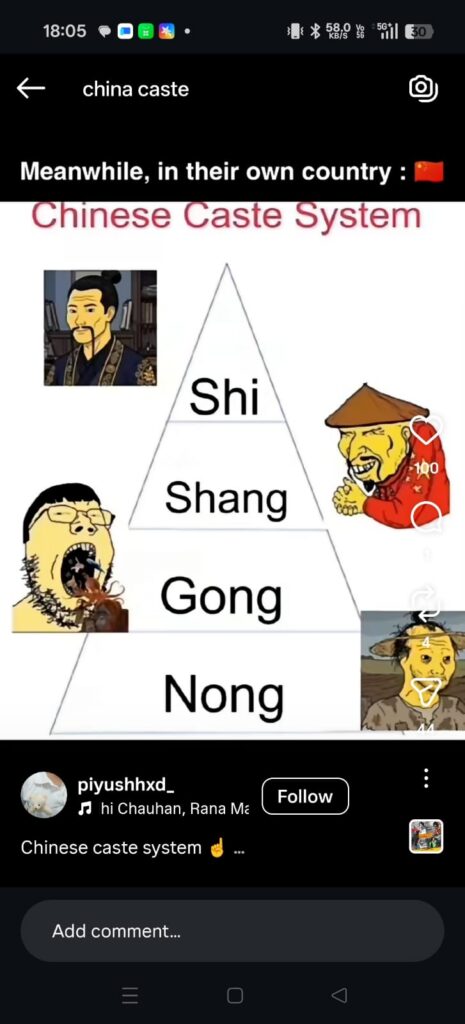
1- Shi (scholars and officials)
2- Nong (farmers)
3- Gong (artisans and craftsmen)
4- Shang (merchants)
Several viral posts juxtaposed China’s historical Four Occupations framework; Shi, Nong, Gong and Shang, with India’s traditional varna system hierarchy. Although several historians generally regard the two systems to be fundamentally different.
This framework dates back roughly two millennia and represented a social hierarchy rather than a hereditary caste system. As the debate intensified further, Indian meme creators revived these historical categories and presented them as evidence that China had long maintained social divisions comparable to caste.
Historians, however, generally distinguish the Four Occupations system from caste because social mobility remained possible and the categories lacked the rigid hereditary restrictions associated with caste systems. However the historical references proved highly effective in online discourse, where it has been observed that simplified narratives often travel faster than nuanced academic explanations.
China’s Response
Chinese media outlets, particularly Global Times, strongly rejected the “Chinese caste system” narrative. The publications have rigorously argued that some Indian social media users had inaccurately equated China’s social inequalities with caste discrimination. According to the Chinese position, the Four Occupations system was a historical classification rather than a caste hierarchy, while Hukou represents an administrative registration mechanism rather than a hereditary caste institution.
Chinese commentators maintained that social inequality alone does not amount to caste discrimination. For Beijing, the controversy touches a particularly sensitive nerve.
China frequently presents itself as a socialist society committed to equality and social cohesion. Consequently, international discussions associating China with caste-like discrimination challenge a central component of the country’s official self-image.
Beyond Caste: A Battle of Narratives
At its core, this controversy is not simply about caste, poverty or tourism. It is about the perspective of image identity. China sought to project an image of modernity, prosperity and development through tourism-driven soft power. Indian users immediately responded by highlighting poverty, social stratification and institutional inequalities.
The resulting debate evolved into a broader contest over who gets to define the “real China.” Some users focused on Hukou, migrant workers and rural-urban disparities. Others shared provocative memes, poverty videos and historical references. Meanwhile, Chinese media attempted to challenge what it viewed as a misleading comparison. The outcome was a classic embodiment of digital nationalism, where social media becomes a battlefield for contrasting narratives, national identities and geopolitical rivalries.
Conclusion
The debate concerning China’s alleged “caste-like” system reveals how quickly discussions about tourism can transform into conversations about inequality, governance and national image. China’s tourism campaign was formally tailored to feature its successes. Instead, it sparked a global conversation about what lies beyond the skyscrapers, high-speed trains and carefully curated promotional videos.
Whether one accepts the caste comparison or rejects it in academic terms is inaccurate, the controversy underscores a larger reality of the digital age: nations no longer compete only through military power, economic influence or diplomacy. They increasingly compete through narratives, perceptions and information.
And in that contest, a viral meme can sometimes traverse much further than a missile.
By Sruti Bhaumik