

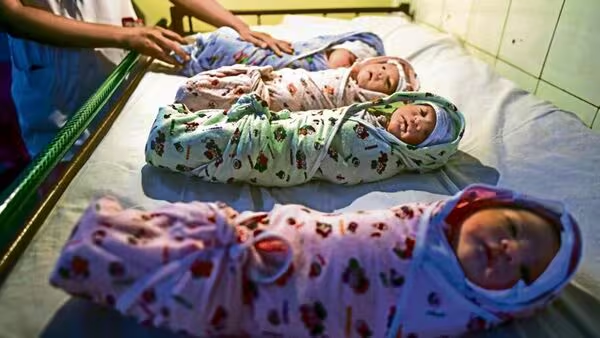
For years, India has been known as one of the most populous countries in the world. Its growing population was seen as a sign of economic strength and a large workforce. However, in recent years, the stats have changed. India’s birthrate is steadily declining. Families are opting to have fewer children compared to previous generations. This trend is visible across both urban and rural areas.
The reason behind this falling birthrate is concerning. Some people consider it a natural outcome of social and economic progress, while others think it is driven by changes in healthcare standards. The decline will impact India’s economy, workforce, healthcare system, and society in the near future. Thus, it is essential to understand the reasons behind it.
Through this article, you can understand the meaning of birthrate, fertility trends over the last five decades, and why this change is occurring.
What Does a Falling Birth Rate Mean?
The term “birthrate” refers to the number of births occurring in a population over a defined period. The Total Fertility Rate (TFR) indicates the average number of children a woman is expected to have during her lifetime.
Over the last few decades, India’s fertility rate has declined significantly. A 2024 Sample Registration System Statistical Report published by the Office of the Registrar General and Census Commissioner under the Union Ministry of Home Affairs reported a national TFR of 1.9, which is below the replacement-level benchmark of 2.1. Replacement level means the average number of children a woman should have during her reproductive years to keep the population stable from one generation to the next. Unfortunately, for the first time, the TFR has dropped below the replacement level, marking a demographic milestone for the country.
Fertility Rates Over the Last Five Decades
In the past five decades, India’s fertility rate has declined dramatically. Here’s a look at how it has changed:
- During 1971-1981, there was a drop in TFR fell from 5.2 to 4.5. By 1991, it reached 3.6 before dropping to 1.9 in 2024.
- In this five-decade period, urban fertility fell from 4.1 in 1971 to 1.5 in 2024, while rural fertility declined from 5.4 to 2.1.
Among Union Territories and larger states, the stats between 2012-14 and 2022-24 were as follows:
- Delhi recorded the sharpest decline in fertility, as it reduced by 29.4 per cent.
- Gujarat was next with a drop of 25 per cent.
- There was a drop of 23.5 per cent in Tamil Nadu.
- The decline in Bihar was the slowest at 9.4 per cent.
- Chhattisgarh followed with a reduction of 11.5 per cent.
- The decline in Himachal Pradesh and Punjab was 11.8 per cent each.
While these stats are alarming, they don’t indicate that India’s population will immediately shrink. Due to its large young population, India will continue to grow for some time. However, the pace of growth is slowing considerably.
Top Reasons for the Falling Birth Rate in India
A combination of social, economic, and cultural changes is driving India’s declining birthrate. From higher education levels and urbanisation to rising living costs and changing family preferences, several factors are influencing couples to have fewer children than previous generations.
Rising Education Levels, Especially Among Women
One of the biggest reasons behind India’s falling birthrate is the improvement in education. As more women gain access to higher education, they often choose to delay marriage and focus on career development. Education also increases awareness about family planning, healthcare, and financial management.
Urbanisation and Changing Lifestyles
India is rapidly urbanising. Millions of people have moved from villages to towns and cities in search of employment and better living conditions. Urban life is very different from rural life. Housing is more expensive, living spaces are smaller, and the cost of raising children is significantly higher.
In rural areas, larger families were often beneficial because children could contribute to agricultural work. In cities, however, children represent a substantial financial responsibility involving education, healthcare, housing, and extracurricular activities. As urban lifestyles become more common, couples naturally choose smaller families.
The Rising Cost of Raising Children
The cost of private schooling, higher education, and healthcare continues to rise. For middle-class families, raising one or two children can already be a significant financial commitment. As economic pressures increase, many couples decide that a smaller family is the most practical choice. They believe that having fewer children allows them to provide a better quality of life.
Greater Access to Family Planning
The availability of contraception and family planning services has improved considerably across India. Government awareness campaigns and healthcare programs have helped people make informed decisions about family size.
Unlike earlier generations, where larger families often resulted from limited access to healthcare and contraception, modern couples can plan their families according to their personal and financial circumstances. This increased control has played a major role in reducing birth rates.
Women’s Participation in the Workforce
The role of women in Indian society has changed significantly over the past few decades. More women are pursuing careers, starting businesses, and seeking financial independence. Balancing career responsibilities and childcare can be challenging, particularly in workplaces where childcare support remains limited. As a result, many working women choose to have fewer children or delay childbirth.
Delayed Marriages and Parenthood
The average age of marriage has risen in many parts of India. Young adults today spend more years in education and career-building before settling down. Since marriages occur later, the number of reproductive years available for childbearing naturally decreases.
Couples who marry in their late twenties or thirties are more likely to have one or two children rather than three or four. The desire for emotional compatibility, financial stability, and career growth before marriage has contributed significantly to this shift.
Changing Social Values
Indian society is undergoing a major cultural transformation. Traditionally, large families were often considered desirable. Children were viewed as economic support, caregivers in old age, and symbols of family prosperity.
Today, attitudes are changing. Many young couples value personal freedom, travel, career growth, and lifestyle choices alongside family responsibilities. As personal preferences evolve, family sizes tend to become smaller.
Better Child Survival Rates
In the past, higher child mortality rates encouraged families to have more children. Advances in healthcare, vaccinations, nutrition, and maternal care have dramatically improved child survival rates in India. Parents are now more confident that their children will survive and thrive. As a result, families no longer feel the need to have additional children as a safeguard against health risks.
Increasing Economic Aspirations
Modern Indian families have higher expectations for their standard of living. Many parents want to provide quality education, better housing, international travel opportunities, and strong career prospects for their children. Achieving these goals often requires substantial financial resources.
From family size, parents are now increasingly focusing on maximising opportunities for each child. This shift from “more children” to “more investment per child” is one of the defining features of modern demographic change.
Is a Falling Birthrate Good or Bad?
The answer is complex because a falling birthrate brings both benefits and challenges.
Benefits
- Reduced pressure on resources: Smaller populations can ease pressure on housing, healthcare, education, and natural resources.
- Higher investment in children: Families can devote more resources to each child’s development.
- Improved living standards: Smaller families often experience better financial stability.
- Women’s empowerment: Lower fertility rates are often associated with greater educational and career opportunities for women.
Challenges
- Ageing population: Over time, a lower birthrate can lead to a larger elderly population.
- Work force shortages: Fewer young people may enter the labour market in future decades.
- Higher social welfare costs: Governments may need to spend more on pensions and elderly healthcare.
- Economic growth concerns: A shrinking working-age population can slow economic growth if productivity does not improve.
Final Thoughts
India’s falling birthrate is the result of several interrelated factors, including higher education levels, urbanisation, rising living costs, greater access to family planning, changing social values, and increased participation of women in the workforce. These developments reflect a society that is becoming more modern and economically ambitious.
Lower birth rates can become a challenge related to ageing and workforce availability in the future. However, they also bring important benefits such as improved living standards and greater opportunities for women and children. Rather than viewing the decline solely as a problem, it can be understood as part of India’s broader journey toward social and economic development. Policymakers need not focus solely on reversing the trend, but on preparing the country for the demographic changes that lie ahead.
Article by Gayatri Sarin
List of references:
https://pubmed.ncbi.nlm.nih.gov/41793333
https://visionias.in/current-affairs/monthly-magazine/2025-10-04/society/decline-in-fertility-rat e-in-india
https://casi.sas.upenn.edu/iit/data-for-india-rukmini-2025-part-two
https://www.forbesindia.com/article/news/indias-fertility-fall-a-demographic-divide-emerges-a s-birth-rates-decline/2986953/1
https://www.lowyinstitute.org/the-interpreter/population-paradox-india https://www.clearias.com/fertility-rate-in-india/
https://timesofindia.indiatimes.com/city/patna/total-fertility-rate-declines-to-2-7/articleshow/1 31413962.cms