
The rapid rise of artificial intelligence has created a new form of anxiety among several writers, artists, journalists, and creators across the world. As AI systems have become increasingly capable of producing essays, poems, stories, artworks, and even novel-length texts, many have begun to ask whether human creativity itself is under threat or not.
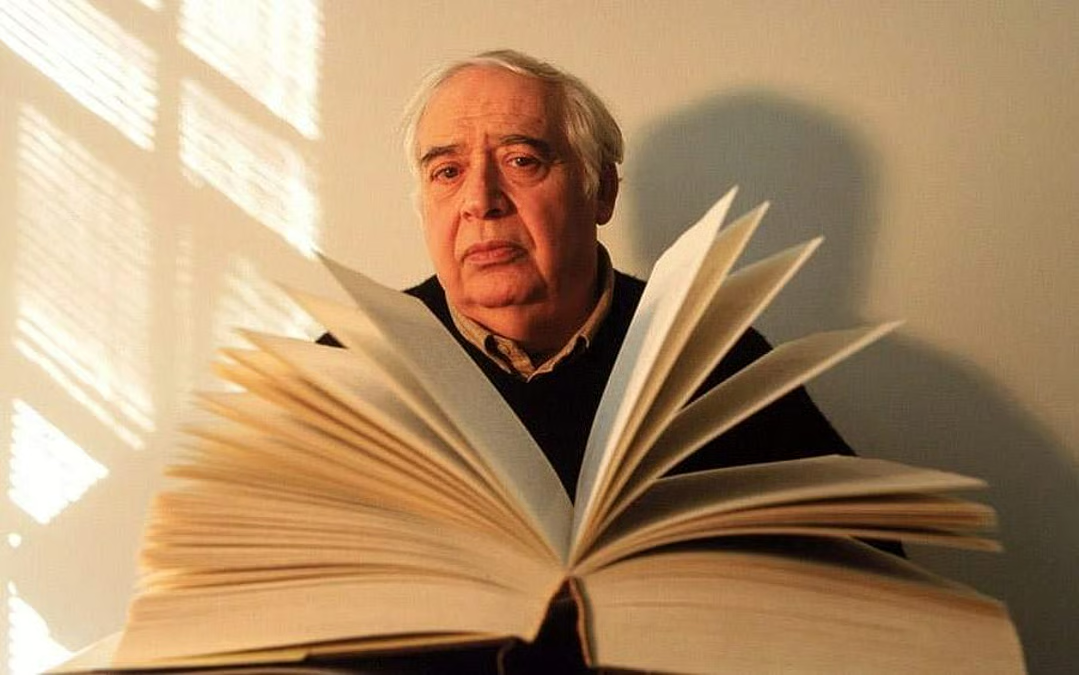
While these concerns appear uniquely contemporary, literary criticism may already provide a useful framework for understanding them. Harold Bloom’s concept of the “Anxiety of Influence” offers an intriguing lens through which we can critically evaluate the relationship between human creators and artificial intelligence.
Harold Bloom is often remembered for his famous phrase “Anxiety of Influence.” Bloom did not simply claim that writers are influenced by previous writers. Rather, he argued that strong writers struggle against their predecessors in order to create space for themselves. Every creator begins by admiring someone who came before them. A poet may admire Shakespeare, a novelist may admire Virginia Woolf, and a Bengali writer may admire Rabindranath Tagore. Yet genuine creativity does not emerge through imitation alone. It emerges through a complex process of resistance, reinterpretation, and transformation. As John Locke famously argued, the human mind begins as a tabula rasa or blank slate. Knowledge and understanding are gradually formed through inheriting various experiences, observations, and vivid interactions with the world.
In a very similar manner, there’s something one cannot deny; “creativity does not emerge in isolation”. Every creator inherits ideas, traditions, influences, and experiences that shape their intellectual development. Nothing is produced entirely from a vacuum; rather, inspiration becomes the bedrock upon which new thoughts, interpretations, and creative expressions are built. It is through this process that legacy slowly transitions into creativity and novelty. Bloom believed that young writers experience anxiety because they fear remaining trapped under the shadow of earlier great creators.
If a writer completely accepts the authority of a predecessor, it becomes quite difficult to establish a distinction module or a voice. For this reason, strong writers often “misread” their predecessors. This misreading is not a mistake but a creative act. The younger writer mostly reconfigures the older writer, acknowledging limitations, possibilities, or alternative directions that allow a new literary identity to surface.
In Bloom’s view, literature is not a peaceful inheritance but a struggle between generations of creators. Bloom’s famous observation that “originality must compound with inheritance” encapsulates this idea perfectly. Every creator inherits influences, but originality seldom emerges from what one does with those influences. Shakespeare himself had predecessors. Tagore had predecessors, Virginia Woolf also had predecessors. No creator emerges from a complete vacuum state. Yet great creators transform inherited traditions into something distinctly their own.
Emergence of AI
The emergence of artificial intelligence further questions the conventional notions of creativity. AI systems are trained on vast archives of human-created texts, images, ideas, and cultural productions. In many ways, AI represents the most substantial archive of influence ever assembled. It learns from literature, journalism, academic writing, and countless other forms of human expression. However, there still exists a crucial difference between AI and the human creator. AI inherits influence, but it does not experience the anxiety of influence. A human writer may wonder whether they can ever surpass Shakespeare or escape the vibrant persona of Tagore’s shadow. AI does not ask such questions ever. It possesses no ambition, insecurity, admiration, jealousy, or desire for recognition. It does not struggle with the subjective ego of the successors. It does not fear being rendered less visible by earlier creators. Instead, it processes patterns and generates outputs based on learned relationships within data. This disparity reveals an important shift like creative anxiety. During Bloom’s time, writers feared their predecessors. Today, many writers fear artificial intelligence. The anxiety has moved from creator versus predecessor to creator versus algorithm. Contemporary writers increasingly ask whether AI will replace authors, journalists, screenwriters, or artists. The concern is not necessarily that AI is more creative than humans. Rather, the concern is that AI is significantly faster. A novelist may spend years writing a book. A journalist may spend days researching an article. An academic may devote months to developing an argument. AI can generate convincing drafts within seconds. Consequently, many creators fear becoming replaceable within a technological environment that rewards speed and efficiency. Yet the relationship between AI and creativity is deeply paradoxical. AI depends entirely upon human creativity. Without human-written novels, poems, essays, articles, and stories, there would be no data from which AI could learn. The technology that appears to challenge creators is itself built upon generations of creative labour. In this sense, while Bloom viewed influence as a creative burden, AI consistently modifies influence into a technological system.
This raises an important question: can a machine that never struggles be genuinely creative? Bloom believed that creativity emerges through the distinctive process of intellectual and creative struggle. Writers question their predecessors, resist inherited traditions, and develop unique identities through that struggle. AI, by contrast, does not experience artistic rebellion or intellectual uncertainty. It can imitate patterns, generate language, and reproduce compositions aesthetic features, but it does not possess the sense of individuality that drives human creators to reconceptualize themselves. This does not mean that AI is useless. Like calculators, search engines, and other technological tools, AI can assist human creativity. It can help generate ideas, simplify information, organize research, and accelerate drafting. The real question is not whether AI replaces writers, but whether writers continue to exercise their creative agency. If creators surrender originality entirely to algorithms, creativity may weaken. If they use AI as a tool while upholding intellectual control, the human creator remains at the centre of the creative process.
Harold Bloom’s Anxiety of Influence has not disappeared in the age of AI. Instead, it has transformed. Creators no longer struggle only against literary predecessors but increasingly against algorithmic systems trained on those predecessors. The fear of influence has become the fear of technological replication. Yet Bloom’s theory ultimately reminds us that creativity is more than the reproduction of patterns. It is a human struggle for originality, identity, and meaning. Artificial intelligence may inherit the archive of human culture, but the anxiety that produces genuine artistic individuality remains, at least for now, uniquely human.
Article by Sruti Bhaumik