

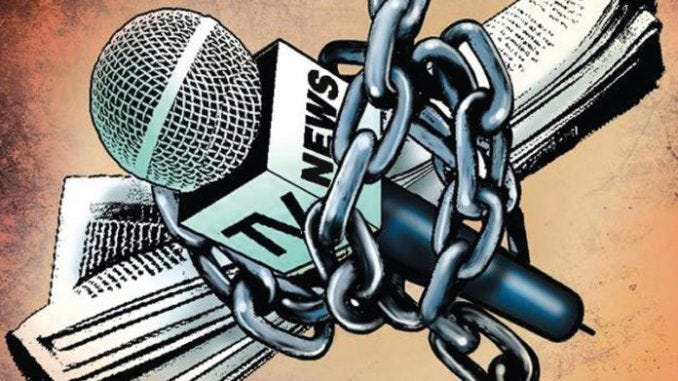
In May 2026, a brief exchange in Norway sparked a debate that quickly crossed national boundaries. During a media appearance, Norwegian journalist Helle Lyng asked the Indian Prime Minister Narendra Modi why he didn’t take questions from what she described as ” the freest press in the world.” Modi did not provide a response, instead left the venue. The significance of the incident was not merely that a question remained unanswered. But very often the politicians all across the world ignore questions, avoid interviews, and even refuse to comment on sensitive matters.
Here, in this article we do not seek to determine whether one leader was right or wrong. Instead, we are going to thoroughly examine the constant relationship between political power, media accountability, democratic legitimacy, and the changing nature of communication in the contemporary digital age.
What Happened in Norway?
As the formal proceedings concluded, Norwegian journalist HelleLyngraised a question that would soon travel far beyond the room in which it was asked. Addressing Prime Minister Modi, she asked why the Indian Prime Minister rarely engaged in open questioning from what she described as the world’s freest press.
The question was brief, but it touched upon an issue that had already been the subject of discussion among journalists, political commentators, and media scholars for several years. Modi did not respond to the question and continued leaving the venue. Within hours, the clip circulated widely across social media platforms and international news outlets.
What made this moment different was that it appeared to symbolize a much larger debate. Critics pointed out that Prime Minister Modi has generally preferred speeches, radio broadcasts, social
media communication, and structured interactions over open-ended press conferences where journalists can ask follow-up questions. Supporters, however, argued that democratic accountability is not measured solely through press conferences and that governments remain accountable through elections, institutions, and constitutional mechanisms.
The symbolism of the incident was amplified by its location. The question was asked in Norway, a country consistently ranked among the strongest performers in global press freedom assessments. The controversy did not just end there. Following the incident, Helle Lyng publicly stated that she had temporarily lost access to some of her social media accounts. While no publicly verified evidence established a connection between the account suspensions and the controversy, the incident intensifies discussions surrounding press freedom and political scrutiny.
The following day, the debate continued during an official briefing attended by Indian representatives. Indian diplomat Sibi George responded to questions regarding press freedom, democratic accountability, and international perceptions of India. His response emphasized India’s constitutional framework, democratic institutions, electoral processes, and vast media
ecosystem. He argued that many foreign observers often fail to appreciate India’s scale, diversity, and political complexity.
The Democracy Which Exists Beyond The Periphery Of Elections
Many people seldom characterise democracy with elections. Although elections are undoubtedly fundamental, democracy does not begin and end at the ballot box only, this is something we need to clearly understand. Citizen select representatives to govern on their behalf, but the right to vote is accompanied by the right to question. Democracy requires institutions, laws, civil liberties, informed citizens, and mechanisms of accountability. Elections provide a medium of representation; an accountability that ensures that representation remains meaningful throughout the process.
The central question is therefore not whether citizens can elect governments. But the question is, whether citizens can continue to question governments after the elections are over. Can they ?
From Subjects to Citizens: “The Historical Origins of Questioning Power”
In the ancient kingdoms, rulers were rarely expected to answer ordinary people. Political authority flowed in one direction. Kings had the authority to speak, while their subjects were expected to listen.
The Enlightenment Era revolutionized this ancient understanding. Thinkers such as John Locke, Montesquieu, and Jean-Jacques Rousseau challenged the traditional assumptions about power and authority.
The Enlightenment stimulated citizens to question political authority, but later thinkers expanded the discussion of power itself. Michel Foucault argued that power does not operate solely through governments or laws; it is also exercised through systems of observation, discipline, and social control. His discussion of the Panopticon suggested that individuals often regulate their own behaviour because they believe they are being strictly watched. While Foucault wrote in a very different context, his work reminds us that accountability is not only about who holds power but also about how power is observed, challenged, and legitimised within society.
Once citizens became the source of political authority, a new question emerged: if governments rule in the name of the people, should they not also answer to them? This idea forms the philosophical foundation of modern democratic accountability.
Journalism and the Rise of the Fourth Estate
Citizens cannot monitor governments each and every single day. They cannot attend every meeting, investigate every policy decision, or verify every public claim. Therefore, Journalism has emerged as an intermediary mode of communication between governments and citizens. For this reason, journalism came to be known as the Fourth Estate. Journalists do not govern, but they scrutinize those who are in the subjective authority of power.
Why Do Such Difficult Questions Matter?
Many critics often assume that journalists ask difficult questions because they at times dislike certain politicians, but the reality is completely different. These difficult questions often reflect concerns that ordinary citizens would raise if they had direct access to the political leaders. If the fuel prices rise, citizens ask why, and it’s their fundamental right to question the government they’ve elected. If policies change unexpectedly, citizens seek explanations.
The purpose of difficult questioning is not necessarily to embarrass governments. It is to seek clarity, test claims, and ensure accountability. Democracy is not only about the freedom of leaders to speak, it is also about the freedom of citizens to question.
The Imperfections of Journalism
Simply defending journalism does not require the essence to romanticize it. Modern media systems are shaped by commercial interests, political loyalties, ideological divisions, and competition for attention. Journalists can become participants in political narratives rather than merely being neutral observers. Media organizations can prioritize sensationalism over substance and speed over verification.
This reality matters because the debate is not between perfect journalists and imperfect politicians. Both institutions operate within systems of pressure, competition, and influence. The challenge is therefore to preserve accountability while recognising the imperfections of those tasked with providing it.
Why Leaders Avoid Questions
Political leaders avoid questions for a variety of reasons. One of the most prominent causes is the arena of Diplomatic negotiations.
Diplomatic negotiations may be extremely sensitive. National security concerns may restrict public disclosure. A single statement can affect markets, generate diplomatic consequences, or become a viral controversy. Modern politics has also become increasingly image-driven. Politicians are no longer simply public officials; they are public brands. Communication teams carefully manage appearances because a brief clip can dominate public discussion for days.
The Politics of Silence
The key issue is not whether a leader occasionally avoids a question. The key issue is what repeated avoidance of unscripted questioning might try to indicate. It may strongly demonstrate a disposition for controlled communication. It may reflect risk management in an era of viral
media. It may also reveal various concerns about misinterpretation or political polarization.
At the same time, critics argue that reduced opportunities for questioning weaken direct accountability. Journalists exist partly to ask questions governments would rather not answer. When opportunities for questioning become limited, citizens lose opportunities to witness power being challenged in real time.
This does not automatically prove democratic decline, authoritarianism, or institutional failure. Such claims require far more evidence.The more productive question is this: whathappensto democraticaccountabilitywhenpoliticalcommunicationbecomesincreasinglymanagedand lessspontaneous?
India, Norway,and Competing Democratic Emphases
The exchange in Norway became significant because it reflected different democratic priorities. Norway places strong emphasis on press freedom, transparency, media access, and public scrutiny of political leaders. The fundamental assumption is that questioning power strengthens democracy.
India’s official democratic narrative often emphasizes elections, constitutional protections, institutional functioning, judicial independence, and citizen participation. The argument is that democratic legitimacy is demonstrated through representative institutions and public participation.
The disagreement was therefore not between democracy and non-democracy. It was between different understandings of what democratic accountability should prioritize.
Press Freedom Rankings and Global Perceptions
The Norway incident gained additional significance because it occurred against a broader global debate on press freedom. According to the 2026 World Press Freedom Index published by Reporters Without Borders(RSF), global press freedom has reached its lowest average level in twenty-five years, with increasing legal and institutional pressures on journalism worldwide. Norway continues to rank first globally in press freedom, while India ranked 157th in 2026.
These rankings do not by themselves evaluate whether a country is democratic or undemocratic, but they do influence international perceptions regarding transparency, media independence, and
public answerability. Therefore, a question about press freedom raised in Norway resonated far beyond a routine media interaction and became part of a larger conversation about democratic legitimacy in the digital age.
Political Communication in the Digital Age
For much of the twentieth century, information followed a relatively simple route:
Government→Journalists→Citizens.
Today, social media platforms, podcasts, livestreams, and digital communication allow leaders to reach citizens directly.
Government→SocialMedia→Citizens.
This transformation has undeniable benefits. Citizens can hear leaders without mediation. Governments can communicate rapidly during crises. Public information can travel instantly. Yet a fundamental question remains;
If leaders can speak directly to citizens, who asks the follow-up questions?
A speech is one-directional. A press conference is interactive.A prepared statement can explain a position, but it cannot respond to unexpected challenges. The unique function of journalism lies in asking what comes next.
The Future of Democratic Accountability
The future may follow two different paths :-
● An optimistic future would allow direct communication and journalistic scrutiny to coexist. Leaders could communicate explicitly with citizens while remaining willing to answer difficult questions.
● A more pessimistic future would see leaders increasingly operate without journalists altogether. Citizens would receive more information than ever before, yet fewer opportunities to see power challenged.
Contemporary democracies face one of the most unique kinds of challenges. Never before have citizens had so much access to political leaders, yet never before has the role of editorial autonomous questioning appeared so uncertain.
Conclusion
The debate triggered by a question in Norway was never purely about one journalist or one political leader. It reflected a broader transformation taking place across democracies. The central issue is not whether leaders should communicate directly with citizens. The defining issue is whether direct communication can replace public questioning without eroding
accountability. Democracy is not only the right to vote. It is also the right to question power. The challenge facing contemporary democracies is ensuring that both rights continue to work in tandem with one another in an age increasingly dominated by carefully curated communication, viral media, and global political optics.
The tension between power and public scrutiny is not a new concern. Bengali folk traditions have long reflected on the uneasy relationship between virtue and authority. The well-known line, “Dekho bhalo jone roilo bhanga ghore,mondo se je sinhasone chore,” conveys an enduring public anxiety: that power does not always rest with the most virtuous, and that authority must therefore remain open to public scrutiny. Whether in monarchies or democracies, the principle remains relevant. The justification of power depends not merely on possessing authority but on remaining answerable to the people in whose name that authority is wielded.