

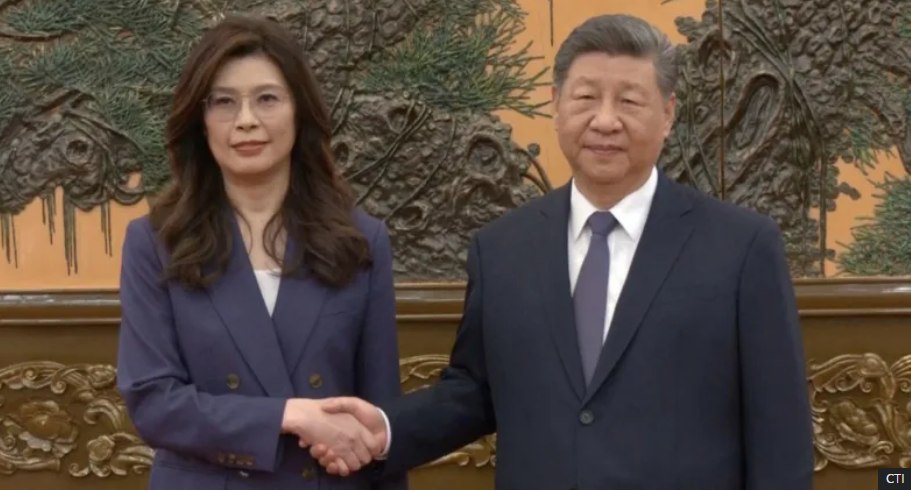
The recent visit of Cheng Li-wun, chairperson of Taiwan’s opposition party Kuomintang (KMT), has drawn the attention of scholars and global media alike. The visit, undertaken between 7-12 April, is more than the optics it has generated. While visits by high-ranking KMT officials to China have been a common practice in the past, the peculiarity of this episode emerges from several factors, such as the timing of the trip, taking place just weeks before the upcoming summit between Donald Trump and Xi Jinping. Other factors include an overly critical stance towards traditional allies and a deviation from predecessors in terms of handling cross-strait relations.
Background and Context
Taiwan, officially known as the Republic of China, represents a special, if not unique, case. Despite having its own territory, a democratically elected government, and a military, its sovereignty remains contested by China and has been acquiesced in by many countries following China’s ‘
One China’ policy. While Taiwan functions independently and maintains relations with a handful of countries, it remains outside the United Nations and other international organisations due to the aforementioned Chinese pressure. Thus, the China factor has complicated Taiwan’s international relations, as has its impact on Taiwan’s domestic politics.
Since its democratisation in the late 1990s, the domestic politics of Taiwan has revolved around questions of Taiwanese identity and the nature of its relationship with mainland China. In this regard, the stands of the two major parties in Taiwan are worth mentioning. The ‘Pan-Blue coalition’, led by the KMT, is known for its advocacy of closer ties with mainland China; in this respect, the KMT claims to be the only party capable of preventing war, and its overtures to China have thus been dubbed by proponents as peacemaking efforts across the strait. In contrast, the ruling Democratic Progressive Party (DPP) represents the ‘Pan-Green’ camp, which emphasises a distinct Taiwanese identity and advocates an independent sovereign state. Pan-Green supporters have alleged that this overture by the KMT towards the Chinese Communist Party (CPC) and China amounts to capitulation to Chinese coercion.
Pursuant to this overture to China, KMT officials have undertaken high-level visits to China in the past. This began with the then chairperson Lien Chan’s visit to China in 2005, which led to the reopening of party-to-party dialogue after years of hostilities. Other successive visits include: chairperson Wu Po-hsiung’s 2009 visit; Eric Chu’s 2015 meeting with Xi Jinping; chairwoman Hung Hsiu-chu’s visit in 2016; and former president Ma Ying-jeou’s visit in 2023. The core principles underlying these meetings have been uniform across all these visits: reaffirmation of the ‘1992 Consensus’ and opposition to Taiwan independence.
Another aspect is how these differing stances of both parties vis-à-vis China have been perceived by the people in Taiwan, and how they have shaped electoral outcomes. While one survey has pointed to an increasingly unfavourable impression of China among the Taiwanese populace, an overwhelming majority, of more than 80 per cent of the population, still supports maintaining the status quo. This preference for the status quo signifies a form of pragmatism: the desire to ward off any imminent risk of invasion from China in the event of a declaration of independence, while preserving the democratic system achieved through years of mobilisation. Accordingly, voters’ choices over the years in national elections between the DPP and the KMT can also be interpreted as an oscillation between the two, aimed at avoiding both the ‘overselling of sovereignty’ and the over-provocation of Beijing. Thus, the KMT and the Pan-Blue coalition’s overtures towards China, including such visits, are not without support among the Taiwanese people (just as the same holds for the DPP in its advocacy for independence).
How Cheng Li-wun’s visit differs from her predecessors: Implications for China, Taiwan and the United States
Party-to-party interaction between the KMT and the CPC has provided China with a convenient means to bypass Taiwan’s democratic institutions and elected government. This suspension of official communication began when the DPP came to power in 2016. With respect to Cheng’s visit, analysts have pointed to fundamental shifts in her approach to China vis-à-vis her predecessors as well as other KMT officials.
Wen-Ti Sung, a fellow at the Atlantic Council, has emphasised how previous KMT figures such as Eric Chu and Hou Yu-ih (the KMT presidential candidate in the 2024 election) sought political accommodation with Beijing while simultaneously advocating the strengthening of Taiwan’s defence to achieve deterrence. In contrast, Cheng has portrayed defence preparedness as “inviting war”. By calling for “institutional arrangements” to prevent war, while downplaying the importance of deterrence, she has signalled a clear divergence from her predecessors.
Beyond this shift, her remarks on Taiwan’s traditional allies have also been overtly scathing and unprecedented by KMT standards. For instance, during her trip she described cross-strait division as an “unhealed wound” left by “Japanese imperialism”. Similarly, she emphasised that Taiwan would not be “a chessboard of external interference”, a formulation that aligns closely with the CPC’s narrative that Taiwan is merely a pawn, rather than an autonomous player, in the strategic competition between China and the U.S.
The display of such bonhomie between Cheng and CPC has ramifications for all sides beyond the usual optics and fanfare associated with such visits. On China’s part, these visits fit well within its United Front activities towards Taiwan, including the use of economic incentives, the emphasis on ‘shared history and nationhood’, and the sidelining of the elected government. The announcement of ten measures covering cultural cooperation and trade facilitation, among other areas, by the CPC following Cheng’s visit exemplifies this approach. As the proposed meeting between Donald Trump and Xi Jinping takes place this month, it may provide China with an opportunity to cite Cheng’s visit as evidence of its sincerity in seeking a peaceful resolution to what it terms an ‘internal matter’.
Cheng has couched the relationship with China in terms of civilisational ties and shared history, while simultaneously casting aspersions on Taiwan’s ties with the U.S. By referring to ‘external interference’ in cross-strait relations, and through her critical view of the U.S. in the ongoing deadlock over the defence budget between the KMT and the DPP, she has also raised questions over the future of ties not only between the U.S and Taiwan, but also between the KMT and the U.S.
Finally, the implications of this shifting stance of the KMT under Cheng for Taiwan’s standing can be understood in terms of how the ‘1992 Consensus’ is being interpreted. China interprets this consensus to mean that there is only one China, and that the People’s Republic, led by the CCP, is its sole representative. In contrast, the KMT’s long-standing understanding has been ‘one China, respective interpretations’. By emphasising that the consensus is a ‘verbal expression of adherence to one China’, Cheng appears to move away from this earlier formulation, thereby potentially undermining the relative legitimacy that Taiwan has claimed through these differing interpretations of the consensus.
Conclusion
The KMT, through its overtures to China, has sought to solidify its image as a ‘peacemaker’; recent as well as past visits to China by KMT officials form part of these ‘peacemaking’ efforts. While the DPP has been critical of this approach, the KMT has nevertheless enjoyed considerable support among the populace. What appears to be changing under the chairship of Cheng Li-wun is the extent to which the KMT is deepening its ties with China.
Historically, the public has expressed disapproval of both ‘hyper pro-independence’ positions (as reflected, for instance, in the 1996 presidential election) and what may be termed the ‘overselling of sovereignty’ (as reflected in the Sunflower Movement of 2014 opposing closer economic integration with China). The upcoming local elections in November may serve as a barometer of how Cheng’s more pronounced pro-China stance is being perceived by the public at large.
Given this pro-China tilt, if the KMT strengthens its position and wins the presidential election in 2028, it could have the potential to significantly alter not only cross-strait relations and Taiwan’s ties with the U.S, but also the very nature of the Taiwanese state.
By: Nikhil Tiwari
Nikhil Tiwari is a PhD candidate at the Centre for East Asian Studies, Jawaharlal Nehru University (JNU), New Delhi, India