

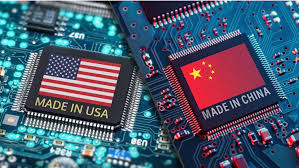
Power in the contemporary world is being subjected to a profound transformation. It is no longer confined to territorial control or military strength; rather, it is gradually anchored in technology and, more specifically, in the periphery of intelligence systems. This shift is not just theoretical, it is already unfolding. As artificial intelligence becomes central to economic, military, and political structures, the nature of global power is being reconfigured but also leading to the AI Cold War.
Understanding the AI Cold War
The idea of an AI Cold War draws from the earlier Cold War, where there was no direct military confrontation between the United States and the Soviet Union. Instead, competition took place through nuclear capabilities, the space race, and the intense ideological influence. A similar pattern is now visible between the United States and China. There is no direct war currently taking place, yet intense competition does exist in artificial intelligence, data, semiconductors, and digital systems. This is why it is often portrayed as a silent war for technological dominance, where traditional weapons are incrementally replaced by technological superiority. This phase became more visible around 2017–2018, when China formally announced its ambition to become a global leader in the sphere of artificial intelligence.
Why does AI actually matter?
Artificial intelligence is no longer merely a technological tool; it has evolved into a central source of power. It strongly influences economic systems through automation, military capabilities through drones and cyber warfare, governance through surveillance, and information flows through algorithmic influence. A striking irony of the digital age is that humans are repeatedly required to prove they are not machines, through mechanisms such as CAPTCHA; while simultaneously perating within systems governed by algorithms. This raises an important question: are humans controlling technology, or are technological systems subtly shaping human behaviour? This reflects a deeper transformation: control is no longer always visible, but embedded within systems. Thus, it becomes apparent that whoever leads in AI is likely to lead in global power structures.
The Evolution of the US–China Rivalry
The rivalry between the United States and China has evolved in three phases:
● 1990–2010 (Economic Cooperation): China’s rapid economic growth was supported by US investment, with minimal conflict.
● 2016–2020 (Trade War): The US accused China of unfair trade practices, leading to tariffs and restrictions.
● 2020–Present (Technological Rivalry): The focus shifted to AI, semiconductors, and data; marking the emergence of the AI Cold War.
The Technological Battleground
The AI Cold War is primarily fought through technological systems rather than physical weapons.
Semiconductors: The Backbone of AI
Semiconductors, or chips, are the ‘CORE OF POWER’ of artificial intelligence. They process information, perform calculations, and facilitate advanced computing. Without them, AI systems cannot operate. The United States has strictly restricted the rapid export of advanced chips to China and has consistently pressured its allies such as the Netherlands and Japan in order to curb connectivity to key technologies. Companies like NVIDIA produce the most advanced AI chips, while ASML provides essential chip-making equipment. In response to this move by the United States, China is investing heavily in domestic semiconductor production to reduce dependence on foreign systems. Control over semiconductors has become the basis of technological power.
The AI Race: From Business to State Power
The confrontation between companies such as OpenAI, Google, and Microsoft in the US, and Baidu, Alibaba, and Tencent in China, directly reflects a broader shift. Artificial intelligence is no longer just a strategic business, it is increasingly an instrument of state power, steering governance, decision-making, and global influence.
Data and Digital Control
AI depends on massive amounts of data. China benefits from a large population and centralized systems, while the US leverages global digital platforms. This has led to the immediate emergence of two parallel digital ecosystems, gradually dispersing the global internet. Data is not merely information; it is the raw material of intelligence and control.
The Physical Dimension
Despite being largely technological, the rivalry has certain visible geopolitical aspects as well, which seems to be clearly visible in the forefront. In the South China Sea, both nations assert strategic presence. Taiwan remains the most sensitive flashpoint due to its extensive dominance in advanced chip manufacturing. Both the respective countries are integrating AI into military systems, including drones, surveillance, and cyber warfare.
A Global Network, Not Just Two Powers
While the rivalry is mostly centred on the US and China, it also incorporates a broader global network.
■ Taiwan → advanced chip production
■ Netherlands → chip-making machines
■ South Korea → industrial production
■ Japan → materials and components
Countries like India and others act as balancing players, engaging with both sides while building their own capabilities.
Selective Decoupling and Strategic Adjustment
The world is not splitting completely but it is definitely undergoing a controlled fragmentation.
☆ Selective Decoupling: Separation in critical areas such as AI and chips while maintaining broader economic ties.
☆ De-risking: Reducing dependence without severing relationships.
☆ Friend-shoring: Moving supply chains to trusted countries.
☆ Tech Sovereignty: Building independent technological systems.
The Changing Nature of Alliances
Alliances are no longer defined solely by military cooperation only. Today, they are shaped by:
1. technology
2. supply chains
3. data
4. economic alignment
Countries now cooperate not only for defence but in order to control systems of influence and power as well.
AI Cold War – The Future Scenarios
Three possible trajectories could merge in the upcoming Era of AI Dominance:
● Dual Systems: US-led and China-led technological blocs
● Multipolar World: Multiple countries develop independent capabilities
● Hybrid Model: Competition combined with limited cooperation
Conclusion
The AI Cold War embodies a decisive shift in global power structures. The rivalry between the United States and China is no longer about territory or traditional warfare, but it is more about control over technology, data, and systems of intelligence. Power today lies not in territorial conquest, but in shaping the infrastructure that others depend upon. The future of global order will be defined not by who regulates territory, but by who controls intelligence, technology, and influence. Much like how power in any system seeks expansion beyond its initial domain, technological dominance too extends across borders, influencing regions, systems, and societies.
Article written by Sruti Bhaumik