

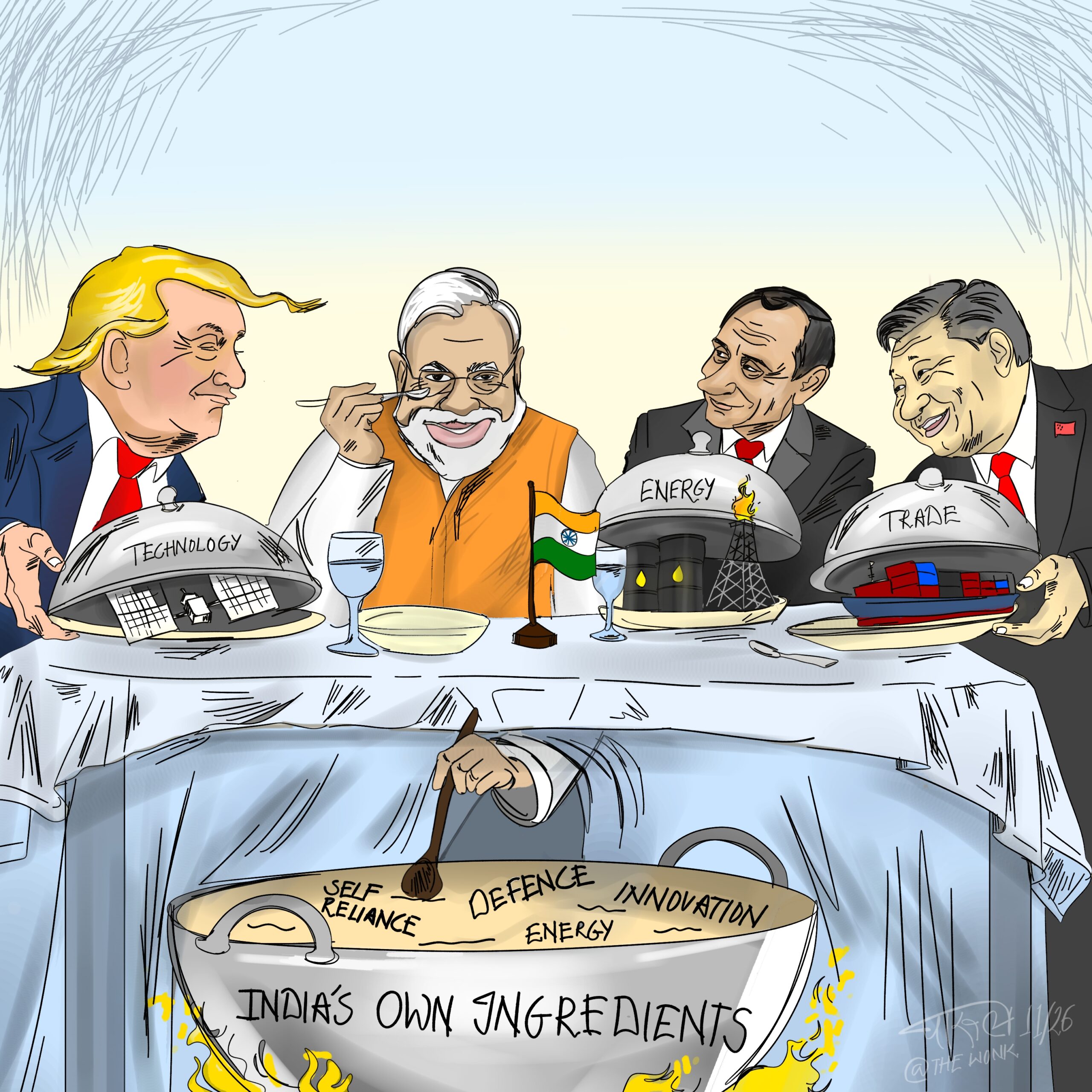
India is a country that follows a strategy of strategic autonomy. This means that India can collaborate with certain countries without feeling the pressure to conform. The strategy stems from the Non Aligned Movement and follows a very flexible approach, which means that India sees the U.S, Russia and China as both allies and competitors.
During the Cold War, India wanted to move towards a multipolar world and saw the major powers as balancing each other. Modern day leaders follow this strategy. Foreign Minister Jaishankar famously said that we should “engage America, manage China, reassure Russia,” whilst maintaining our relations with Europe, Japan and its neighbours. India follows a strategy of selective alignment. It participates in Western-led alliances such as the Quad and technology partnerships.
Diplomatic Alignments and Multilaterals
India is a member of many international groupings and founding member of the Quad with the U.S, Japan and Australia. This grouping focuses on security of the Indo-Pacific however this ‘democratic quad’ has become an important part of U.S strategy. India is very enthusiastic about participating in joint military exercises and infrastructure projects with the group however usually leaders do not explicitly label them as being anti China.
India is also co-leaders of BRICS along with Brazil, Russia, China and South Africa. It has expanded this to 10 members by 2026 (Iran, UAE, Ethiopia and Egypt). Indian leaders used the BRICS during the Beijing Summit 2024 to advocate for Global South issues however were careful not to come across as anti western.
India is also a member of the Shanghai Cooperation Organisation with China, Russia, Pakistan and others. This allows India to push for counter terrorism issues and show diplomatic relations within the region. For example, during the 2025 Summit in Tianjin, Prime Minister Modi sat between Putin and Xi and helped create a declaration on security. However there has been underlying tensions between China and India (border disputes and trade deficit).
India also became the G20 president in 2023. India pushed for the Voice of the Global South and held a large summit in New Delhi. India also proposed that the African Union should become a permanent member of the G20 to position itself as a link between developing and developed countries. India also participates in many smaller multilateral groupings, such as I2U2 (Israel, UAE and U.S.), BIMSTEC in South Asia/Bay of Bengal and also co-chairs various groupings such as the Quad Plus technology grouping.
India is always trying to find a balance in all groupings. India does not want to align with any formal alliances (India does not participate in AUKUS or NATO expansions). However, India is happy to bring together like-minded democracies. India is very keen to participate in Western-led technology partnerships such as semiconductor supply chains. India is also excited about the Quad vision of a free infrastructure. India often complains about U.S. meddling in South Asian disputes. Russia has played a new role. Russia has lost some of its influence as a global power after Ukraine.
India has mostly abstained from voting on issues relating to Ukraine and Russia in the UNSC since 2022. India does not want to upset either Moscow or Western capitals. India has created a network of relations with everyone. All of this is underpinned by the theme of non-alignment.
India and the United States: A Strategic Partnership with Economic Friction
India has seen a significant growth in relations with the United States in the last two decades. Both countries also share similar priorities around China’s growing influence in the Indo-Pacific region and the need for secure supply chains, cutting edge technology and maritime security. India shares a strong partnership with the United States around Defence, Space, Artificial Intelligence, Semiconductors, Clean Energy and Counterterrorism.
India has participated in the Quad with the U.S., Japan and Australia. This shows that India wants to see stability within the Indo-Pacific; however, India does not see the Quad as a formal military alliance. India does not want to get caught up in a U.S. led conflict with China. As noted by the Council on Foreign Relations, this has caused some limitations to the partnership because India does not want to take a confrontational stance towards China.
There has been some economic tension. The U.S. is a key export market for India. India wants investment from America to strengthen its industry and also become part of global technology supply chains. However, there have been tensions over tariff issues.
In 2026, Prime Minister Narendra Modi and Donald Trump met on the 30 th September to discuss trade, defence, energy and critical technology. Marco Rubio (U.S Secretary of State) visited India between the 20 th and 22 nd October. However reports showed that an overall trade deal had not been finalised.
India and Russia: A Partnership Built on History, Defence and Energy
India has a long history of working with Russia. Moscow has been an important supplier of defence equipment since the Cold War. This includes aircraft, tanks, missiles and air defence systems. Russia has also supported India’s civil nuclear energy programme and is still an important part of their energy security.
The Ukraine war has changed the relationship. Western sanctions have caused Russia to shift energy exports to Asia. This has allowed India to purchase crude oil from Russia. This helps manage energy costs and meet the needs of a large and growing economy. Russia benefits from accessing the Indian market.
Recent data shows that trade between the two countries is strong. According to the India Brand Equity Foundation, bilateral trade reached US$47.7 billion during the first seven months of 2026, a 24.3% increase year on year. Russian exports to India accounted for approximately US$44.9 billion, including US$36 billion in crude oil imports. Indian exports to Russia, however, were only around US$2.8 billion, highlighting a substantial trade imbalance.
The defence relationship has also continued. The Indian Navy completed the INDRA bilateral naval exercise with Russia in October 2026. However the relationship is becoming more complex. Russia has become increasingly reliant on China (especially since the invasion of Ukraine). This causes concerns for New Delhi. If Russia becomes closer with China then India will lose its ability to be an independent strategic counterweight.
India must maintain its relationship with Russia but not let its historic ties limit its other partnerships. It is not about whether India should turn away from Russia, but how India can diversify its defence supplies and increase exports whilst limiting its over-reliance on Russian energy.
India and China: Economic Interdependence Amid Strategic Rivalry
India’s relationship with China is the most challenging of the three major powers. This is because there is a lot of economic interdependence but there are also territorial disputes and strategic distrust. The 2020 Galwan Valley clash (which resulted in 20 Indian soldiers losing their lives) caused a huge impact on the relationship.
Both parties have attempted to manage tensions however there are still issues with the boundary dispute. This is made more complex due to China having a strong partnership with Pakistan.
There is a paradox with the economic relationship. China is a key importer for India. India imports electronics, machinery, chemicals and industrial parts from China. Whilst this is beneficial for India, it causes issues with critical supply chains. During the financial year 2024-2025 the trade deficit reached around US$99.2 Billion.
However, recent diplomatic movements have shown that both parties understand the need to manage differences. The 25th round of Special Representatives’ boundary talks between India and China took place in Beijing on 25 August 2026. Eight points of consensus were reached, including additional meeting points for military commanders and new boundary hotlines. Both parties agreed to host the next round of talks in India in 2027.
On the 12th September 2026, Prime Minister Narendra Modi met with Chinese President Xi Jinping discussing border peace, trade deficit, supply chains and market access during the BRICS summit in New Delhi. On the 13th October, India reaffirmed that the Union Territory of Ladakh is an integral part of the country.
This shows that India takes a proactive approach when engaging with China but does not want to be strategically naïve. As there is an extensive economic relationship between both countries, India cannot afford to ignore China. However, India must have credible deterrence to ensure it has better infrastructure around the borders and diverse critical imports.
India has engaged with BRICS and the Shanghai Cooperation Organisation to build a dialogue with China. However, India has also engaged with the U.S., Japan and Australia to strengthen its position in the Indo-Pacific. This is not a paradox. This is an attempt to control the economic dependency whilst preparing for strategic competition.
Multi-Alignment: India’s Broader Geopolitical Strategy
India’s strategy to balance its relationships goes beyond bilateral relations. By being a member of the Quad, BRICS, the Shanghai Cooperation Organisation and the G20, India is able to engage with countries that have differing political and economic interests.
India collaborates with the U.S., Japan and Australia through the Quad to strengthen maritime security, infrastructure and emerging technology. However, India also collaborates with Russia and China through the BRICS and SCO forum. Furthermore, India has strong relationships with Europe, Japan, ASEAN and Gulf nations to ensure diversity in investment, technology and energy.
India has been increasingly looking at technology and supply chain security. In February 2026, India was invited to join the Pax Silica initiative. India has also been part of the India-U.S. AI Opportunity partnership. This can help India reduce its dependence on concentrated sources of critical technology and increase investment in high-end manufacturing.
There are some limitations to being multi-aligned. The interests of different countries may not always align. Just because countries are working together in one area does not mean they will support each other in another. The U.S. may want India to reduce its reliance on Russian energy, while Moscow wants to maintain its business relationship with New Delhi. China is an important economic partner; however, security issues remain. India must decide whether to work with each partner based on its own national interests.
Strategic Autonomy Must Be Backed by National Capability
India’s geopolitical balancing act is not a neutral strategy. It is a practical way of ensuring that it maximises its national interests. The U.S. provides advanced technology, investment and strategic partnerships. Russia provides strong defence relationships and energy supplies. China is an influential neighbour and a key trading partner. However, serious security issues remain.
Recent developments in October 2026 show that this strategy is still relevant. India continues to work with Washington to negotiate a trade deal while protecting its economic interests. It is also building stronger business and energy relationships with Moscow while engaging with Beijing despite unresolved territorial issues. There are opportunities with each relationship, but there are also risks.
India needs to boost its indigenous defence industry to increase competitive exports, provide assurance of energy security, develop advanced technology and build robust supply chains to achieve true strategic independence. This will help reduce over dependence on any single country thus allowing New Delhi more freedom to make independent decisions.
Overall, India’s long-term goal should not simply be to balance the U.S., Russia and China, but to strengthen its economic and strategic position so that it can choose to work with each country on its own terms. In an increasingly uncertain world, the best way to ensure independence is not to remain neutral between competing powers, but to have the capability to engage with each of them independently.