

The sighting of two US-operated Boeing KC-135 Stratotankers over Indian airspace has drawn attention to an important but often overlooked aspect of Indian military aviation: the Indian Air Force’s requirement for reliable aerial-refueling capacity. The obvious question is why India needs American tanker aircraft when it already operates six Russian-origin Ilyushin Il-78MKI aerial refuellers.
The answer lies in the difference between possessing a fleet and having enough aircraft available to meet training and operational requirements.
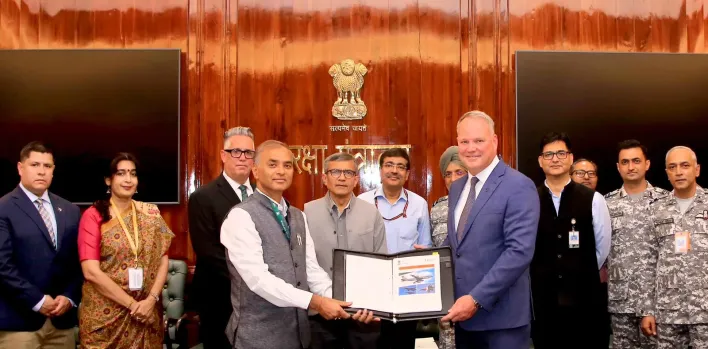
The Ministry of Defence signed a contract with US-based Metrea Management on March 28, 2025, for the wet lease of one flight-refuelling aircraft, a KC-135, to provide air-to-air refuelling training to pilots of the Indian Air Force and Indian Navy. Under a wet-lease arrangement, the provider supplies the aircraft along with its operating crew and associated support. This allows the military to access the service without having to independently operate and maintain another tanker.
The development has acquired fresh attention following reports that two Metrea-operated KC-135-family aircraft, bearing registrations N5xxMA and N7xxMA, have been observed operating over India. However, the original government announcement specified one aircraft, and the presence of two aircraft does not establish that both are operating under the IAF contract. Their precise contractual roles need confirmation.
India’s aerial-refuelling journey began taking shape in the early 2000s, when the IAF moved to acquire six Il-78 tankers from Uzbekistan. The first aircraft joined the newly raised 78 Squadron at Agra in March 2003, with the remaining aircraft inducted by 2004. The acquisition marked an important change in the IAF’s ability to extend the range and endurance of its combat aircraft.
The Il-78MKI became a crucial force multiplier, allowing compatible fighters to remain airborne for longer periods, undertake extended missions and reposition over greater distances. Its probe-and-drogue refuelling system supports aircraft such as the Su-30MKI, Mirage 2000 and Jaguar. The IAF has also demonstrated aerial refuelling with its Embraer airborne early warning and control aircraft and conducted successful refuelling trials with the indigenous Tejas Mk1 in 2018.
But the six-aircraft fleet has faced persistent maintenance and serviceability challenges. A report by The Indian Express in June 2025 noted that only three to four of the six Il-78MKI tankers were serviceable at a given time. The Comptroller and Auditor General had earlier highlighted delays in repairs, inadequate availability of spares and shortcomings in maintenance support. This means that the IAF cannot assume that all six aircraft will be available whenever training or operational requirements arise.
This helps explain the decision to bring in a contractor-operated tanker. Aerial refuelling is a demanding skill. The receiving pilot must maintain precise formation with the tanker and connect the aircraft’s refuelling probe to a drogue, or basket, trailing behind the tanker. Both aircraft must maintain carefully controlled flight parameters throughout the transfer. Regular practice is essential to maintain proficiency, and using a leased aircraft can reduce the training burden on the ageing Il-78 fleet.
There is also an interesting technical distinction. The KC-135 was originally designed around a flying-boom refuelling system, but Metrea’s aircraft can be configured with its Multi-Point Refuelling System (MPRS) pods. These allow probe-equipped aircraft to receive fuel through the probe-and-drogue method used by the IAF. The leased aircraft is therefore not simply a tanker of a different origin; its configuration is important to the training requirement.
Another aspect of India’s aerial-refuelling capability is the practice of buddy refuelling. The term refers to one combat aircraft carrying a refuelling pod and transferring fuel to another aircraft of the same type or a compatible platform. The technology you may recall from discussions around the MiG-29K is the Russian UPAZ refuelling pod.
The MiG-29K, operated by the Indian Navy, has a buddy-refuelling capability using the UPAZ system. The Su-30MKI also has a buddy-refuelling capability through a strap-on pod, as confirmed by the Ministry of Defence in a written reply in the Lok Sabha in 2017. This allows a suitably configured aircraft to act as a limited, tactical refuelling source for another aircraft.
However, buddy refuelling is not a substitute for a dedicated tanker. The aircraft transferring fuel must carry the relevant pod and reserve fuel for the transfer, which places limits on the amount of fuel available and the mission it can undertake. A dedicated tanker, by contrast, is designed to carry and transfer substantially larger quantities of fuel to support multiple aircraft. The two capabilities complement each other rather than serve the same purpose.
The larger issue is that the IAF needs a more dependable and sizeable tanker fleet as its combat aircraft undertake increasingly demanding missions. India has been pursuing the acquisition of additional aerial-refuelling aircraft for years. In February 2024, the Defence Acquisition Council cleared the procurement of six new tankers, while the IAF was reported to be conducting technical evaluations in 2025. The Metrea arrangement provides an interim training resource; it does not resolve the longer-term requirement for dedicated tankers.
For the IAF, the value of aerial refuelling extends well beyond increasing the flying time of fighter aircraft. It supports long-range deployments, extended air operations, strategic mobility and the ability to keep aircraft airborne when operational circumstances demand it. As India’s air power requirements grow, the availability of reliable tankers will remain an important factor in determining how effectively its combat fleet can be employed.
The KC-135 arrangement, therefore, is best understood as a practical response to a training and fleet-availability challenge. India already has the capability, but it needs more consistent access to it. The immediate lease can help sustain pilot proficiency, while the larger task remains modernising and expanding the country’s dedicated aerial-refuelling capacity.