

Sometimes, a small change can start a much bigger conversation.
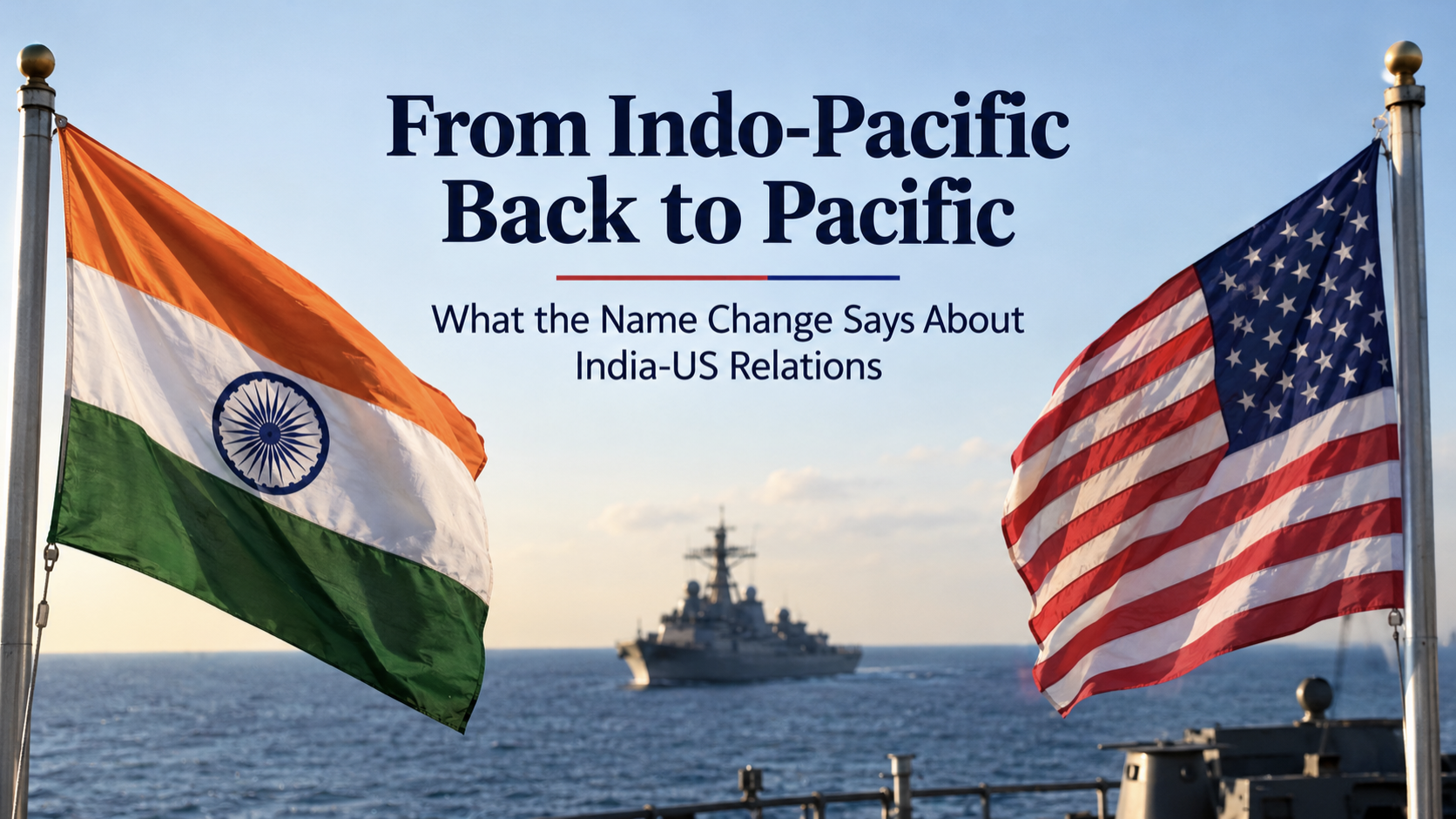
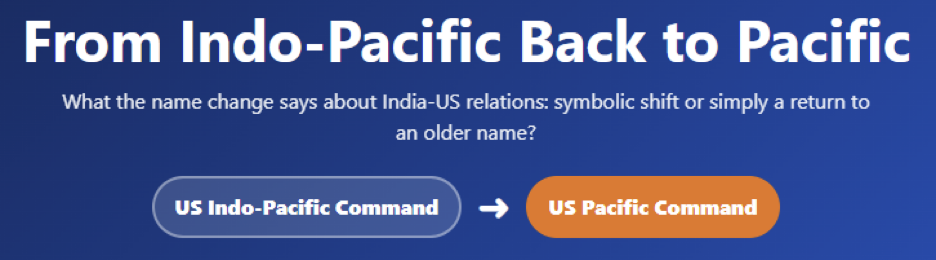
On June 16, 2026, the United States announced that its US Indo-Pacific Command would return to its former name, US Pacific Command. The decision brought back a name that had been in use for more than 70 years before it was changed in 2018.
The Pentagon described the move as a way to honour the command’s history. It also made one thing clear: the command’s mission and geographical area of responsibility would remain unchanged.
So, why has the decision attracted attention in India?
The answer lies in the timing. India and the United States have spent years building closer defence and diplomatic ties. But trade disagreements, differences over Russian oil and changing regional priorities have also tested their relationship. Some also ask whether the change reflects how Washington sees India’s role against China.
The name change has added another question to the discussion. Does it signal a shift in America’s approach to India, or is it simply a return to an older name?
The answer is not as simple as it might appear.
Why Did the US Add “Indo” to the Name in 2018?
To understand the latest decision, it helps to look back.
The US Pacific Command was established on January 1, 1947, under President Harry S. Truman. It became an important part of America’s military presence across the Pacific region.
On May 30, 2018, the United States renamed it the US Indo-Pacific Command. The announcement came from then-Defence Secretary James Mattis, who pointed to the growing connection between the Indian and Pacific oceans.
The change reflected a wider understanding of regional security. Trade routes, maritime activity and China’s growing influence were making the two oceans increasingly connected in strategic terms.
India’s role was also becoming more important to Washington.
For New Delhi, the new name carried a positive message. It recognised India’s growing place in American thinking about Asia and the importance of cooperation between the two countries.
The original announcement was widely seen as a symbolic recognition of India’s strategic importance. The Associated Press reported on the 2018 name change and its significance for India.
But a name is only one part of a relationship. Defence agreements, military exercises and regular diplomatic contact matter far more when it comes to actual cooperation.
That is why the return to the old name deserves attention, but not an immediate conclusion.
What Has Changed in 2026?
On June 16, 2026, the US Department of War announced that the command would officially return to the name US Pacific Command.
Its explanation focused on military history, tradition, and the command’s long-standing role in the region.
Importantly, the announcement stated that its area of responsibility, stretching from the waters off the US West Coast to India’s western border, would remain the same. Its fundamental mission would also continue unchanged.
The details are available in the official US Pacific Command announcement.
This is an important point. The United States has changed the command’s name, but its official announcement does not describe a withdrawal from ties with India in the region, or a reduction in military responsibilities.
That does not mean the decision has no political significance. Names can reflect how governments want to present their priorities. But the available evidence does not establish that Washington intended to send India a negative message.
The distinction between a symbolic change and an operational change matters. The first can invite questions; the second would require evidence of changes in actual policy or military activity.

So far, the name change alone does not prove that America’s approach to India has changed.
Why the Timing Matters for India
The decision came during a difficult period in India-US relations.
Trade has been a major source of tension. In August 2025, the United States imposed tariffs of up to 50% on most Indian goods. A framework announced in February 2026 envisaged an 18% reciprocal tariff rate, but negotiations subsequently faced difficulties.
Energy has also been a sensitive issue. India continues to make decisions about its oil supplies based on price, availability and national energy needs. Washington, meanwhile, has raised concerns about India’s purchases of Russian oil.
These disagreements affect businesses, exporters and wider economic planning. They also make every new diplomatic development more likely to attract scrutiny.
Against this background, it is understandable that some observers might see the removal of “Indo” as another sign of distance between the two countries.
However, timing does not establish motive. The Pentagon has not said that the renaming was a response to India’s trade policy or its energy purchases.
It would therefore be premature to treat the change as evidence that the United States is deliberately reducing India’s importance.
Is This About India’s Approach to China?
There is another way to look at it. The “Indo-Pacific” idea was mainly about balancing China’s rise. So some experts ask a simple question. Did the US hope India would do more against China, including in the South China Sea? And does Washington feel that hope has not been met?
A writer in ThePrint says this could explain why the US seems less keen on the “Indo-Pacific” label. According to this view, India has chosen to keep tensions with China under control and rebuild trust, instead of openly standing against it. Many in the West expected something different. An analysis from the Hudson Institute goes a step further. It says the new name suggests the Indian Ocean is not central to America’s plans on China.
Some Indian experts disagree. A commentary from MP-IDSA says India’s independent approach is a clear policy choice, not a weakness. It calls the name change a symbol, not a break in relations.
Two points are worth remembering. First, the Pentagon has not given this as a reason, so it is only an opinion. Second, India’s stand on China is also shaped by its own border and security concerns, not just by what the US wants.
If this view is correct, the real question is how closely the two countries can work together on China while India stays independent.
Defence Cooperation Tells a Bigger Story
Military cooperation offers a more practical way to judge the relationship.
In February 2026, Admiral Samuel J. Paparo, then commander of the US Indo-Pacific Command, visited India to discuss shared security interests and strengthen military ties. His visit included meetings with senior Indian defence officials and engagements involving technology and defence cooperation.
The details are available in the official US Pacific Command report on Paparo’s February visit.
Paparo returned to India from October 3 to 8, 2026, after the command had restored its former name. The Tribune reported on the visit, which focused on strengthening military cooperation and discussing emerging technologies and maritime security.
These visits do not prove that every disagreement has been resolved. But they show why it would be misleading to judge the entire defence relationship by a change in name.
India and the United States continue to have practical reasons to cooperate, including maritime security, technology development and regional stability.
The real test will be whether such engagement continues to produce meaningful results.
Trade and Energy Could Decide the Next Chapter
Trade negotiations provide another important measure of the relationship.
On October 20, 2026, US Secretary of State Marco Rubio met India’s External Affairs Minister S. Jaishankar in Mumbai. According to the Associated Press report on the meeting, Rubio said the two countries were very close to completing a trade agreement, with a small number of issues still outstanding.
That was an encouraging statement, but it did not mean the agreement had been signed.
For businesses, the final terms matter more than optimistic comments. A completed agreement could offer greater clarity on tariffs and trade, while continued delays would leave important questions unresolved.
Energy will require equally careful handling. India needs reliable and affordable supplies, while the United States has its own concerns about Russian oil and global energy security.
Neither country is likely to get everything it wants. Progress will depend on finding arrangements that both governments can accept.
If trade negotiations reach a concrete conclusion and energy discussions move forward, those developments would provide stronger evidence of cooperation than any change in military terminology.
What Does the Change Mean for the Quad?
The Quad brings India, the United States, Japan and Australia together to discuss regional security and cooperation.

Its work includes maritime issues, critical technologies and other shared concerns. For India, it is one way to cooperate with important partners while maintaining its own foreign policy priorities.
The return to the name Pacific Command does not, by itself, mean that Washington intends to weaken the Quad or reduce India’s role in it.
That question should instead be judged through future meetings, joint initiatives and the willingness of all four countries to continue working together.
India and the United States do not need to agree on every issue for their partnership to remain useful. But both need to show that their shared interests can lead to practical action.
The Quad’s future will depend on that effort, not simply on the name of a US military command.
What Should India Watch Next?
Four developments deserve particular attention.
First, the trade agreement. Will both sides finalise and sign it? A completed deal would provide a clearer picture of their economic relationship than repeated assurances that negotiations are close to completion.
Second, energy cooperation. India and the United States will need to manage their differences over Russian oil while addressing India’s need for affordable and reliable supplies.
Third, defence and Quad cooperation. Continued military engagement, technology partnerships and regional coordination will help show whether the strategic relationship remains strong.
Fourth, India’s approach to China. How closely the two countries can work together on China, while India keeps its independent approach, will help show how far their strategic goals match.
These developments will provide more meaningful evidence of the direction of India-US relations than the name change alone.
The Bottom Line
The return from Indo-Pacific Command to Pacific Command is worth noticing. But it is not, by itself, proof that the United States is turning away from India.
The official announcement says the command’s mission and area stay the same. Still, trade problems and disagreements over energy show that the two countries face real challenges. Some experts also wonder if the US hoped India would do more against China, and if this name change is a message about that. The Pentagon has not said so, and some Indian experts call it a symbol, not a break.
So India should not ignore the change, but it should not panic either. The best step is to watch what both countries actually do next.
Will they finish their trade deal? Can they handle their energy differences? Can they work together on China while India stays independent? Will defence and Quad cooperation keep giving real results?
These are the questions to watch.
The name on the letterhead has changed. Whether the partnership changes too depends on actions and results, not on one word.