

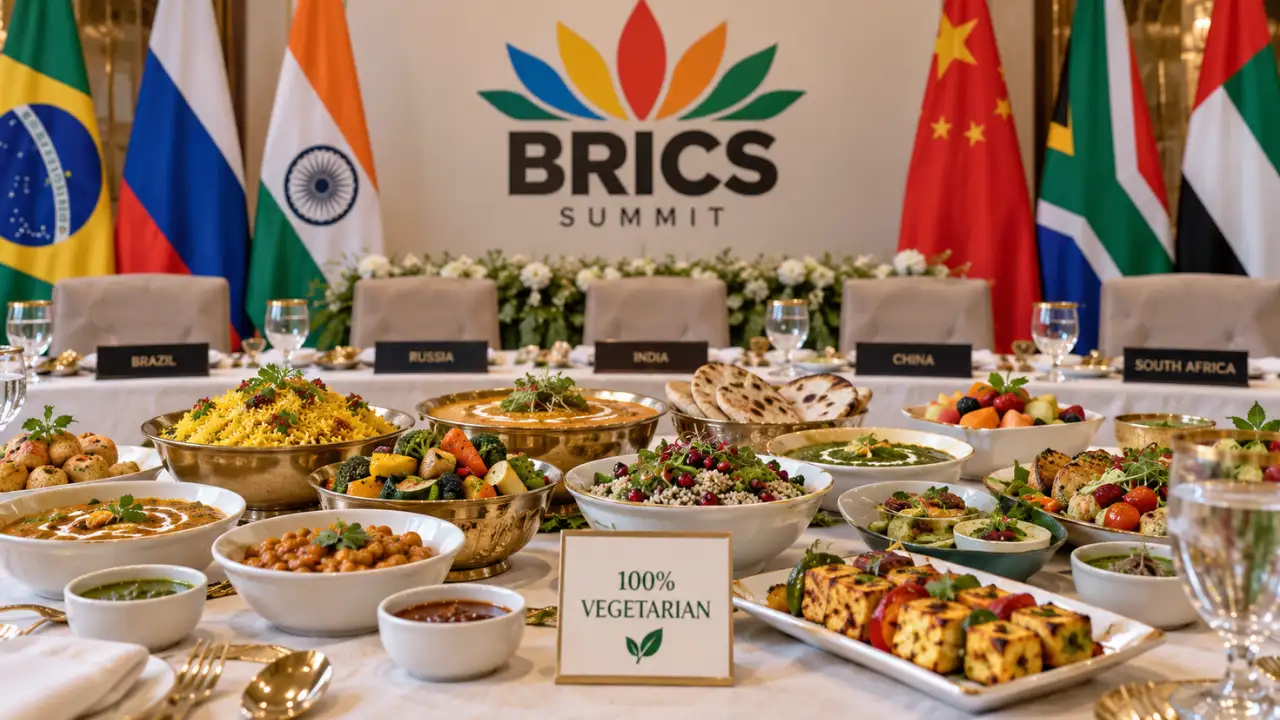
When the world’s leaders meet for a major diplomatic summit, the discussions tend to centre around geopolitics, trade, security, technology and cooperation. However, the 18th BRICS Summit in New Delhi has one peculiar feature that sets it apart from other summit. India hosted an extravagant all-vegetarian gala dinner for the visiting leaders and delegates at Bharat Mandapam on September 12, 2026.
This was not just any dinner, but one that sought to highlight India’s regional cuisine, with delicacies such as khandvi mille feuille, mushroom galouti, paneer lababdar, Himalayan morels, millet pulao, beetroot raita, Old Delhi fruit cream and shahtoot phirni making this a memorable dining experience.
This decision has generated quite a controversy, considering the cultural differences among the BRICS nations. Perhaps this is an opportune moment to discuss the question: Can food be a diplomatic tool without stereotyping a country’s cuisine?
Food as a Language of Diplomacy
Diplomacy is also about cultural exchange. Food is the perfect medium for such an exchange since it is universal. India’s dinner for the visiting leaders was an excellent example of using food to woo the guests. India showcased its regional cuisine, and the dinner was a grand tour of the country’s culinary delights.
The dinner began with khandvi mille feuille (inspired by Gujarat’s khandvi) and khumb galouti (mushroom version of the famed galouti kebab). As for the main course, the chefs have prepared paneer lababdar, Gucchi Marmik, carrot bean poriyal, thakkali belle saaru, millet pulao, beetroot raita and Indian breads. To finish off the meal, guests were served Old Delhi fruit cream with jalebi and shahtoot phirni.
What is interesting about this menu is that it showcased India’s geographical diversity. Gujarat was represented by khandvi, the Himalayan region by morels, South India by poriyal (lentils and spinach) and lentil preparations, and Delhi by its desserts. In fact, this was not merely a dinner, it was a tour d’honneur of Indian cuisine.
Showcasing Vegetarian India
India has a rich and varied cuisine. Indian vegetarian food is also quite diverse. This is because the Indian subcontinent has been a confluence of various cultures. Indian vegetarian cuisine is not just simple vegetarian fare from north to south and west to east, you can find a bewildering variety of vegetarian dishes made from indigenous ingredients and using traditional cooking methods.
The BRICS menu was an attempt to show this variety. Use of millets in the menu showed India’s interest in this group of nutritional cereals. The menu also included Himalayan morels, saffron, coconut, curry leaves and other spices that reflect India’s diverse cuisine. According to The Indian Express , the dinner was an exercise in showcasing India’s vegetarian cuisine and its association with healthy and wholesome food.
This makes the menu quite significant. While most people are familiar with the quintessential Indian dishes the butter chicken, the biryani and the naan the Indian vegetarian cuisine is vast and diverse. The dinner was perhaps an attempt to show the foreigners that, yes, Indians do eat more than chicken and mutton.
From Local Ingredients to Global Diplomacy
The BRICS summit used food as a diplomatic tool, not just during the dinner. India’s attempt to woo the visiting delegates went beyond the dinner menu. For instance, the media kit, a gift for journalists covering the summit included products from various parts of India. Bihar’s sattu and makhana, Odisha’s Koraput coffee, and handicrafts from Gujarat were included in the kit. The initiative was intended to showcase the “India Story”.
This is an example of how Indian regional products get publicity through global events. Sattu is a coarse flour that can be made from various cereals like wheat and barley. It is healthy and is used in making various healthy Indian snacks and beverages. Makhana, or fox nuts, is a healthy snack. Koraput coffee is a high altitude coffee from Odisha. These three items represent various food products from India.
The use of regional products is an interesting aspect of cultural diplomacy. This is because it introduces the delegates to the local products. Makhana, for instance, may be a new product for many people. The idea is that the same product can open up new business opportunities in the host country (in this case, India) and the guest country (in this case, the countries represented by the BRICS delegates).
The “India Friendship Menu”
Interestingly, the food diplomacy did not end with the dinner. The hotels hosting the foreign delegates have special menus for them. The executive chef of Taj Mahal, New Delhi, Kaushik Misra, said that his team had worked on the menus for the foreign delegates. They worked for months to understand the food preferences of the visiting groups. The Taj Mahal prepared an “India Friendship Menu” for in room dining. Unlike the official dinner, this menu also featured non vegetarian delicacies like nalli nihari, pepper fry with almonds. The idea was to provide comfort food while also introducing Indian dishes.
This was an important distinction. While the official dinner was all vegetarian, the “India Friendship Menu” had both vegetarian and non vegetarian dishes. The menu was, in fact, an admission that no single menu can showcase an entire country’s cuisine. Different people have different tastes, and the BRICS countries represent a wide swathe of people with varying food preferences.
The “India Friendship Menu” at the Taj Mahal was an eye opener in this respect. Kaushik Misra and his team did not limit themselves to vegetarian fare. In fact, the menu included nihari, which is a stew originating from the Mughal era. In addition, the Taj team also prepared a map of India that showcased regional delicacies. The delegates were also given recipe books to take back with them. Thus, the food diplomacy went beyond a dinner – the menus became a part of the cultural exchange between India and the BRICS countries.
Why the Vegetarian Menu at BRICS 2026 Became Controversial
The official dinner menu was supposed to reflect India’s regional cuisine, but it featured exclusively vegetarian items. In India, this has led to a backlash with some people claiming that it was a failure of the government to recognise the country’s diverse cuisines. Congress leader Rahul Gandhi remarked that Indian non vegetarian food was also a part of the country’s cuisine. The New York Times echoed this view, writing that although some government officials claimed that the dinner was a showcase of India’s vegetarian cuisine, many others said that it was an insult to Indian cuisine.
This is an interesting argument. It brings us to the core of the problem with food diplomacy: can you showcase an entire cuisine? And, if not, whose preferences are being catered to? A dinner, or even a menu, can only represent a particular segment of a country’s cuisine. It is a choice that the host makes. The question is what narrative does the host want to push through the menu?
In this case, India wanted to promote vegetarian cuisine.
However, that does not mean that vegetarians are the sole representatives of Indian cuisine. India has a long history and tradition of non vegetarian cuisine as well. It is impossible to ignore the contribution of the non vegetarian food segment in India’s culture and cuisine. Besides, Indian vegetarian food also varies widely across regions and communities. That is why India’s choice of food for the BRICS dinner has created a lot of controversy in the country.
Xi Jinping’s Absence and the Food Debate
It has been reported that Chinese President Xi Jinping did not join the dinner. Speculation followed, linking Xi’s absence to the vegetarian menu. Interestingly, reports say that Xi left the dinner early, returning to his hotel to rest. There is no information on whether the reason for him leaving was the food. The New York Times remarked that some analysts said that the menu was a diplomatic snub to China, but others said that there was no evidence for this.
This is an important point. The entire debate on the menu is based on a misunderstanding. Xi’s absence from the dinner has been reported, but it has not been stated that it was because of the menu. On the other hand, the choice of vegetarian food for dinner has been stated as a fact.
In this case, there are too many assumptions being made on both sides. The menu choice is definitely a sensitive issue for many people. However, it would be irresponsible to jump to conclusions without verifying facts.
Beyond the Dinner Table
India’s food diplomacy goes beyond the dinner plate. While the main event was the dinner, other initiatives were taken to impress the foreign delegates with Indian cuisine. For example, at The Leela Palace, edible lotus made with rose, saffron and cardamom, millet cookies, granola bars and wellness infusions were served. The LaLiT combined Indian and international dishes, whereas ITC Maurya created chocolate Matryoshka dolls for the Russian delegates and a chocolate model of Moscow’s skyline. This is an example of how food can be used creatively to impress foreign dignitaries.
Food diplomacy is a clever tool because it is flexible. India used different approaches for different events. The main dinner was a showcase of Indian vegetarian cuisine. Other hotels combined Indian and international fares. The message being sent out was that India was willing to accommodate different tastes. After all, different people have different preferences, and food is a personal preference for many people.
Another interesting aspect of food diplomacy is that the hosts can simultaneously promote their culture and respect the culture of the guests. This is an important point since it shows that food diplomacy can be a mutually beneficial experience for both sides.
A Plate as a Diplomatic Message
The BRICS vegetarian dinner was an excellent example of how food can be used as a tool for diplomacy. The menu itemised India’s commitment to promoting its rich and diverse cuisine to the world. It was an attempt to educate the foreign delegates on what Indian food is all about. At the same time, the choice of vegetarian food indicated India’s concern for the health of the guests.
The dinner was a showcase of India’s commitment to food diversity. It was a tribute to India’s food traditions, including the use of indigenous food items such as millets and Himalayan morels. The dinner also showed that Indian cuisine has a unique place in Indian culture. At the same time, the various hospitality initiatives showed that India cared about the comfort and convenience of the foreign delegates.
This is an important message since the success of a global event depends on the satisfaction of the guests. India’s food diplomacy, therefore, reflects both its national goals and its concern for the well being of the guests.
The vegetarian dinner for the BRICS leaders was an innovative initiative. It created quite a buzz, both in India and abroad. While some people criticised the dinner, others appreciated India’s efforts at promoting its cuisine. The entire episode shows how India is using food as a diplomatic tool to build relationships with other countries.