

Saudi Arabia is coming under pressure from an increasingly difficult security situation as Iran-aligned Houthi forces in Yemen intensify attacks on Saudi territory, energy infrastructure and other strategic sites. The Houthis have also advanced along Yemen’s Red Sea coast and around the Bab el-Mandeb Strait, one of the world’s most crucial maritime chokepoints. For Riyadh, the menace is therefore no longer limited to missiles and drones. It involves the security of its territory, oil infrastructure, energy exports and maritime routes associating the Red Sea with the Gulf of Aden.
Saudi Arabia has subsequently been seeking assistance from several countries as its defensive resources come under extreme pressure. Reports clearly indicate that Riyadh has approached countries including France, Britain, Pakistan and Egypt, while its supply of missile interceptors has reportedly come under strain. The United States has also been providing intelligence cooperation and targeting assistance while stopping short of direct intervention against the Houthis.
But one reported channel of assistance is particularly unusual: ISRAEL.
When Security Needs Cross a Diplomatic Boundary
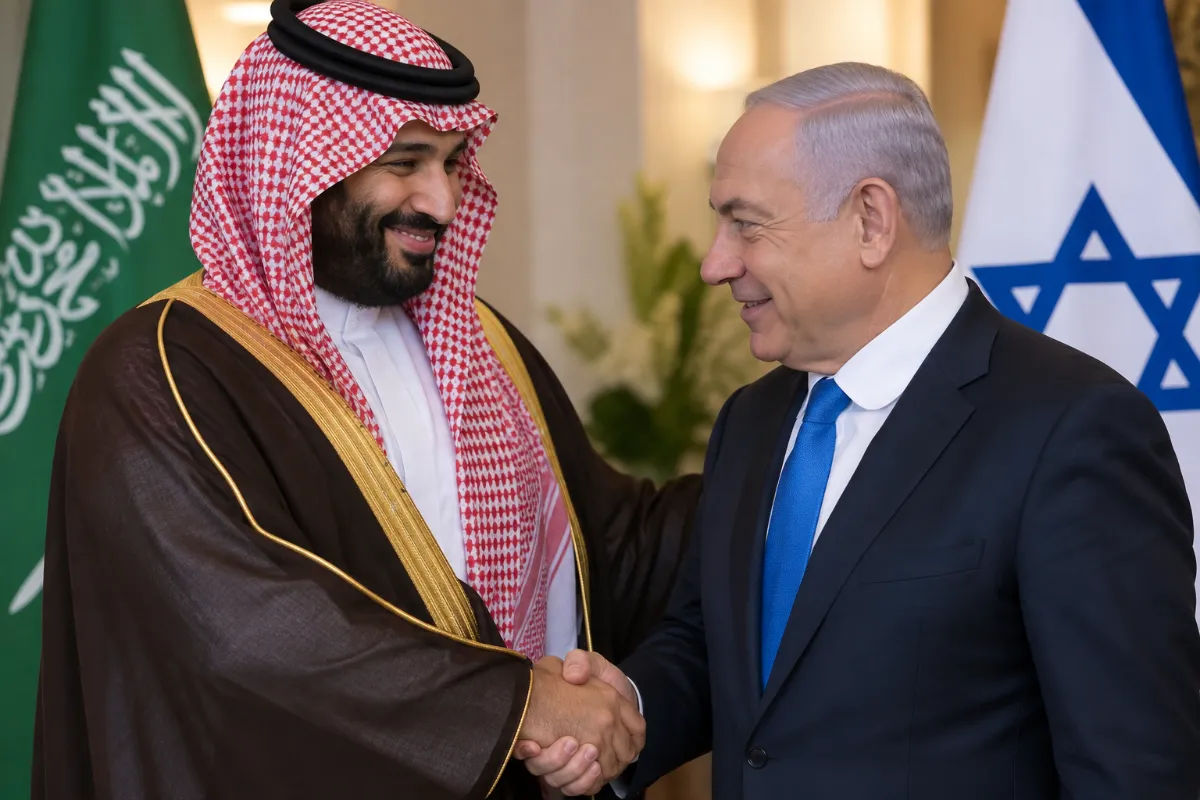
Reports from several other regional outlets indicate that Saudi Arabia and Israel have held US Central Command-mediated discussions over Israeli intelligence assistance against the Houthis. The reported assistance concerns intelligence on Houthi military positions, weapons infrastructure, deployments and intentions. This does not mean that Israel is sending troops to defend Saudi Arabia. The reported cooperation is being centred primarily on intelligence and related security capabilities.
But, the significance lies somewhere else. Saudi Arabia and Israel do not have formal diplomatic relations, and Riyadh has not recognised Israel diplomatically. Yet the contemporary security environment is creating a narrow area in which their interests can certainly overlap. This is the difference between political alignment and strategic convergence.
Political alignment would definitely imply a broader convergence of foreign-policy objectives. That is not what is happening here. Saudi Arabia has not rapidly adopted Israel’s regional positions, nor has it abandoned its position on Palestinian statehood. Strategic convergence is comparatively more confined. Two states can have fundamentally different political positions while recognising that cooperation on a particular security problem serves both their immediate interests.
That appears to be the logic behind the reported Saudi-Israeli contact.Israel has extensive experience with missile and drone threats, Iranian weapons networks, intelligence collection and Iranian-aligned armed groups. It has also faced repeatedly stated Houthi attacks since the Gaza war began. For Riyadh, therefore, Israeli intelligence could have operational value even without any broader political rapprochement. Saudi Arabia does not have to become an ally of Israel to conclude that Israeli intelligence could help it understand the threat it is facing.
Security Co-operation is Not Normalisation
This distinction becomes particularly important when discussing Saudi-Israeli normalisation.
Normalisation would undoubtedly mean establishing formal diplomatic relations and opening a broader relationship involving official diplomatic channels and prospectively economic, technological, security and people-to-people cooperation. Saudi Arabia has so far remained outside the Abraham Accords, unlike the UAE and Bahrain, and has not yet consolidated formal relations with Israel.
Riyadh has also strongly maintained that the Palestinian issue remains central to any kind of future normalisation issue. Saudi officials have reiterated that momentum towards normalisation depends on resolving the Palestinian question and setting up a credible path towards Palestinian statehood. Saudi government statements in 2026 have continued to support an independent Palestinian state on the 1967 borders with East Jerusalem as its capital.
That is why the reported Israeli assistance is especially noteworthy. A Saudi official reportedly said that even Israeli assistance against the Houthis would not itself advance normalisation, with Riyadh’s position remaining unchanged.
In other words:
Security cooperation does not necessarily equal diplomatic normalisation.
Saudi Arabia could, if the reports are accurate, accept limited Israeli intelligence assistance while maintaining its existing political position on Israel and Palestine. The question therefore is not simply why Saudi Arabia is “turning to Israel”. It is whether strategic necessity can create cooperation without fostering diplomatic reconciliation.
The Pakistan Question
This becomes more intriguing because Saudi Arabia has recently strengthened its formal defence relationship with Pakistan and Türkiye. The Makkah Joint Defence Agreement, signed by Saudi Arabia, Pakistan and Türkiye in August, treats an armed attack against one member as an attack against all three. The agreement was also presented as a collective-defence arrangement intended to strengthen regional security and deterrence.
When the Houthi attacks intensified, however, questions emerged over how the pact would operate in practice. Earlier in September, Pakistan said that no military response under the agreement was then being discussed, while its defence minister implied that the pact could become operational if the conflict spilled over into Saudi Arabia.
The situation has since evolved. Pakistan has now said that its bilateral defence arrangements with Saudi Arabia are operational and that some deployments have taken place under the existing bilateral agreement, while Islamabad continues to keep the details of its operational response confidential. Pakistan has also publicly reaffirmed its commitment to defending Saudi Arabia.
This makes the simplistic narrative that “Pakistan betrayed Saudi Arabia, forcing Riyadh to turn to Israel” difficult to sustain.
A defence pact does not necessarily mean that every partner can provide every capability a state requires in every theatre. Pakistan and Türkiye may contribute through military deployments, air defence, diplomatic pressure or other forms of assistance, while Israel may offer a different capability: intelligence on Houthi positions, weapons networks and operational intentions.
The probe is therefore not why Saudi Arabia has abandoned its defence partnerships. It is why different security requirements are producing different forms of cooperation.
CENTCOM: Bridge Between Formal Diplomacy and Security Co-ordination
This is where the United States becomes crucial.
Saudi Arabia has a longstanding security relationship with Washington, while Israel is integrated into the US Central Command framework. CENTCOM therefore provides an institutional channel through which states without formal diplomatic relations can nevertheless coordinate around a common security concern.
Recent reports of CENTCOM-mediated Saudi-Israeli contact illustrate this distinction. The relationship does not constitute formal Saudi-Israeli diplomacy. Instead, it critically reflects how regional security networks can operate across diplomatic boundaries when immediate interests overlap.
The emerging architecture can therefore be understood as:
Saudi security crisis → US assistance → CENTCOM coordination → Israeli intelligence capability → Houthi threat
That is why the development is more significant than a simple story about Saudi Arabia “asking Israel for help”. It is a story about how regional security cooperation can function beyond formal diplomatic relationships.
The Wider Regional Equation
The Houthi threat also extends beyond Saudi Arabia. The Houthis are aligned with Iran, and their advances along the Red Sea coast and around the Bab el-Mandeb have created wider concerns about maritime trade and energy security. With the Strait of Hormuz also under severe pressure, disruption around Bab el-Mandeb could affect another major route for energy and global commerce. Reuters have also reported that Saudi Arabia has also appealed to China to use its influence over Iran to restrain the Houthis, after which Beijing privately urged Tehran to help prevent further escalation.
This reveals something important about Riyadh’s current strategy.
Saudi Arabia is not choosing one camp. It is seeking different forms of leverage from different powers:
Western partners → defensive assistance
Israel → reported intelligence assistance
Pakistan and Türkiye → defence architecture and security commitments
China → diplomatic leverage over Iran
This is a notably more complex strategy than the idea that Pakistan’s limitations simply pushed Saudi Arabia towards Israel. It highlights that Riyadh is attempting to match specific capabilities with specific problems.
Strategic Necessity, NOT Political Reconciliation
Saudi Arabia is therefore not unexpectedly becoming pro-Israel. Israel is not suddenly becoming a Saudi ally. Riyadh has not abandoned its position on Palestinian statehood, nor have the two countries firmly created any kind of diplomatic relations.
What appears to be developing instead is a limited convergence around a specific security problem. That distinction matters because states do not inherently have to become friends before they cooperate. They do not have to resolve every political discord before identifying a narrow area of overlapping interests.
The reported Saudi-Israeli intelligence contact, if sustained, could therefore represent something more subtle than normalisation: strategic cooperation without political reconciliation. The larger question is whether this is the beginning of a broader Saudi-Israeli security relationship or simply a provisional convergence created by an immediate crisis. At present, the evidence does not establish a new strategic partnership between the two countries. What it does portray is that strategic necessity can create channels of cooperation even when formal diplomacy stays frozen.
For Saudi Arabia, the priority is immediate: protect its territory, energy infrastructure and maritime interests. For Israel, the Houthi threat overlaps with its own security concerns. For the United States, CENTCOM provides the framework through which these objectives can coincide.
The Middle East is therefore demonstrating a familiar geopolitical reality: countries do not always cooperate because they agree. Sometimes, they cooperate because the threat they face makes limited convergence more useful than the prolonged distance.