

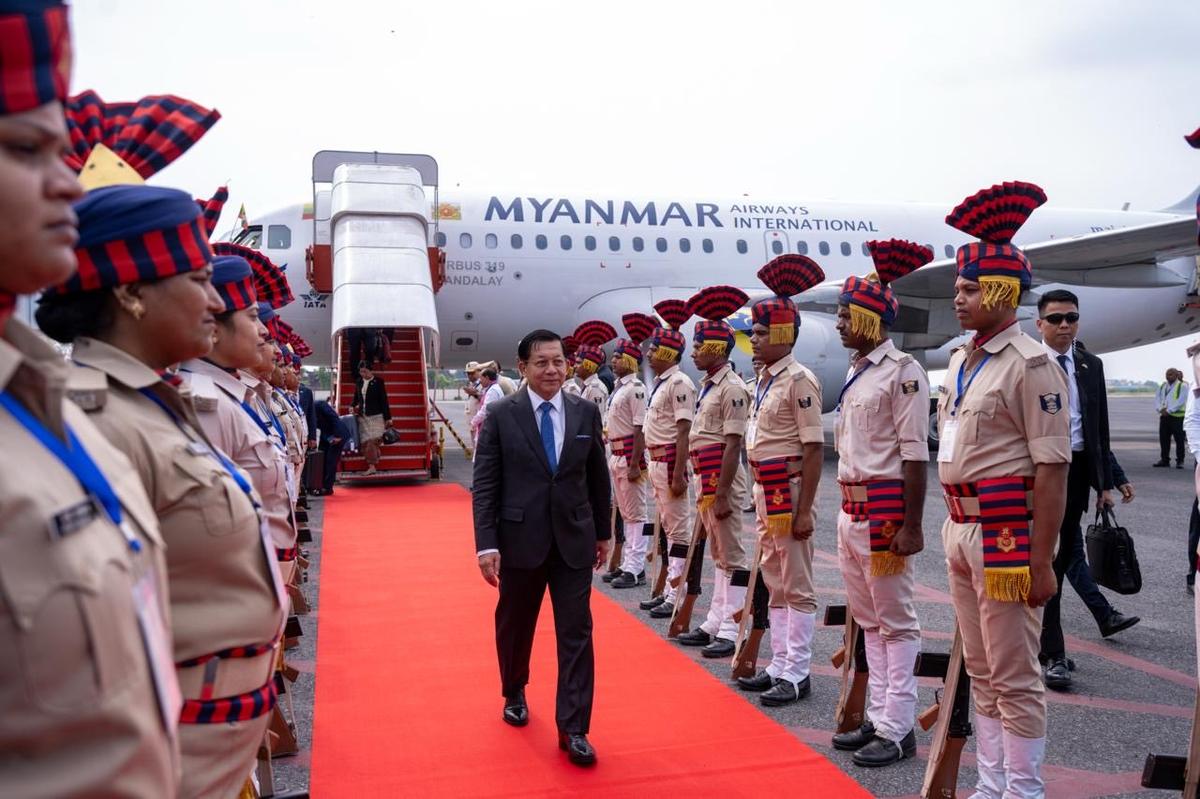
Myanmar President U Min Aung Hlaing’s visit to India, undertaken between 30 May and 3 June 2026, is important in many respects and has significant implications for both countries. The much-discussed visit is particularly noteworthy because it was Hlaing’s first visit to any country since assuming the office of President in April this year. He was accompanied by a large delegation comprising officials such as the Governor of the Central Bank, Union Ministers from various ministries, and leaders from industries including agriculture, pharmaceuticals, energy, banking, and construction. The visit concluded with high-level talks on enhancing bilateral trade, adopting mechanisms such as Rupee–Kyat settlement, and strengthening trade and investment cooperation in sectors such as energy, mining, agro-processing, and petroleum.
From Myanmar’s standpoint, the visit is being seen as an effort by the current President to shore up support for his government, which has faced harsh criticism and sanctions, particularly from European countries and the United States, following the suspension of the previously democratically elected government and the incarceration of leaders such as Aung San Suu Kyi and others.
For India, Myanmar holds importance in several ways. India shares a 1,643-km international land border with Myanmar, spanning four north-eastern states. Given the porous nature of this border, as well as ongoing instability and insurgency in the region, cooperation with Myanmar is crucial for ensuring security and stability along the frontier. Moreover, Myanmar is the only ASEAN member state that shares a land boundary with India and serves as India’s gateway to South-East Asia.
Here, geography rather than abstract ideology dictates much of the trajectory of India’s policy towards Myanmar. Consequently, while India maintained strong ties with the earlier National League for Democracy (NLD) government, it avoided openly criticising the military intervention that deposed the democratically elected government in 2021.
Recent years have also been challenging for Indian foreign policy, as it has had to grapple with anti-India sentiments in several neighbouring countries, including Nepal and Bangladesh. These developments have been accompanied by the ever-increasing footprint of China in these countries. Chinese influence in Myanmar is no exception; on the contrary, China has been a consistent backer of the military junta. Thus, India’s overture towards Myanmar can be seen as a pragmatic step to balance Chinese influence in the region and thereby ensure stability in its bordering areas.
This article further elaborates on three key issues: security and stability in India’s North-Eastern region; enhancing trade and connectivity with ASEAN, including Myanmar; and balancing Chinese influence in the region. In conclusion, the article examines the challenges facing India in achieving these objectives.
Imperative of Myanmar’s Cooperation in Securing the North-East Region
As mentioned earlier, India shares a 1,643 km land border with Myanmar. Four Indian states: Arunachal Pradesh, Nagaland, Manipur, and Mizoram, lie along this border. A significant portion of this porous frontier passes through difficult hilly and mountainous terrain, facilitating the illegal movement of drugs, weapons, and militants. In this respect, it is pertinent to note that the region’s proximity to the Golden Triangle, comprising Myanmar, Laos, and Thailand, one of the world’s major drug-producing regions, has further exacerbated the existing fragility of the situation. Moreover, such drug smuggling is more than merely a law-and-order issue; the income generated from trafficking has played a crucial role in sustaining insurgencies across several states in North-East India.
While President Hlaing reiterated Myanmar’s assurance during his visit that its “territory would not be permitted to be used against India’s security interests”, the changing security situation on the ground makes such assurances less convincing. Large swathes of Myanmar’s border regions are now controlled by rebel groups, limiting the junta’s ability to exercise effective authority. Nevertheless, as the Tatmadaw (Myanmar’s armed forces) continues its efforts to recapture lost territories, India’s best hope remains a unified and stable Myanmar, which is essential for its own security and stability.
Addressing Connectivity Challenges in India’s North-East and Expanding Outreach to ASEAN
The development of the North-Eastern states and their connectivity with mainland India have been persistent concerns for successive governments. In this regard, Myanmar has proved crucial, not only in facilitating connectivity to the North-Eastern region but also in linking India with the wider ASEAN region. Two projects deserve particular mention here. The first is the Kaladan Multi-Modal Transit Transport Project, which connects Sittwe Port (developed and operated by India) in Myanmar to the India-Myanmar border. The second is the 1,360-km India-Myanmar-Thailand (IMT) Trilateral Highway, which connects Moreh in Manipur to Mae Sot in Thailand via Myanmar.
Thus, as the Prime Minister emphasised in his conversation with President Hlaing, Myanmar lies at the confluence of India’s major foreign policy initiatives, including the Act East Policy, Neighbourhood First Policy, and MAHASAGAR. More importantly, Myanmar’s geography makes it indispensable for the stability, connectivity, and development of India’s North-Eastern region.
The China Factor in India-Myanmar Relations
Myanmar has been a part of China’s Belt and Road Initiative (BRI) through the China-Myanmar Economic Corridor (CMEC). It also provides China with a coveted access to the Indian Ocean, thereby helping to address Beijing’s so-called “Malacca Dilemma”. While ASEAN and many other countries witnessed a deterioration in their relations with Myanmar following the 2021 military intervention, China, on the contrary, strengthened its ties with the new junta-led government.
As China has expanded its influence across many of India’s neighbouring countries, India’s engagement with Myanmar can be seen as an effort to retain its strategic influence and counter China’s growing presence in the region. Discussions between India and Myanmar on critical minerals and rare earths provide opportunities for India to expand its footprint in Myanmar, while also enabling Myanmar to reduce its economic dependence on China.
Conclusion
India and Myanmar have benefited from mutual cooperation across multiple areas, including trade, investment, security, and intelligence sharing. The presence of a long and porous border has incentivised both countries to collaborate in ensuring security and stability. In India’s case, it has sought Myanmar’s cooperation in securing and improving access to its North-Eastern region, which has historically witnessed various insurgent movements. Myanmar’s unique geographical position has also enabled it to play a vital role in facilitating India’s access to the wider ASEAN region. On the other hand, under its Neighbourhood First Policy, India has been among the first responders to humanitarian and disaster-relief operations in Myanmar. In the economic domain, India has been an important development partner, particularly in the context of the heavy sanctions imposed on Myanmar.
Despite these positives, challenges remain in the bilateral relationship. While India’s response to the Tatmadaw’s 2021 intervention in Myanmar’s politics has been measured, the decision to welcome the former junta chief and current President has generated negative optics for India. Challenges also persist on the ground. As border regions such as Sagaing and Chin State remain under the control of rebel groups, several of India’s ambitious connectivity and infrastructure projects have faced delays. The absence of effective central authority in these regions has further complicated India’s efforts to ensure security and stability along its own sensitive border areas.
In conclusion, India prioritises a stable Myanmar, which is a prerequisite for safeguarding its interests in the region and beyond. This strategic consideration is reflected in India’s recent outreach to President Hlaing’s government. While the policy carries certain risks and challenges, sustained engagement has the potential to generate long-term benefits for both countries.
By: Nikhil Tiwari, PhD candidate at the Centre for East Asian Studies, Jawaharlal Nehru University(JNU), New Delhi, India