

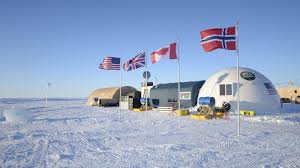
Global warming is not a new phenomenon. It has persisted for many decades and continues to accelerate. Yet, as the Arctic ice melts at an extraordinary speed, a once frozen frontier buried beneath the vast expanses of snow and ice is progressively transitioning into one of the most strategically contested regions in the world.
A region that was once considered too hostile and inaccessible for sustained human activity is now gradually developing into a major geopolitical arena.
The Arctic is an extremely cold region surrounding the North Pole, which is connected to countries such as Russia, the United States through Alaska, Canada, Norway, Denmark through Greenland, Iceland, Finland, and Sweden. It is covered with glaciers, sea ice, and frozen landscapes. For several centuries, the Arctic region has remained too dangerous, too remote, and too inaccessible for large-scale geopolitical rivalry. However, contemporary climate change is now altering that reality.
As the ice melts, ships can pass through previously blocked routes, oil and natural gas reserves become easier to access, pivotal minerals gain strategic importance, and the military movement becomes increasingly possible.
Environmental transformation is therefore becoming a major geopolitical opportunity. Countries are now racing to control Arctic resources, shipping corridors, and strategic military positions.
One of the major reasons behind the growing significance of the Arctic is the emergence of new shipping routes. Traditionally, the ships travelling from Asia to Europe mostly passed through the Indian Ocean, the Suez Canal, and the Mediterranean Sea. But these routes are long, expensive, and increasingly vulnerable to geopolitical instability.
The Strait of Hormuz, for instance, has repeatedly demonstrated how political conflict can threaten global trade and energy transportation.
The melting Arctic is opening what is popularly known as the Northern Sea Route, which is largely controlled by Russia. This route is shorter, faster, and potentially cheaper. Historically, the control of trade routes has always consistently turned into economic and geopolitical power. The British Empire expanded through maritimedominance, while strategic corridors such as the Suez Canal and the Malacca Strait became central to global trade. Similarly, Arctic routes may become some of the most important strategic trade corridors of the twenty-first century.
The Arctic is also attracting significant global attention because of its vast energy reserves. Scientists have estimated that the region contains vast quantities of untapped oil, natural gas, and other resources. In modern geopolitics, energy is directly linked to power.
Especially after the Russia–Ukraine war and the global energy crisis, energy security has become a prime concern for states. As a result, the countries are becoming gradually aggressive regarding Arctic access and resource claims.
Alongside oil and gas, the Arctic also possesses rare earth minerals crucial for semiconductors, batteries, artificial intelligence technologies, military systems, and electric vehicles. Contemporary geopolitics is no longer concerned solely with territory; it is also deeply interconnected to supply chains, technological infrastructure, and critical minerals. The Arctic region is therefore becoming strategically valuable not only geographically, but technologically as well, which is drawing heavy concerns worldwide.
The military dimension of the Arctic is equally important. During the Cold War, the Arctic already held strategic significance because missiles and submarines could easily operate through this region. Today, militarisation is once again rapidly increasing.
Russia remains the most active Arctic power because a substantial portion of the Arctic coastline belongs to it. Russia has expanded military bases, increased naval activity, deployed submarines, and developed a large fleet of icebreakers, which are specialised ships capable of breaking thick Arctic ice and creating navigable paths for other vessels to freely move. Russia possesses the world’s largest icebreaker fleet, giving it considerable strategic advantage in the Arctic.
For Russia, the Arctic offers trade power, military leverage, energy access, and geopolitical influence. Particularly after the implementation of Western sanctions, the Arctic has become increasingly important to Russia’s long-term strategic ambitions.
China, despite not being geographically a part of the Arctic, is also attempting to expand its presence in that region. China refers to itself as a “near-Arctic state,” a term thatremains controversial in Western strategic circles. Beijing has invested in Arcticinfrastructure, shipping projects, research initiatives, and energy cooperation. It has also promoted the idea of a “Polar Silk Road” connected to the Belt and Road Initiative.
This has generated heavy concern in the West, where many fear that China may gradually expand its strategic influence in the Arctic through the advancement of its technological and economic penetration.
The United States and NATO have consequently become increasingly alert. If Russia and China start to dominate the Arctic routes and infrastructure, they could potentially gain control over crucial trade corridors, energy routes, and military positioning.
Countries such as Norway, Finland, Canada, and the United States have therefore intensified their Arctic focus. Finland’s entry into NATO has further elevated Arctic security concerns.
Climate change is no longer merely an environmental issue; it is increasingly redefining the tactics of global geopolitics. The Arctic today reflects a space where climate transformation intersects with military rivalry, resource extraction, trade politics, and strategic competition. Questions therefore come into prominence regarding who will ultimately control the Arctic, whether the region could become another South China Sea, and whether environmental transformation itself may generate future geopolitical conflicts or not.
The Arctic Beyond Geopolitics
The Arctic is not simply a geopolitical battleground. It is also an ecological system, an indigenous homeland, and a climate warning zone. A major inaccurate perception is that the Arctic is an empty frozen space. In reality, approximately 400,000 indigenous inhabitants live across the Arctic region, including communities such as the Inuit, Sami, and Yupik peoples. These communities depend heavily on fishing, reindeer herding, Arctic wildlife, and ecological stability. Climate change explicitly threatens their livelihoods, cultural traditions, food systems, and social identities.
Many indigenous communities strongly oppose excessive drilling, militarisation, mining, and environmental destruction because, for them, the Arctic is not merely a strategic resource frontier, but it is home, culture, spirituality, and survival for them.
The Arctic itself is not a country and therefore does not possess a single government, president, or unified democracy. Instead, it is shared among multiple Arctic states.
However, Arctic governance partly functions through the Arctic Council, an intergovernmental forum established in 1996 that includes Arctic countries, indigenousrepresentatives, and scientific cooperation groups. The Arctic Council focuses on environmental protection, sustainability, climate research, and regional cooperation. Yet it lacks military authority and cannot prevent states from pursuing strategic competition.
Scientists have constantly warned that the Arctic is warming nearly four times faster than many other regions of the Earth. One major reason behind this concern is the Albedo Effect. Ice and snow normally reflect sunlight back into space. However, as Arctic ice melts, dark ocean water becomes uncovered, thereby soaking up greater amounts of heat and accelerating global warming further.
Another major concern is permafrost; permanently frozen ground that has existed for thousands of years across Arctic regions. As temperatures rise, permafrost melts, releasing methane gas into the atmosphere. Methane is a highly potent greenhouse gas capable of intensifying global warming significantly. The melting of permafrost can also trigger land instability, infrastructure collapse, and ecosystem disruption. Scientists, climate institutes, NASA, NOAA, the IPCC, and Arctic researchers continue to monitor glaciers, study ocean temperatures, track wildlife patterns, and warn governments regarding the ecological risks associated with Arctic transformation.
However, science and geopolitics increasingly appear to be moving in completely opposite directions. Scientists emphasise environmental protection and sustainability, while the states often prioritise the strategic and economic advantage.
This reveals one of the central contradictions of modern geopolitics: climate change is simultaneously destroying the Arctic and making it economically attractive.
Governments steadily treat the Arctic as an opportunity for trade, shipping corridors, military expansion, and resource extraction, while scientists view it as an ecological emergency zone and a warning system for planetary instability.
Why the Arctic Cannot Become Another Antarctica
Unlike Antarctica, which remains protected largely through cooperative scientific treaties such as the Antarctic Treaty of 1959, the Arctic is fundamentally different.
Antarctica is a largely isolated frozen continent with no permanent indigenous population or strong sovereignty structures. The Arctic, by contrast, is an ocean surrounded by powerful sovereign states possessing military presence, economic interests, indigenous populations, and legal territorial claims.The Arctic is also governed partly through the United Nations Convention on the Law of the Sea (UNCLOS), which allows states to claim Exclusive Economic Zones, continental shelf rights, and resource access. These legal mechanisms intensify competition by enabling states to assert economic claims over Arctic spaces.
When the Antarctic Treaty was signed in 1959, the climate crisis had not yet emerged as a potential geopolitical issue. The Arctic trade routes were not opening, and large-scale resource competition was far less intense. Climate change is therefore opening spaces that were once inaccessible. This reflects the tension between environmental protection and geopolitical competition.
Climate Change, Realism, and the Contradictions of Modern Geopolitics
Scientists have repeatedly warned governments for years regarding glacier melting, rising temperatures, methane release, biodiversity collapse, and ecosystem disruption.
Reports continue to be published by institutions such as the IPCC, NASA, Arctic Council researchers, climate institutes, and universities. Governments are fully aware of these warnings. The persistence of Arctic competition therefore raises a deeper geopolitical question: if states understand the environmental risks, why does strategic rivalry continue?
The answer lies partly in how governments perceive national interests. This situation reflects what international relations scholars describe as the security dilemma.
Even if states recognise that competition may be dangerous, they continue competing because they fear strategic disadvantage if they withdraw. A major theoretical explanation for Arctic competition also emerges through realism in international relations. Realism argues that states primarily give precedence to survival, power, and security. Even when governments understand environmental risks, they continue pursuing strategic advantage because national interests often dominate the long-term environmental concerns.
Opportunity or Ecological Catastrophe?
The Arctic represents both economic opportunity and ecological warning simultaneously. Some governments also argue that strategic military presence prevents unilateral domination by rival powers. NATO, for example, often frames Arctic security as necessary for maintaining geopolitical balance.
However, the dangers remain equally significant. Increased drilling, mining, militarisation, and industrial activity threaten biodiversity, accelerate ecological collapse, intensify global warming, and increase the possibility of geopolitical conflict. Some geopolitical analysts fear that the Arctic could gradually emerge as a new Cold War-style strategic frontier.
The burden of these transformations often falls unfairly upon indigenous communities and fragile ecosystems, while major powers and corporations gain the greatest economic advantages. This creates intense ethical questions regarding environmental justice and global inequality.
The melting Arctic therefore reflects a deeply troubling contradiction: the same environmental crisis threatening planetary stability is simultaneously generating new opportunities for geopolitical competition.
India and the Arctic Question
India, despite not being an Arctic country, also possesses growing strategic interests in the region. India’s Arctic Policy of 2022 demonstrates increasing Indian engagement through scientific research, climate studies, environmental monitoring, and sustainable development initiatives. India also operates the Himadri research station in Svalbard, Norway, where Indian researchers study glaciers, climate systems, Arctic ecosystems, and atmospheric changes.
Arctic developments immediately affect India because Arctic warming influences monsoon systems, sea levels, extreme weather conditions, and agricultural patterns.
India therefore cannot remain entirely detached from Arctic geopolitics. Simultaneously, India’s growing economic and technological ambitions make Arctic trade routes, critical minerals, and scientific diplomacy increasingly significant as well.
Conclusion
The Arctic can also be understood symbolically through literature and philosophy. Frankenstein, framed within frozen polar landscapes, reflected humanity’s dangerous quest of power and mastery over nature. Victor Frankenstein’s scientific ambition ultimately produced consequences beyond his control. In many ways, the Arctic today mirrors that same contradiction. Humanity is transforming one of Earth’s last symbolic wildernesses into another arena of extraction, militarisation, and strategic competition. From a postcolonial perspective, major powers increasingly treat the Arctic as a “new frontier,” similar to how colonial powers historically viewed distant lands as spaces for extraction and strategic expansion. The Arctic is gradually becoming part of a neo-colonial and extractive geopolitical logic.
Romantic literature often described extreme natural spaces such as mountains, oceans, and polar regions through the idea of the sublime; the spaces so vast and powerful that they inspired awe, fear, and human insignificance. Yet modern geopolitics increasingly attempts to measure, control, militarise, and exploit even these sublime spaces. The Arctic crisis ultimately demonstrates how climate change is no longer merely an environmental issue, but a transformative force capable of restructuring global power, territorial politics, and the future of international order.
~ Sruti Bhaumik