

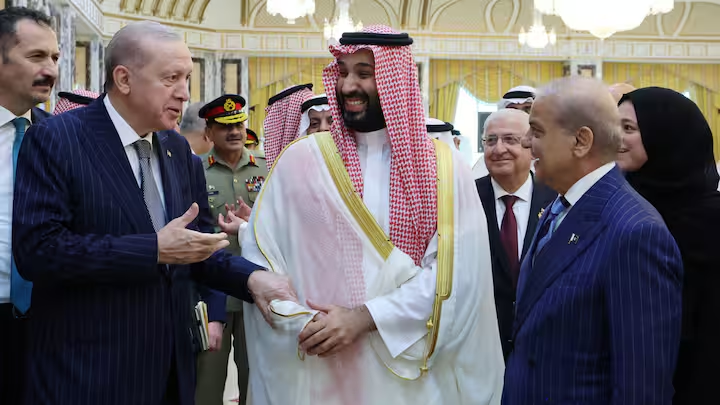
On 7th August 2026, Saudi Arabia, Türkiye and Pakistan signed the Mecca Joint Defence Agreement in Mecca. The central clause of this Defence Agreement is straightforward: an armed attack against any one of the three countries will be regarded as an attack against all three. That promptly seeks to involve an extensive comparison with Article 5 of NATO, whose collective defence tenet often treats an attack on one member as an attack against all.
But calling the agreement an “Islamic NATO” would be premature.
The Mecca agreement incorporates a NATO-like collective defence principle, but it does not currently possess NATO’s integrated command structure, permanent military machinery or comparable institutional scope and intensity. The agreement is, for this reason better acknowledged as a prime regional security framework whose operational architecture is still underway. Türkiye has said that a political and military committee will bring together foreign ministers, defence ministers and military chiefs, alongside joint exercises and deeper defence-industrial cooperation.
The substantive and concrete question, therefore, is not simply whether three countries have signed a defence pact, the key question however still remains:
Can three geographically separated countries with divergent security priorities actually establish a durable collective security arrangement?
This is where the story becomes considerably more interesting.
The very first question which comes to our mind is: Why these three countries?
Initially these countries, Saudi Arabia, Türkiye and Pakistan appear to have little reason to form a single security framework. They do not share borders. They do not face exactly the same enemies. Their relationships with the United States, China, Iran, Israel and India are different. Yet their capabilities reinforce one another.
Saudi Arabia brings enormous financial resources, energy significance, strategic geography in the Gulf and considerable diplomatic weight in the Arab and Muslim world. For several decades, Riyadh has relied heavily on the United States for its security measures. The prompt question now confronting Saudi Arabia is not necessarily whether the United States remains useful or not. It clearly does, and the importance of the United States is indisputable.
The fundamental question is whether Riyadh should depend almost entirely on a single external security provider when the regional environment has become more frequently volatile. The answer seems to be diversification rather than substitution.
In other words, Riyadh is not simply declaring :
“We no longer need America.”
Rather it is saying:
“We do not want our security to depend on only one external power.”
That is the basic principle of strategic hedging.
The geopolitical term Strategic hedging means firmly holding on to existing partnerships while concurrently creating additional options as well. In very simple terms, this can be best described as a backup strategy. Saudi Arabia can efficiently retain its relationship with Washington while consolidating its relationship with Türkiye and Pakistan.
Türkiye brings something very disparate. It has one of NATO’s largest militaries, a rapidly developing indigenous defence industry and striking capabilities in drones, unmanned systems, electronic warfare and aerospace technologies. It is also already a NATO member. That makes its presence significantly intriguing.
Türkiye is not leaving NATO to join a different bloc. It is remaining inside the Western security architecture while simultaneously participating in a regional security framework with Saudi Arabia and Pakistan. Turkish officials have clearly stressed that the agreement does not seek to swap the existing alliances. This is strategic hedging again: maintaining one security relationship while building another.
Pakistan brings yet another set of capabilities. It has a large and experienced military, deep rooted defence ties with Saudi Arabia, an established defence relationship with Türkiye and nuclear deterrence. Pakistan and Saudi Arabia had previously signed a Strategic Mutual Defence Agreement in September 2025, under which aggression against either country would be considered aggression against both. The 2026 agreement thus did not emerge from nowhere; it expanded an existing Saudi-Pakistani security relationship by bringing Türkiye into a broader framework.
The logic becomes clearer when the three are placed together:
Saudi Arabia — financial power, investment and strategic Gulf geography.
Türkiye — defence technology, military capability and industrial competence.
Pakistan — military experience, manpower, strategic importance and nuclear deterrence.
In partnership, they can potentially create a security ecosystem that none of them possesses individually.
The agreement has been advancing for years rather than coming into view suddenly on 7 August. The Saudi-Pakistani defence relationship was officially deepened in September 2025. Before the Mecca agreement, the four countries: Saudi Arabia, Türkiye, Pakistan and Egypt, were already meeting through the R4 consultative mechanism. On 21st of June 2026, their foreign ministers met in Cairo to further discuss regional and international developments, security, stability and coordination. The Mecca agreement therefore represents the formalisation of a broader pattern of consultation and cooperation. Even the timing of this agreement is worth noting. The Middle East has experienced repeated missile and drone attacks, confrontation involving Iran and Israel, instability around the Gulf and Red Sea, and uncertainty over how far external powers can guarantee regional security. This does not mean the Mecca pact is an anti-Iran alliance. Infact, it is also understood that Iran has been approached to also join this Pact.
Türkiye’s Foreign Minister Hakan Fidan in very clear terms said that no common threat was written into the agreement and that countries that do not attack the signatories are not considered targets. This difference simply cannot be overlooked.
Iran is part of the strategic environment in which the agreement emerged. It is not officially named as the enemy. The same caution applies to Israel as well. The pact should not be merely represented as an anti-Israel alliance either.
Is this really an “Islamic NATO”?
The phrase is extremely alluring because the agreement was signed in Mecca by three muslim majority states and contains a collective defence provision. But it would be misleading to take the comparison too far.
NATO has 32 members, decades of institutional experience, established command arrangements, integrated military planning and extensive mechanisms for interoperability. The Mecca agreement does not at the moment possess that machinery.
It is therefore NATO-like in one important respect, the collective defence principle, but not NATO in institutional or execution related terms.
This distinction becomes particularly important when we ask what actually happens after an attack. Let’s suppose that Pakistan is under a serious attack. So does that automatically mean Saudi Arabia without delay sends fighter aircraft and Türkiye sends troops to Pakistan?
No, they do not.
Following Fidan’s explanation, the country under attack would first request assistance and then it has to clearly specify what kind of support it needs. The immediate reaction to the situation could range from intelligence and logistics to ammunition or potentially military units, depending on the circumstances. The emerging structure is designed to involve foreign ministers, defence ministers and chiefs of the armed forces, endorsed by a Saudi-based secretariat. Joint land, naval and air exercises, air-defence cooperation, unmanned systems, electronic warfare, artificial intelligence and defence industry cooperation are also being established over time.
This creates a crucial disparity :
Political commitment:
An attack on one is treated as an attack on all.
Operational commitment:
Strictly speaking what force will be deployed, by whom, when, under whose chain of command and for how long?
The first principle exists.
The second is still being operationalised. That does not make the pact pointless. It means that its political promise currently remains ahead of its complete military machinery.
The real power may be deterrence or discouragement. The immediate power of the pact may therefore not be that three armies will suddenly fight together. It may be unpredictable. An adversary taking into account an attack on Saudi Arabia now has to ask:
Am I really attacking Saudi Arabia alone, or could Türkiye and Pakistan become involved?
That uncertainty can itself create severe deterrence.
That uncertainty also exposes one of the most uncomfortable problems surrounding the agreement :
Who is the aggressor, then? Suppose Pakistan launches an offensive against another country, that country retaliates, and Pakistan then invokes the pact. Would Saudi Arabia and Türkiye without requiring a separate decision be projected to defend Pakistan? Not necessarily the case. The circumstances of the conflict would matter. The identity of the aggressor would matter. The extent of the attack would matter. The assistance requested would matter. And the political decisions of the other members would also matter.
The India question
India has some legitimate reasons to watch the pact carefully, but it would be inaccurate to describe it as an anti-India military alliance, as things stand. Pakistan’s inclusion matters because Pakistan already has a close defence relationship with Türkiye and a longstanding security relationship with Saudi Arabia. The new agreement conceivably transforms these bilateral relationships into a more interconnected security relationship. This is exactly how contemporary geopolitics increasingly works: countries do not necessarily choose one friend and reject another. They compartmentalise relationships according to different interests.
Bangladesh could change the equation
The possibility of expansion makes the agreement even more consequential. Türkiye’s President Recep Tayyip Erdoğan has said that Egypt could join the pact and that the arrangement is open to further members. Egypt, therefore, is a possible future participant, not a current member. Bangladesh is now just another important prospective outcome. Bangladesh’s Foreign Minister Khalilur Rahman said on 27 August that Bangladesh would positively consider joining if the existing members invited it, while stressing that the question of membership had not yet arisen. This brings another question into focus.
If Bangladesh joins, it would have to balance the benefits of closer security cooperation with Saudi Arabia, Türkiye and Pakistan against its existing relationships with India, China, the United States, Japan and other partners. The India angle becomes especially important because Bangladesh shares a direct geographical relationship with India. But if Pakistan were involved in a future India-Pakistan conflict, would Bangladesh be expected to assist Pakistan? Once again, the answer is not automatic nor predetermined. And that is exactly why Bangladesh must certainly ask what responsibilities under the membership would actually give rise to. Expansion could give the pact more military capability, money, geography and diplomatic weight.
A pact without impact?
This is where the criticism of the Mecca agreement becomes legitimate. But that does not mean the pact has no repercussions. Its defence-industrial cooperation could ultimately prove more significant than its immediate military role. The Turkish Defence Ministry has specifically identified joint development and production, technology cooperation, maintenance and logistics as goals, alongside cooperation in unmanned systems, electronic warfare and artificial intelligence. The similar logic applies to interoperability as well, and this is where we have to be careful. The three militaries do not use identical equipment or systems. Pakistan has significant Chinese-origin platforms, Saudi Arabia has historically relied heavily on US-origin systems, while Türkiye is gradually developing indigenous systems. Joint exercises are therefore not merely symbolic.
They address a practical question :
Can these militaries actually operate together if a crisis occurs?
That will determine whether the pact becomes a genuine security architecture or remains essentially a political declaration. History offers two important lessons worth taking into account. The first comes from the alliance system before the First World War. Europe’s major powers were fragmented into contending alliance groupings. The assassination of Archduke Franz Ferdinand initially produced an Austria-Hungary–Serbia crisis. But mobilisation, alliance commitments and mounting decisions transformed a local crisis into a continental and eventually global war. The lesson is not that the Mecca Pact will create another world war. Its structure is far less developed.
The second example is even more relevant, the Central Treaty Organization (CENTO).
Pakistan and Türkiye were both members, alongside Iran, with Britain participating and the United States as an associated participant. CENTO emerged from the Baghdad Pact during the Cold War and was intended primarily to contain Soviet influence. Yet when Pakistan fought India in 1965, Pakistan invoked the treaty. Iran and Türkiye offered verbal support, while Britain and the United States remained neutral. CENTO ultimately proved ineffective to provide the kind of collective defence Pakistan anticipated. The historical experience therefore serves as a pivotal warning: ‘An alliance does not become effective merely because countries sign a treaty.’
The Mecca Pact therefore brings all of these issues into focus :
So what is the Mecca Pact really?
It is not an Islamic NATO.
It is not clearly an anti-Iran alliance.
It is not an anti-India alliance.
And it is not yet a fully integrated military organisation.
It is better recognised as an attempt by regional powers to build an supplementary layer of collective security in an increasingly uncertain international system.
The Mecca Pact is of serious political importance today, but its military effectiveness has yet to be highlighted. Its future will certainly rely on whether the three countries can turn political commitments into functioning institutions, joint exercises, interoperability, defence-industrial cooperation and credible crisis-response mechanisms. The possibility of Egypt and Bangladesh joining makes that question even larger.
The real test of the Mecca Pact, therefore, will not be whether its members can promise to defend one another in peacetime.
The real test, however, will come when defending one another conflicts with their respective national interests.
That is why the key question should not be:
“Is this the Islamic NATO?”
Instead we should be asking…
“Have Saudi Arabia, Türkiye and Pakistan created a new military bloc, or merely made a promise whose real meaning will only be demonstrated when the first serious crisis tests it?”
Article by Sruti Bhaumik