

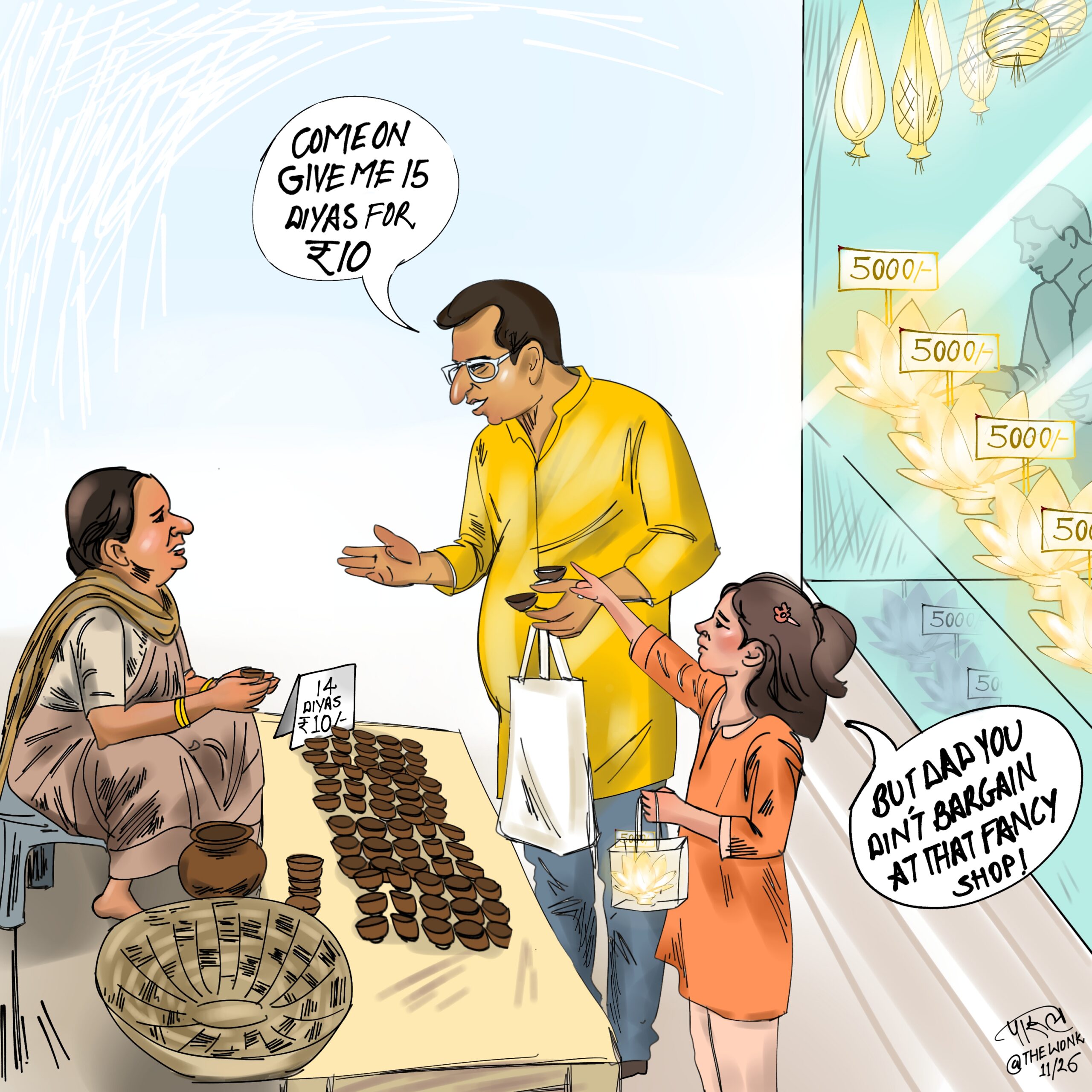
A walk through a Westside store during the festive season can make one pause and wonder how our idea of celebrating Diwali has transformed. Rows of carefully curated decorations, contemporary lamps, decorative lights and festive accessories occupy the shelves, each reflecting what has come to be recognised as the “modern Diwali aesthetic”. The same visual language follows us onto Amazon, Flipkart and Blinkit, where ease of access and visual appeal gradually shape our festive choices. Yet, somewhere between these carefully displayed assortment and the familiar online shopping carts, the humble earthen diya and the handmade terracotta miniature sculptures seem to be losing their place. It makes one wonder: who decides what makes a Diwali exquisite? When did the things crafted by local artisans become less desirable than those presented as contemporary festive indispensable items? And, as our ceremonies procure newer forms, what happens to the people whose hands have helped influence them for successive generations?
In 1961, a government study of a pottery-producing village in Delhi chronicled something that may sound familiar even today: potters were struggling with deteriorating demand for earthen lamps. The Village Pottery report, published as part of the Census of India, recorded how rising mustard oil prices and the growing popularity of candles had begun impacting the market for traditional diyas. What is particularly striking here, is that this economic deterioration goes back further than online shopping, LED decorations and the quick-commerce platforms that now shape festive consumption. More than six decades later, the products have altered, but the precariousness surrounding traditional livelihoods still remains constant.
The history of the diya, however, goes much further into antiquity. Terracotta lamps have been used in the Indian subcontinent for centuries, serving both everyday and ritual purposes. Over the long period of time, their association with religious observances, particularly Diwali, gave them a clearly defined place in the festival’s material culture. Yet the traditional Diwali marketplace was never bound to ordinary earthen lamps. Clay figurines and decorative terracotta dolls, some holding fourteen diyas above their heads and others carrying three, four or five lamps, were also a major part of the festive purchases in several regions. These objects beautifully combined craftsmanship with the symbolism of illumination. Today, many such traditional decorations are becoming overshadowed as electric lamps, LED arrangements and factory-produced ornaments occupy an increasingly influential place in the market.
This is not just an argument against technological change. Festivals, like the societies that celebrate them, evolve, and that’s quite natural. Consumers have different preferences, and modern lighting offers convenience and variety. But there is a question worth asking: in the pursuit of a newer festive aesthetic, are we gradually slipping away the objects and craftsmanship that once moulded the material experience of Diwali? More importantly, who gets to decide what that aesthetic should particularly look like? When products displayed on Amazon, Flipkart or Blinkit increasingly influence what consumers consider fashionable or desirable, the role of digital marketplaces extends beyond marketing sales. These platforms also shape how people visualise their celebrations. The economic consequences of this shift have become clearer when one looks at the people producing traditional festive goods. A recent report from Pune’s Kumbharwada describes how pottery wheels are slowly giving way to hand-pressed moulds. Mechanisation has enabled some producers to increase their output considerably, but the sellers have reportedly earned only around ₹1 to ₹1.50 per diya. Greater production, therefore, does not automatically render into improved livelihood prospects. The change also triggers questions about the future of traditional production techniques and the skills handed down through generations.
The challenges are not confined only to Pune. In Assam’s Asharikandi, a terracotta craft village, artisans have allegedly supplied nearly 80 lakh diyas in 2026. Yet the wholesale rate was reported at around ₹900 per thousand lamps, with artisans asserting that prices had remained largely unchanged for several years despite rising costs. In Odisha, one pottery community registered a fall from more than 80 diya making families around two decades ago to approximately 40 today. These are generally local examples rather than national statistics, but they definitely illustrate the uneven conditions under which traditional craft communities mostly operate. Some places continue to receive substantial orders, while the others continue to struggle in order to retain workers and also to pass on their skills.
The challenges are also associated with the supply chain. Kumartuli, Kolkata’s renowned idol-making neighbourhood, has faced severe shortages of clay and rising costs of bamboo, wood and transportation. Although idol-making and diya production are quite different trades, both of them bring to light the economic hardships experienced by traditional pottery-based occupations. The cost of manufacturing an object is only one part of the equation. Artisans must also equally consider fuel, labour, packaging, transportation, breakage and the margins taken by intermediaries. The price eventually paid by a consumer may be considerably higher than the amount received by the person who made the product. Recognising this difference is crucial to understanding who ultimately captures the economic value generated during the festive season. Meanwhile, organised retail and digital commerce have revamped the scale and convenience of festive shopping. Shopping malls, branded stores and e-commerce platforms offer consumers a wide range of decorations, gifts and lighting products, often supported by extensive advertising and seasonal discounts. Quick-commerce services have further condensed the distance between a consumer and a purchase. These developments are not inherently harmful, nor does every online purchase exclude a traditional producer. Digital platforms can also provide artisans with access to wider markets. But the real concern is whether these small producers have the required resources, visibility and bargaining power to participate in this transitioning marketplace on specific affordable terms.
Geir Heierstad’s Caste, Entrepreneurship and the Illusions of Tradition: Branding the Potters of Kolkata offers a useful perspective on this transformation. His study of Kumartuli critically analyses how the traditional artisans have adapted to commercial markets, changing production arrangements and modern entrepreneurship. It challenges the idea that craft communities simply preserve an unchanged tradition; they continually negotiate economic and social changes. However, adapting to these changes also requires new opportunities, and not every artisan has equal access to them.
Diwali’s marketplace will still continue to take shape, as it should. But the survival of a festival’s symbols does not necessarily ensure the survival of the livelihoods built around producing them. The diya may remain a perpetual image of Diwali, even as the potter’s position within its economy becomes increasingly uncertain. Supporting traditional sellers does not require completely abandoning modern technology or consumer choice. It demands recognising that convenience and cultural continuity need not be mutually exclusive. Perhaps the more important question is not whether Diwali should change, but whether the people who have helped shape its material traditions can find a true place in the festival’s transitioning economy.
There is something about the growth of a tree that offers a useful way of comprehending this interdependence. While its branches, leaves and fruits grow upwards, its roots continue to grow beneath the soil. Though largely unseen, these roots are the most essential elements for the tree’s survival and growth. They anchor it to the ground and supply the nutrients that sustain everything above. The apparent growth of a tree cannot be separated from the concealed work taking place beneath the surface. The changing landscape of Diwali can be understood in much the same way. Newer products, online marketplaces and evolving consumer preferences may be reconfiguring the way we celebrate the festival, but the traditional skills and artisan clusters that sustain its material culture must not be overlooked. The fashioning of clay, the making of earthen lamps and the skilled workmanship passed down through generations continue to form part of the underpinning of festive production. The emergence of newer products does not make these practices any less significant. Neither can one exist entirely independently of the skills, materials and traditions that have sustained the other.
This does not simply mean that consumers must reject modern products or abandon the convenience of online shopping. Rather, it calls for a more deliberate approach to our festive purchases. Wherever feasible, even buying a few staples from local potters and traditional sellers can help sustain livelihoods that are often marginalised in the larger festive economy.
After all, every festival has two simultaneous realms. For some, it is a time of celebration, happiness, rituals and family gatherings. For others, it is also a crucial source of livelihood, sometimes their primary source of income. What is a season of celebration for one section can be the most pivotal economic period of the year for another. Both the lived experiences deserve to be considered and respected together.