

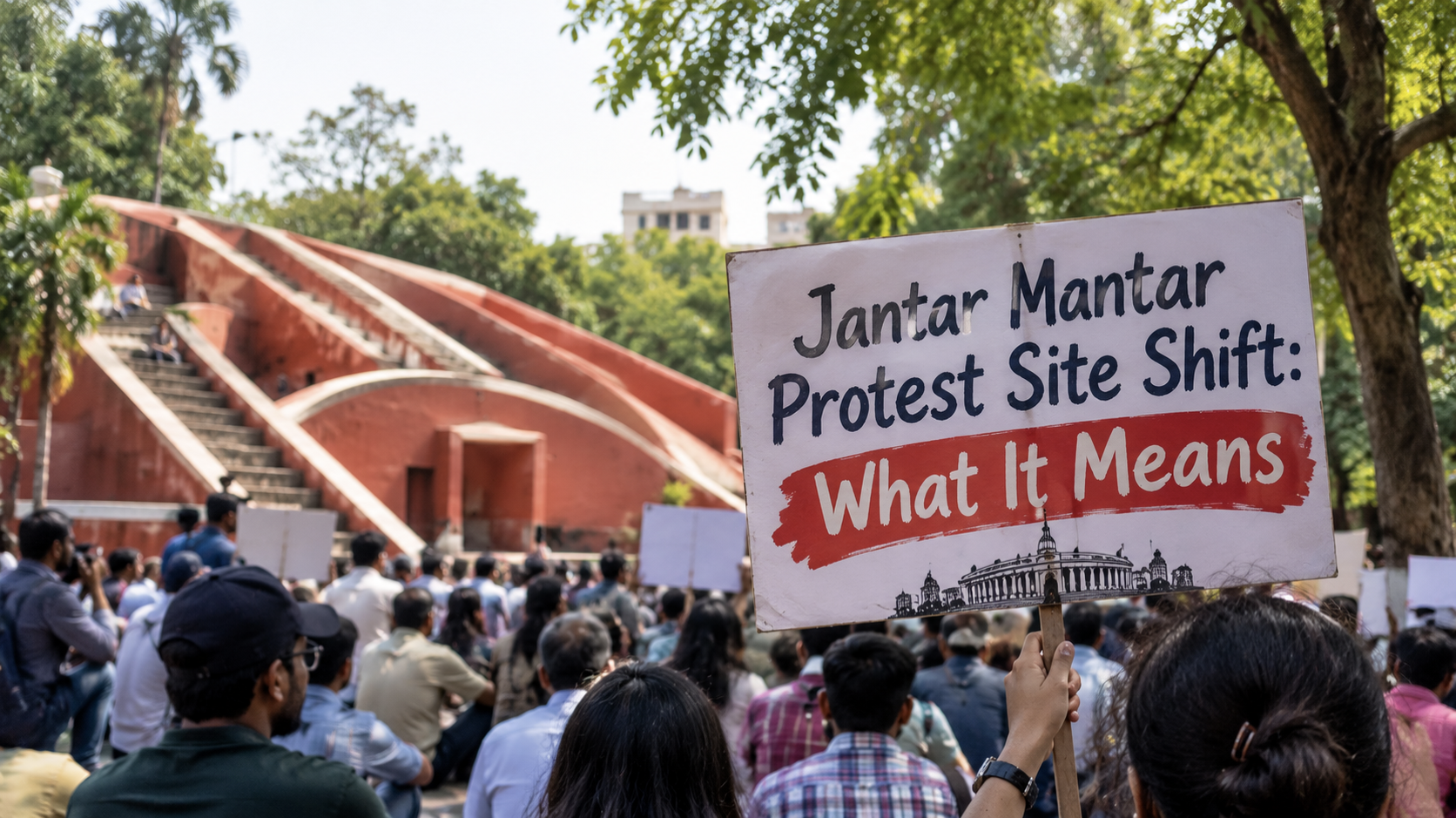
For years, Jantar Mantar was one of the first places people thought of when they wanted to protest in Delhi. It was close to Parliament, easy for journalists to find, and known for demonstrations on issues ranging from corruption to farmers’ rights.
That has now changed. On October 11, 2026, Delhi Police Commissioner Anurag Kumar issued an order removing Jantar Mantar from the list of designated protest sites. Ramlila Maidan, Burari Ground and CBD Ground in Shahdara were named as alternatives. The order became public on October 12 and referred to recommendations from a committee set up by the Ministry of Home Affairs.
The question is not simply whether the new grounds have enough space. It is whether people can reach them, afford them, and still get their concerns heard.
Why Jantar Mantar Became Important
Jantar Mantar offered something that larger grounds could not always provide: proximity to the political centre of Delhi. A small group could gather with placards and attract attention without organising a massive rally.
But the site also had practical problems. Residents raised concerns about noise, crowds and sanitation, while protesters faced questions about drinking water, toilets and emergency access.
The matter reached the courts. In 2017, the National Green Tribunal restricted protests at Jantar Mantar and suggested Ramlila Maidan as an alternative. In July 2018, the Supreme Court set aside the blanket ban and called for a balance between the right to protest and the rights of nearby residents.
That balance remains important. Public safety and residents’ concerns cannot be ignored, but peaceful protesters also need a realistic way to reach the people they want to address.
Have Delhi’s Protest Sites Been Changed Before?
Yes. The history of Delhi’s protest venues shows that the present change is not the first of its kind.
Before Jantar Mantar became Delhi’s main protest hub, the Boat Club lawns near India Gate were a major venue for political demonstrations. The turning point came in October 1988, when farmer leader Mahendra Singh Tikait led an estimated five lakh farmers in a prolonged protest that disrupted traffic and occupied a large part of central Delhi.
The restrictions that followed reflected concerns about managing large gatherings and protecting key government areas. The security climate after the Babri Masjid demolition in December 1992 added to those concerns. By 1993, the Congress government led by P. V. Narasimha Rao had restricted large demonstrations at Boat Club, and Jantar Mantar emerged as an alternative. Reports also describe protests behind the Red Fort during the period when authorities were shifting demonstrations away from Boat Club.
This history matters because relocating protest venues is not new. Earlier governments also restricted access to prominent locations. However, those precedents do not, by themselves, establish whether removing Jantar Mantar from the list of designated protest sites is justified today.
A major turning point came in October 1988, when farmer leader Mahendra Singh Tikait led nearly five lakh farmers in a protest at the Boat Club lawns. The gathering disrupted central Delhi and highlighted the difficulty of managing such a large crowd near important government buildings.
Traffic disruption and security concerns contributed to restrictions on protests at Boat Club. In 1993, the Congress government led by P. V. Narasimha Rao restricted demonstrations there amid security and public-order concerns following the Babri Masjid demolition in December 1992. Protests subsequently shifted towards Jantar Mantar, which remained relatively close to Parliament but was easier to manage than the Boat Club lawns.
The issue resurfaced in 2011, when Anna Hazare planned a fast during the campaign for the Jan Lokpal Bill. Police initially offered JP Park with restrictions on the duration and size of the gathering. Following a standoff, the authorities eventually permitted the protest at Ramlila Maidan for 15 days.
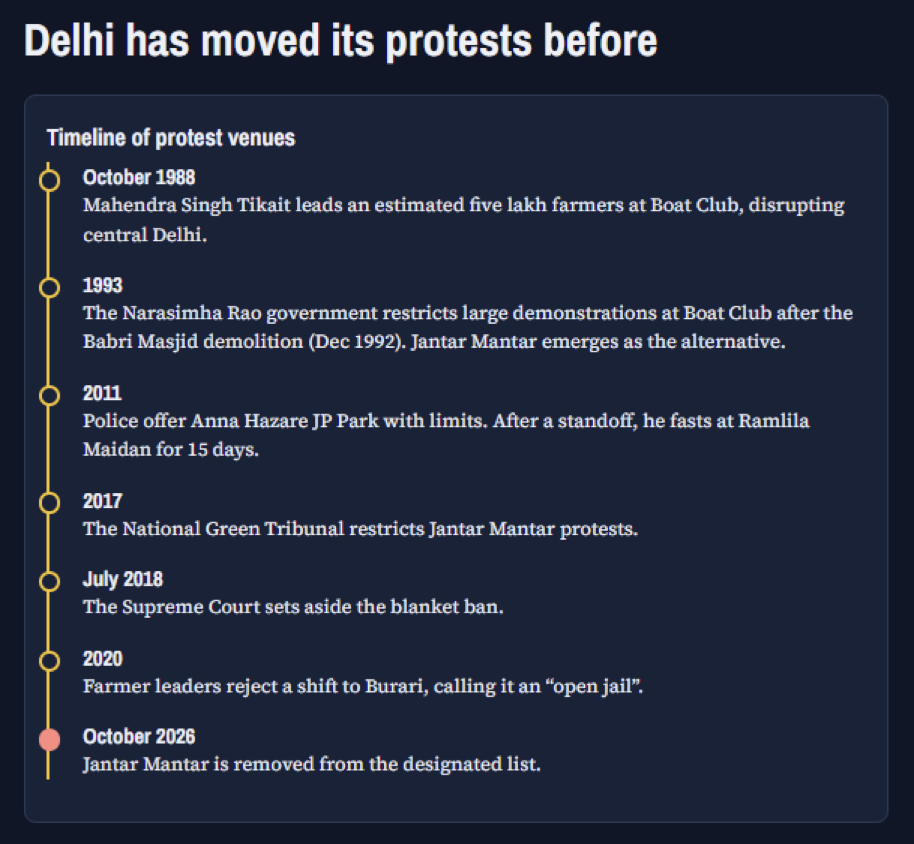
These examples establish an important point: previous governments also changed protest arrangements because of crowd size, traffic, and security. The present decision must be assessed in that context rather than treated as unprecedented.
However, a precedent does not automatically justify every new restriction. Earlier arrangements kept Jantar Mantar available for smaller gatherings near the political centre. The latest order removes that option.
Did Crowd Size and Safety Play a Part?
Crowd size has influenced Delhi’s protest rules for decades.
The 1988 farmers’ demonstration showed how a gathering involving lakhs of people could disrupt traffic across central Delhi. Jantar Mantar offered a smaller alternative, but its limited entry and exit points also made it difficult to manage when thousands gathered.
Crowd capacity is an important consideration, but the physical capacity of a ground is not the same as the number of people permitted to assemble there. Authorities must also consider entry and exit routes, emergency access, nearby traffic, crowd movement, and the resources available for policing. A larger ground may make crowd management easier, but it does not automatically make every gathering safe or every restriction necessary.
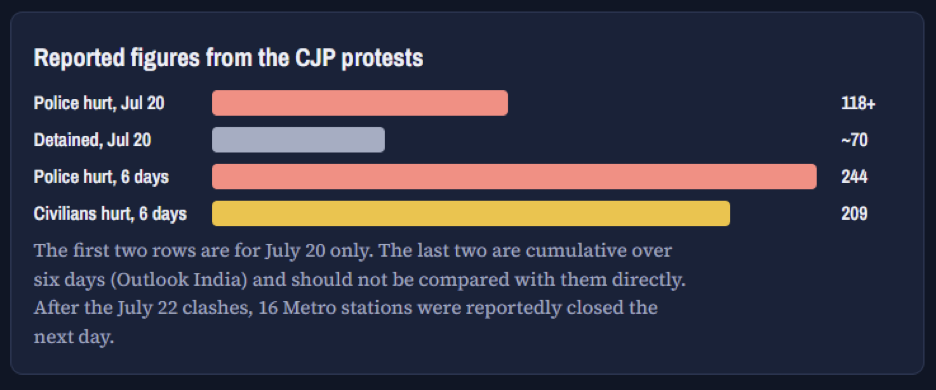
The CJP protests in July 2026 brought these concerns into focus. Thousands of supporters marched towards Parliament, and clashes disrupted central Delhi. After clashes on the night of July 22, 16 Metro stations in the area were reportedly closed the following day.
Still, crowd size cannot explain every decision. The Indian Youth Congress had sought permission for a demonstration involving around 100 to 150 people, but its request was rejected. That raises a separate question: if the concern is safety, why should small gatherings that fall within the stated limit face difficulties too?
The new sites also present practical challenges. Ramlila Maidan has booking costs and limited availability. CBD Ground is farther from the political centre, while Burari is roughly 21 to 23 kilometres from Jantar Mantar, depending on the route and reference point.
Delhi Police has said revised standard operating procedures will be issued for the new venues. Until the applicable crowd limits and permission rules are clear, it is difficult to judge whether the arrangements will work fairly for both small groups and large rallies.
What Do the CJP Protests Tell Us About Security?
Security is the strongest argument that supporters of the venue change can make, and it deserves serious consideration.
The Cockroach Janta Party began protesting at Jantar Mantar on June 20 over paper leaks and alleged irregularities in the examination system. On July 20, thousands of supporters and students marched towards Parliament, demanding the resignation of Union Education Minister Dharmendra Pradhan. The march turned violent.
Delhi Police reported that more than 118 personnel were injured during the July 20 incident, while around 70 protesters were detained that day. Further clashes were reported on July 22, when stones and bottles were allegedly thrown at police near Tolstoy Marg in Connaught Place. An assistant commissioner of police was injured, and police used tear gas.
An Outlook India report cited cumulative figures of 244 police personnel and 209 civilians injured over six days. These figures cover a wider period and should not be confused with the numbers reported for July 20 alone. Police also alleged that criminal or political elements had entered the protest crowd and contributed to the violence.
The violence raises a legitimate question about whether the existing arrangements provided sufficient space and security for large demonstrations. But it does not, on its own, establish that all protests should be moved away from Jantar Mantar. The authorities need to explain whether the decision followed a specific security assessment, what risks were identified, and why those risks could not be addressed through crowd limits, route restrictions or stronger policing. That explanation is essential to distinguish a targeted safety measure from a restriction that also affects peaceful demonstrators
Protesters, meanwhile, accused the police of excessive force, including lathi-charges and tear gas. Delhi Police rejected allegations of excessive force and said it had acted with restraint. These competing claims need to be assessed fairly rather than treating either account as the complete story.
A large ground away from Parliament and government residences can give police more room to manage crowds, maintain emergency access and separate peaceful demonstrators from people engaging in violence. That is a legitimate public-safety consideration.
But changing the venue does not automatically prevent violence. The July clashes involved a march towards Parliament and disruption across central Delhi. A group can still organise a march from another location. Clear rules, trained crowd management and action against those responsible for violence remain necessary.
The question is whether the authorities can address genuine security risks without treating every peaceful protest as a potential threat.

Are the New Venues Practical for Everyone?
The three alternatives offer more space, but they are not equally convenient.
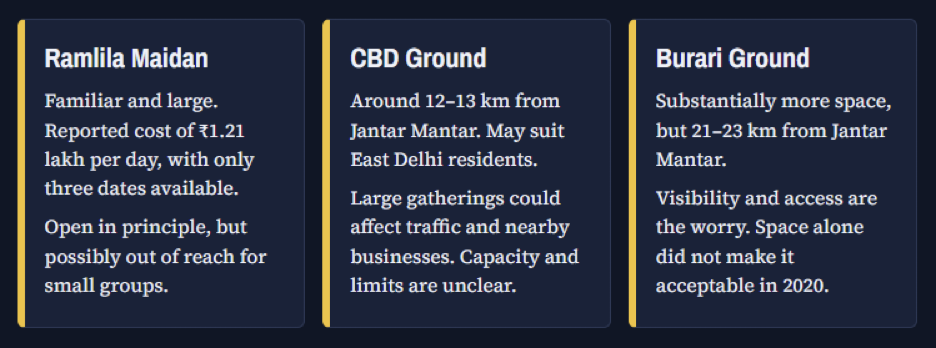
Ramlila Maidan is a familiar venue for major rallies and can accommodate large crowds. However, reported booking charges, security deposits, and limited availability may make it difficult for smaller groups to organise demonstrations. A site that is available in principle may not be accessible in practice.
CBD Ground in Shahdara may work well for some East Delhi residents, but it is around 12 to 13 kilometres from Jantar Mantar. Large gatherings could also affect traffic and nearby businesses. Its capacity, facilities, and applicable crowd limits need to be clearly communicated.
Burari Ground offers substantially more space and was already intended for large gatherings under earlier arrangements. But its distance from central Delhi raises questions about access and visibility. During the 2020 farmers’ protests, some farmer leaders rejected the proposal to shift to Burari and described it as an “open jail.” Their response showed that space alone does not make a protest venue acceptable to those expected to use it.
A demonstration can still attract attention from a distant location, but organisers may have to work harder to reach journalists, supporters and decision-makers. Booking costs and permission requirements can also create obstacles for groups with limited resources.
My Final View: Moving a Protest Is Not the Same as Solving the Problem
I do not think Jantar Mantar should be treated as untouchable. If the site has serious problems with sanitation, emergency access, crowd control, or the impact on residents, the authorities should address them. The history of Boat Club and the violence during the CJP protests show why crowd management and security cannot be dismissed.
The question is not whether Delhi needs designated protest sites. It does. The question is whether the new arrangements provide a fair and practical way for people to exercise their right to peaceful protest.

Earlier governments restricted the Boat Club lawns for reasons linked to crowd management and security. Those precedents deserve consideration, but they cannot substitute for a clear explanation of why Jantar Mantar itself must now be removed from the list.
A successful arrangement must protect residents, manage crowds and prevent violence without placing unnecessary barriers in the way of peaceful demonstrators. The new venues should be judged by how well they meet all three objectives, not simply by how many people they can accommodate.
Sources
- ThePrint, “SC asks Centre to consider alternative venue to Jantar Mantar for protests in Delhi,” October 9, 2026. https://theprint.in/india/sc-asks-centre-to-consider-alternative-venue-to-jantar-mantar-for-protests-in-delhi/3066947/
- Deccan Herald, “No more protests at Delhi’s Jantar Mantar; 3 new sites named,” October 12, 2026. https://www.deccanherald.com/india/no-more-protests-at-delhis-jantar-mantar-3-new-sites-named-4180460
- Supreme Court of India, Mazdoor Kisan Shakti Sangathan v. Union of India (2018). https://indiankanoon.org/doc/80616728/
- Scroll.in, “Supreme Court has allowed protests at Delhi’s Boat Club again, but police say it could be a no-go,” July 2018. https://scroll.in/article/888326/supreme-court-has-allowed-protests-at-delhis-boat-club-again-but-police-say-it-could-be-a-no-go
- Business Today, “New protest site Ramlila Maidan costs ₹1.21 lakh per day, has only three dates available,” October 13, 2026. https://www.businesstoday.in/india/story/new-protest-site-ramlila-maidan-costs-rs-1-21-lakh-per-day-has-only-three-dates-available-561200-2026-10-13
- Onmanorama, “CJP protest turns violent in Delhi; over 100 police personnel, several students injured,” July 21, 2026. https://www.onmanorama.com/news/india/2026/07/21/cjp-delhi-march-violent-police-brutality.html
- Onmanorama, “Farmers’ march: protest at Delhi borders, ‘Burari is an open jail’,” November 29, 2020. https://www.onmanorama.com/news/india/2020/11/29/delhi-farmers-march-protest-delhi-border.html