

‘”India and Russia have been among the steadiest big relationships in the world.”’
–EAM Dr. S Jaishankar
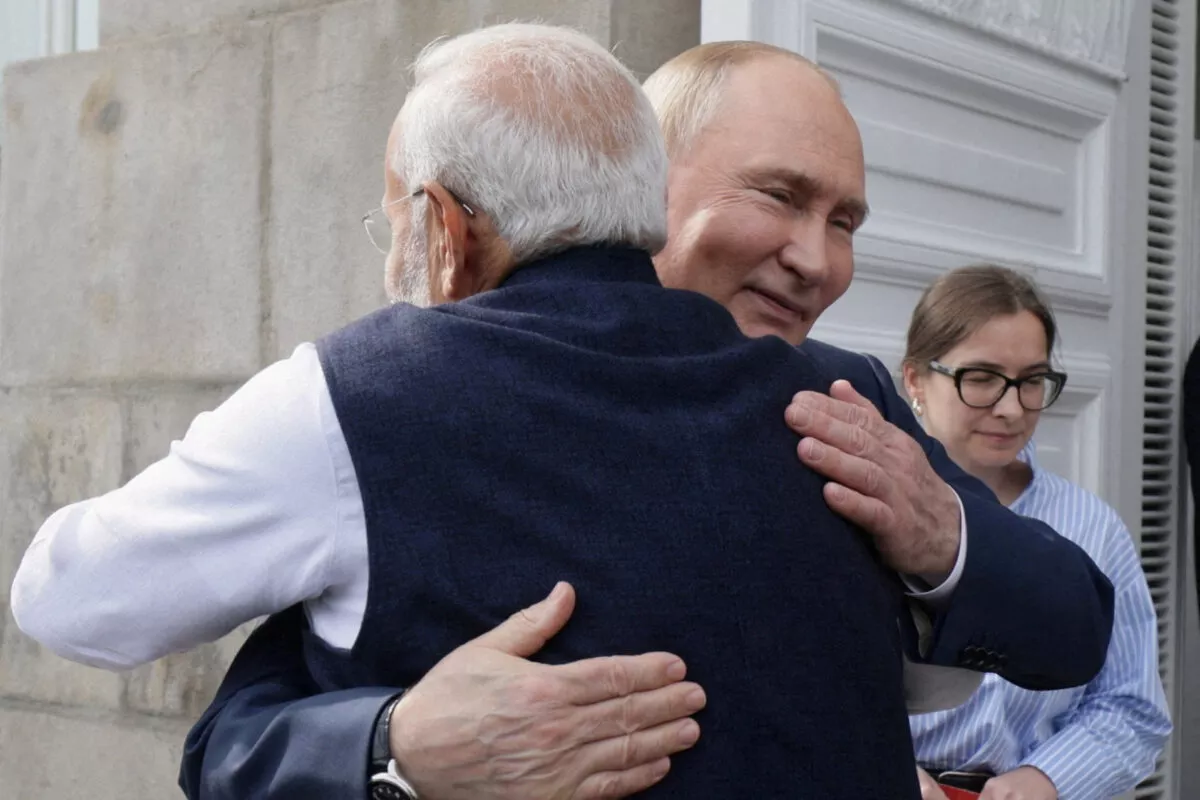
Vladimir Putin was in New Delhi in September for the 18th BRICS Summit, his second meeting with Narendra Modi in less than two weeks and his second trip to India since December 2025. In December, he came for the 23rd India-Russia Annual Summit, which produced a joint statement titled “A Time-Tested Progressive Partnership, Anchored in Trust and Mutual Respect,” and a roadmap called Programme 2030 for the decade ahead.
That summit marked 25 years since the two countries signed their Declaration on Strategic Partnership during Putin’s first state visit to India in October 2000. Twenty-three Annual Summits have taken place since, with pauses during the pandemic and the early years of the Ukraine war. The rhythm returned because neither side treated those gaps as a rupture.
Where this friendship comes from
Most versions of this story start in the Cold War. Moscow backed India at the UN Security Council during the 1971 crisis, and the Treaty of Peace, Friendship and Cooperation signed that year gave India valuable strategic space at a difficult moment. That history matters, but it does not fully explain the relationship today. The 1971 treaty was followed by the 1993 Treaty of Friendship and Cooperation and the 2000 Declaration on Strategic Partnership, eventually elevated to a Special and Privileged Strategic Partnership in 2010.
The bigger idea is strategic autonomy. India decides for itself, case by case, what serves its interests, rather than getting locked into anybody’s camp. That is how New Delhi can buy Russian crude, sit in the Quad with the US, Japan and Australia, and work with Russia and China through BRICS without seeing a contradiction. Russia has generally accommodated that approach, even as India has built much deeper relationships with the West. That flexibility is one reason the relationship has survived beyond the Cold War.
Oil, Tariffs and the Deal That Wouldn’t Die
Trade reached a record $68.7 billion in FY2024-25, but eased to roughly $59.9 billion the following year. In FY2025-26, India imported about $55.4 billion from Russia and exported around $4.5 billion. The imbalance remains the obvious weakness. Both governments are targeting $100 billion in annual trade by 2030, but that requires expanding the relationship beyond oil into exports, investment, logistics and payments. That is the purpose behind Programme 2030.
The oil relationship found its footing after Russia’s invasion of Ukraine in 2022. Russian crude began moving into Asian markets at steep discounts as Moscow faced restrictions in Western markets, while India, which imports most of its crude, bought more. For India, the arrangement offered cheaper supplies at a time of global price volatility and became one of the clearest practical pillars of the relationship.
Washington’s pressure tested that arrangement. In 2025, the US imposed an additional 25 per cent tariff on Indian goods over Russian oil purchases, taking the tariff burden on Indian exports as high as 50 per cent. The additional Russia-linked duty was removed effective February 7, 2026, but the dispute continued to cast a shadow over the relationship. For Delhi, the core issue remains energy security and the freedom to diversify its sources of supply.
From buying weapons to building them to selling them
Defence ties run deepest, and the relationship stopped being a simple buyer-seller arrangement long ago. Russia remains India’s biggest defence partner and the largest source of its imported major arms, even as India has diversified towards France, Israel and the United States. Russia’s share of Indian arms imports fell from around 70 per cent in 2011-15 to about 40 per cent in 2021-25. That decline reflects diversification and growing domestic production as much as any decline in the importance of Russia.
The relationship has also moved well beyond a buyer-seller model. T-90 tanks and Su-30MKI aircraft are built in India under licence, AK-203 rifles are being manufactured in Uttar Pradesh, and BrahMos, jointly developed by India and Russia, has become an Indian export success, with the Philippines already a customer and Indonesia moving into formal cooperation.
This is where Atmanirbhar Bharat changes the old story. India is importing a smaller share of its defence requirements from Russia, but it is also taking a larger role in producing, maintaining and developing systems linked to the partnership. The focus is increasingly on joint research, co-development, co-production, technology transfer and manufacturing in India.
The two navies continue to train through the INDRA exercises. India and Russia are also pursuing greater connectivity and trade, including the Chennai-Vladivostok maritime corridor and the International North-South Transport Corridor.
The China Question
Any honest look ahead has to deal with Beijing. Russia’s economic and strategic ties with China have deepened since 2022, while China remains the central security challenge in India’s strategic calculations. Yet that has not pushed Delhi away from Moscow. Instead, India has continued to work with Russia while managing China separately.
Russia’s closeness to Beijing has not made the Moscow relationship less relevant for India. In some ways, it has made maintaining an independent relationship with Russia more important. Moscow continues to back India’s UN Security Council bid, while defence, energy and diplomatic cooperation remain active.
This matters because the relationship has never rested on one issue alone. India does not need Russia to mirror every Indian position, just as Moscow does not expect New Delhi to follow its lead. That space has allowed both sides to disagree where necessary without turning disagreement into rupture.
More than two governments talking to each other
The relationship also has a social and institutional base. Around 20,000 Indian students study in Russia, most in medicine, while tourism, education and cultural exchanges continue to grow. Nuclear cooperation, including Kudankulam, and space cooperation add another layer that is often missed when the relationship is reduced to oil and weapons. There is also a practical reason for keeping the relationship wide. Russia remains important to India not only because of what it supplies, but because of the systems, skills and institutional links built around decades of cooperation.
Part of what keeps things steady is how directly Modi and Putin talk. Their regular contact covers energy, defence, trade, space and people-to-people ties. Putin has repeatedly praised India’s independent foreign policy, and Russia has continued to support India after major security incidents, including the Pahalgam terror attack in April 2025.
What comes next
At BRICS, Modi, Putin and Xi Jinping appearing together was widely read as a sign of a world becoming more multipolar. A few months earlier, Putin had said that Russia and India needed to work together towards “a just multipolar world order.” The New Delhi Declaration also called for a more representative international system and reform of multilateral institutions.
But the India-Russia relationship does not need grand declarations to explain its staying power. It has survived because it has repeatedly adjusted to new realities. India is more deeply connected to the United States and Europe, Russia is more deeply tied to China, and both countries now have far more diverse interests than they did in 2000. The next phase will therefore be about making the partnership broader through trade beyond hydrocarbons, technology, defence production, connectivity, nuclear energy and space. Programme 2030 is an attempt to give that evolution a framework.
The world around India and Russia has changed considerably, but the partnership has adapted without losing the trust built over decades. The relationship is no longer defined only by old Cold War loyalties or a simple exchange of oil and weapons. It now has to prove its relevance through new economic links, new forms of defence cooperation and a shared interest in strategic autonomy. It is an old friendship operating in a new world.
Trade figures: Ministry of Commerce and Industry, Government of India. Arms data: SIPRI, Trends in International Arms Transfers 2025. Summit language: Joint Statement, 23rd India-Russia Annual Summit, 5 December 2025.