

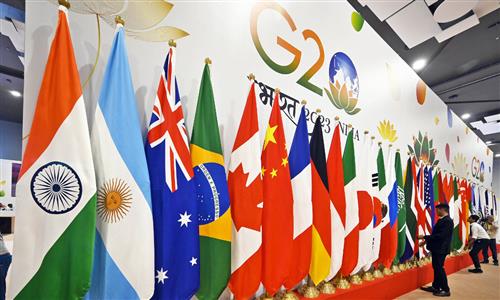
Countries are increasingly trying to work with different powers at the same time, depending on their economic, security and strategic interests. That is where organisations such as the G20 and the Shanghai Cooperation Organisation (SCO) come into play.
The two organisations may seem similar as both bring together major countries including India, China and Russia. However their purposes are very different, with G20 mainly focused on the global economy and SCO having a stronger emphasis on security, Eurasia, connectivity and regional cooperation.
For India therefore the real question is not whether G20 is more important than SCO but rather how India can use both to protect its interests and boost its influence in a changing world.
G20: The economic power table
The G20 is probably the more important platform when it comes to the global economy, as its members represent a large share of global GDP, trade and population. It brings together the world’s biggest economies including the United States, China, India, Japan, Germany and other major emerging economies.
G20 discusses issues such as economic growth, inflation, international trade, debt, climate finance, energy, digital technology and financial stability. This gives the G20 particular importance as a forum given the many challenges facing the global economy today. Trade tensions are rising, countries are becoming more protective of their domestic industries, supply chains are being reshaped and geopolitical conflicts are impacting energy and commodity prices.
The latest G20 discussions epitomise this problem at the 2026 G20 finance ministers’ meeting countries discussed trade imbalances, China’s large export surplus, critical minerals, inflation and global financial stability. The G20 is not just an economic discussion forum anymore – geopolitics has entered the economic conversation.
A trade dispute between two countries can impact global supply chains and a war in one region can cause oil prices to skyrocket around the world. Restrictions on critical minerals can impact electric vehicles, electronics and defence industries. Thus economic and geopolitical issues start to be more intertwined.
SCO: More than just a security organisation
The SCO has a different character. This organisation was originally created with the intention of securing regional security and cooperation in Eurasia. It consists of India, China, Russia, Pakistan, Iran, and the other countries of the region. However, the main areas of work and cooperation now include not only security issues but also energy, trade, technology, culture, and other issues.
The reason why this organisation is so interesting for India is that it actually possesses geopolitical significance for the country. The SCO members occupy South Asia, Central Asia, Russia, China, and Iran. Together, these countries account for over 40% of the world’s population and approximately a quarter of the GDP. This makes the SCO an economically and geopolitically important entity.
For India, the SCO membership provides the opportunity to strengthen strategic ties with Central Asia and Eurasia, which allows India to participate in energy and mineral resource markets, as well as access new transportation routes and infrastructures. However, the development of the International North-South Transport Corridor and the Iranian Chabahar port can provide India with greater trade opportunities with Central Asia and Eurasia. However, the main challenge for India in working with the SCO is the lack of consensus among member states about some issues.
India and China have strategic competition, India and Pakistan have political and security tensions, Russia has a difficult relationship with Western countries and India has important ties with both Russia and the West. The SCO cannot become NATO – its strength is that countries with different interests can still sit at the same table. The organisation has even stressed that it is not a military-political bloc.
G20 vs SCO: Different purposes, different strengths
The simplest way to understand the difference is this:
- G20 = global economic coordination
- SCO = Eurasian security and strategic cooperation
The G20 is more important when the issue is global economic governance, while the SCO becomes interesting when there is discussion of Central Asia, Eurasian connectivity, terrorism and relations between China, Russia, India and other Asian countries.
But there is another important difference. G20 includes major Western economies as well as emerging economies. SCO has a much stronger Eurasian and non-western character. This means India gains something different from each platform. Through the G20 India can engage with the United States, Europe, Japan and other advanced economies while representing the concerns of developing countries.
Through the SCO India can maintain dialogue with China, Russia, Iran and Central Asian countries.
This is extremely valuable for India’s foreign policy.
Why India needs both G20 & SCO
India’s foreign policy today is about maintaining relationships with multiple sides.
This is often referred to as strategic autonomy or multi-alignment. India can work with the United States through the Quad and other partnerships, cooperate with Russia on defence and energy, participate in the SCO with China and Central Asian countries and engage with both developed and developing economies through the G20.
This makes sense as India’s interests cannot be neatly contained within a geopolitical camp. A recent IMF discussion on the changing global order highlights that geopolitics is influencing trade, capital flows, technology and energy decisions and emphasises the opportunity for countries such as India to be bridges between different groups.
Perhaps this is where India’s biggest opportunity lies.
India does not necessarily have to choose between G20 and SCO but can take advantage of its presence in both to connect different parts of the international system.
The Indo-Pacific and the Eurasian connection
There is also an interesting link between the two organisations in terms of the Indo-Pacific.
The Indo-Pacific is becoming increasingly important due to global trade, shipping routes, technology and supply chains. India’s role in the region has therefore been growing significantly.
At the same time India cannot ignore Eurasia with energy from Russia and Central Asia, trade routes in Iran, China’s economic influence and developments in West Asia having significant implications for India’s economy.
The recent SCO summit made clear this connection with India highlighting how conflicts in West Asia can impact energy security, maritime trade and global supply chains.
In other words, Indo-Pacific and Eurasia cannot be considered completely separate strategic spaces.
What does this mean for the future?
The biggest change happening in the world is the shift from a relatively US dominated system to a fragmented and multipolar world. Multipolarity does not mean that countries will necessarily form two camps but they may cooperate with one another on one issue while also compete on another.
India is a good example it can cooperate with China on multilateral issues while strategically competing with it. Maintain defence and energy relations with Russia while expanding its partnership with the US and Europe. Work with Iran on connectivity while maintaining relationships with countries that have difficult ties with Iran.
A 2026 academic study by Ping-Kuei Chen, published in Asian Politics & Policy, notes that India has become more engaged with the G20 because it has greater scope to influence the agenda and build consensus among major powers. The study points to India’s 2023 G20 presidency as an example, when India pushed issues important to the Global South, helped bring the African Union into the G20, and played a bridging role between developed and developing countries. In contrast, India’s influence in the SCO has been limited by competition with China and Pakistan and by Russia’s reduced ability to support India’s initiatives.
Conclusion
So G20 vs SCO is not a competition between two organisations but rather they represent two different dimensions of India’s global engagement. The G20 gives India a seat at the table to discuss the future of the global economy while the SCO gives India a platform to engage with the Eurasian strategic neighbourhood.
Both have weaknesses, G20 being increasingly pulled into geopolitical disagreements and the SCO struggling due to the very different interests of its members. But that is why India needs both. The future global order will probably not be dominated by one country or organisation. It will be shaped by multiple platforms, partnerships and smaller coalitions.
For India the opportunity is to remain flexible, build bridges and push its own interests without aligning with any single geopolitical camp. The real advantage for India is not choosing between G20 and SCO but sitting at both tables and utilising each for a different purpose.
India’s External Affairs Minister, Dr S Jaishankar, recently declared that India’s priorities lie in ensuring accessible and affordable energy for its 1.4 billion population irrespective of the geopolitical scenarios, engaging both the G20 and SCO in these politically unstable times is the best way ahead towards ensuring our economic growth and energy security in the future.