

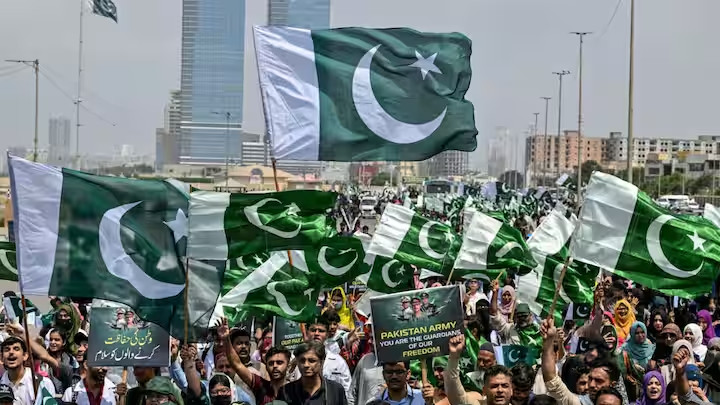
“The real debate is not whether Pakistan has transformed into ‘Punjabistan’ or not, but whether its federal structure can reconcile national unity with regional pursuits.”
The expression “Punjabistan” has recently gained prominence in geopolitical discussions surrounding Pakistan. While the term has appeared in opinion pieces and political commentary, it is neither an official constitutional concept nor a proposal to create a self-governing state either. It actually represents a political critique invoked by some geopolitical commentators, Baloch nationalist groups, Sindhi activists, and regional policy experts to deeply analyse whether Pakistan’s federal system has become unduly centred around the province of Punjab.
This debate has quickly gained renewed significance amid the ongoing unrest in some parts of Balochistan, periodic protests in Pakistan-occupied Kashmir (PoK), and broader concerns regarding the provincial autonomy and equitable governance. The issue therefore extends beyond the realm of electoral politics; it draws quick attention to a deeper constitutional point of contention: Can a federal state maintain national solidarity if significant sections of its provinces conceive of themselves to be politically and economically disenfranchised?
Comprehending Pakistan’s Federal Structure
Pakistan is a true federal republic consisting of four provinces; Punjab, Sindh, Balochistan, and Khyber Pakhtunkhwa (KP), along with the Islamabad Capital Territory and Gilgit-Baltistan. Pakistan also exercises authority over some parts of the former princely state of Jammu and Kashmir, which Pakistan refers to as Azad Jammu and Kashmir, while India refers to it as Pakistan-occupied Kashmir (PoK).
Legally, every province enjoys some defined powers under the same federal framework. However, there are certain critics who argue that constitutional equality has not always been translated into an unbiased distribution of political influence.
Why has Punjab become so Authorative?
The answer predominantly lies in the critical sphere of demography. Punjab accounts for more than half of Pakistan’s population, making it one of the most populous provinces of the country. Thus, it elects the largest number of representatives to Pakistan’s National Assembly, enjoys the largest electoral base, fuels significantly to agriculture and industry, and has traditionally produced many of the country’s Prime Ministers.
From Demographic Strength to Institutional Influence
Many analysts strongly contend that Punjab’s influence extends beyond representative politics into Pakistan’s institutional structure. Historically, Pakistan’s military establishment, which is often considered one of the country’s most influential institutions, has been marked by substantial delegation from Punjab, alongside officers from Khyber Pakhtunkhwa. Since the military has played an establishing role in Pakistan’s political course of development since independence, critics claim that political authority, security decision-making, and administrative influence have steadily coincided around the country’s centre.
Here, the French philosopher Michel Foucault’s understanding of power offers an interesting analytical lens. Foucault has expressed the view that power is not exercised solely through governments but also through institutions, administrative structures, and systems of knowledge. Applied circumspectly to Pakistan’s context, the debate surrounding “Punjabistan” is therefore less about formal constitutional arrangements than about how influence is duly perceived to circulate through political, military, and bureaucratic institutions.
Why does Balochistan hold the centre of this debate?
No amount of discussions of Pakistan’s internal politics can completely ignore the existence of the province; Balochistan. Although it majorly constitutes Pakistan’s largest province by area, Balochistan unfortunately commands a comparatively small population. The province is blessed with abundant natural resources, including natural gas, copper, gold, and the strategically significant Gwadar Port, which serves as a core component of the China-Pakistan Economic Corridor (CPEC).
Despite having this much wealth, Balochistan remains one among Pakistan’s least-developed provinces. Several Baloch political actors strongly argue that while the province promotes significantly to Pakistan’s strategic and economic interests, local communities have not benefited proportionately through employment, infrastructure, healthcare, education, or political representation. Their recurrently voiced grievance may be simply condensed in a simple phrase:
“Our land is rich, but our people remain poor.”
The Historical Roots: Why Does the Baloch Question Still Persist?
The contemporary crisis in Balochistan is not an isolated or sudden development.In 1947, the princely state of Kalat, which forms part of present-day Balochistan, initially sought to remain completely independent. However, in March 1948, following the severe political and military developments and the accession of neighbouring territories to Pakistan, the Khan of Kalat ratified the Instrument of Accession to Pakistan. Pakistan from the very beginning recognises this accession legal and constitutionally resolved. Many Baloch nationalists, however, continue to regard it as the beginning of their political grievances.
Subsequent decades witnessed repeated insurgencies in 1948, 1958–59, 1962–63, 1973–77, and again from the mid-2000s onwards. The current phase of unrest has deeply intensified after the killing of tribal leader Nawab Akbar Bugti in 2006.
What Does Balochistan Truly Want?
One of the greatest misconceptions surrounding the conflict is the assumption that all Baloch groups seek independence. No this is certainly not what they actually want.
This is inaccurate information being spread.
Many mainstream Baloch political parties continue to operate within Pakistan’s constitutional framework. Their main principal demands include greater provincial autonomy, a fairer share of revenues triggered from natural resources, increased employment opportunities for local communities, improved education and healthcare, and greater participation in national decision-making.
In conjunction with these constitutional actors exist militant separatist organisations, including the Baloch Liberation Army (BLA), which urges complete independence and have carried out several fierce and violent attacks against Pakistani security forces and infrastructure. Pakistan strongly designates these organisations as terrorist groups and maintains that negotiations cannot proceed while their violence continues.
The 18th Constitutional Amendment: Reform or Incomplete Federalism?
Pakistan strived to strengthen federalism through the 18th Constitutional Amendment in 2010, one of the most important constitutional reforms in the country’s history. The amendment passed on several substantial powers from the federal government to the provinces, particularly in areas such as education, health, culture, and aspects of local governance. It also intended to promote greater provincial autonomy by reducing the concentration of authority in Islamabad. Yet there are a few critics who argue that constitutional dispersion of authority has not always translated into a practical solution of autonomy.
Several issues involving national security, strategic infrastructure, major natural resources, and projects such as the China–Pakistan Economic Corridor (CPEC) continue to remain closely interconnected with the federal government. Therefore, while constitutional federalism has largely expanded, debates regarding effective power-sharing still prevail. This clearly reflects what political scientists often describe as federal asymmetry, which is a situation where constitutional equality exists, yet the provinces perceive unequal influence over national institutions and geostationary decision-making.
Some scholars have further seen the aspects of the Baloch inquiry through the analytical framework of internal colonialism, strongly arguing that economic raw materials derived from peripheral regions may not always yield into proportionate local expansion or political participation. While this assessment remains under dispute, it has increasingly informed academic discussions surrounding centre–periphery relations in Pakistan.
Why Is Pakistan-occupied Kashmir Being Linked to This Debate?
At the very first glance, Balochistan and Pakistan-occupied Kashmir emerge to represent entirely different political questions. Yet some of the recent developments have encouraged some analysts to examine them together.
Pakistan-occupied Kashmir has witnessed recurring protests concerning electricity tariffs, subsidised wheat, rising living costs, governance, political representation, and reserved legislative seats. Organisations such as the Joint Awami Action Committee (JAAC) have emerged as important voices in these movements.
Critics strongly argue that these protests reveal the escalating dissatisfaction with governance and federal dominance. Pakistani authorities, however, maintain that some unrest has been influenced by external actors while defending their security response.
Pakistan’s Response: Security or Political Dialogue?
Pakistan’s approach to the Baloch question has largely followed two parallel initiatives: security and development.
From Islamabad’s perspective, the militant organisations conducting operations in Balochistan constitute a serious threat to national security. Consequently, the government has heavily relied on the military operations, intelligence measures, and enhanced security to defend the civilians, strategic infrastructure, and major projects such as the China–Pakistan Economic Corridor (CPEC).
Meanwhile, successive governments have openly announced development initiatives involving roads, highways, schools, hospitals, ports, and investment linked to CPEC. According to the Pakistani government, these projects are intended to foster the living standards and incorporate Balochistan more closely with the national economy.
Critics, however, have still remained sceptical about this. They argue that development cannot be measured solely through the medium of infrastructure only. Without any meaningful political participation, equitable resource-sharing, and greater local ownership, infrastructure alone cannot ever completely resolve the severe longstanding resentment.
Possible Future Scenarios
The optimistic scenario anticipates greater political dialogue, stronger provincial participation, more balanced kind of sharing of resource revenues, and development projects that productively involve the local communities as well. Such an approach could reduce intrinsic tensions, solidarity federal institutions, and improve the long-term economic prospects.
The status quo scenario, regarded by many analysts as the most plausible in the near term, would encompass continued security operations in tandem with the periodic unrest, intermittent militancy, and recurring political friction while Pakistan’s state structure remains intact.
And the pessimistic scenario would come to light if the economic instability significantly worsens, regional grievances remain pending, and violence escalates further.
Beyond the “Punjabistan” Line of Argument
The genesis of the term “Punjabistan” reflects far more than a contentious political slogan. It illustrates a broader debate over the core concept of federalism, centre and peripheral relations, political delegation, and equitable governance within Pakistan.
The concrete question is not whether Pakistan has become “Punjabistan,” but whether its federal system can adequately balance national unity with provincial aspirations.
At the heart of the matter, Pakistan’s long-term stability will certainly depend less on military dominance or demographic advantage than on its ability to combine security with meaningful political dialogue, equitable resource-sharing, constitutional federalism, and participatory governance.
Whether these tensions actually deepen or steadily decline will depend on how effectively Islamabad addresses the uprising concerns of its diverse provinces while upholding the integrity of the federation. The debate over “Punjabistan” is consequently not merely about one province’s political weight; it is about the future of Pakistan’s federal settlement itself.
Article by Sruti Bhaumik