

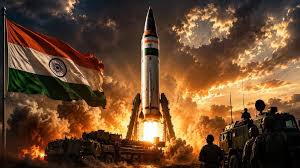
India’s defence capabilities have entered a new phase, with reports suggesting the country’s technical readiness for developing and deploying the powerful Agni VI Intercontinental Ballistic Missile (ICBM). The missile is expected to become India’s most advanced and longest-range ballistic missile, representing a major step forward in the nation’s strategic and military strength.
Agni VI is developed by the Defence Research and Development Organisation (DRDO). It will feature cutting-edge technology, including Multiple Independently Targetable Re-entry Vehicle (MIRV) capability, improved precision, and intercontinental strike range. According to experts, Agni VI is likely to become India’s most advanced and longest-range ballistic missile, one of the most powerful weapons in India’s arsenal.
The Agni missile family has previously helped India emerge as a major military power. From Agni-I to Agni-V, each missile increased the country’s strategic reach and deterrence capability. Agni VI is expected to take this capability to an entirely new level, with longer range, greater accuracy, and advanced MIRV technology.
Understanding the Agni Missile Series
The Agni missile programme started in the 1980s as part of India’s Integrated Guided Missile Development Programme. Over the decades, the Agni series has steadily evolved from short-range missiles to systems capable of striking targets thousands of kilometres away.
Here’s a quick overview:
- Agni-I:Short to medium-range ballistic missile
- Agni-II:Intermediate-range missile
- Agni-III:Improved payload and range
- Agni-IV:Better accuracy and advanced navigation
- Agni-V:Near intercontinental ballistic missile (ICBM) capability
- Agni-VI:Expected next-generation ICBM with MIRV features
While the Agni-V already gave India the capability to reach strategic targets deep inside Asia, Agni VI is expected to extend that capability much further.
Agni VI: A Quick Overview
Although the Indian government has not officially released all technical details, the expected features are:
| Capability | Expecteddetails |
| Range | 10,000 – 12,000 km |
| Payload | Nuclear and conventional |
| Launch platform | Road and rail mobile |
| Fuel type | Solid fuel |
Warheads | Strategic nuclear weapon with 10-11 MIRV capability |
| Warhead weight | 3 tonnes |
| Engine | Four-stage rocket + MaRV |
Such a range would allow India to target locations far beyond Asia if required. The use of solid fuel is important because it allows quicker launch preparation compared to liquid-fuel missiles. This places Agni VI in the category of true intercontinental ballistic missiles.
What is Unique About Agni VI?
Agni VI is being described as a next-generation ballistic missile because of the technologies it is expected to carry. Unlike earlier missiles, Agni VI is likely to combine long-range strike capability with highly advanced targeting systems and multiple warhead deployment.
One of the most significant features associated with the missile is MIRV technology. This allows a single missile to carry multiple nuclear warheads, each capable of striking different targets independently. In simple terms, instead of launching several missiles toward separate targets, one missile can perform the same task more efficiently.
This technology is extremely important in modern warfare because it increases the effectiveness of strategic deterrence. Even advanced missile defence systems struggle to intercept multiple warheads travelling to different targets at high speed.
Agni VI is also expected to use solid-fuel propulsion. Solid-fuel missiles are easier to store, transport, and launch quickly during emergencies. This gives military forces a faster response capability and better operational readiness.
Another important advantage could be mobility. Reports suggest the missile may be road- and rail-mobile, allowing it to be moved and launched from different locations. Mobility increases survivability because enemy forces cannot easily identify and target missile launch systems.
About MIRV Technology: The Biggest Upgrade
One of the most talked-about features of Agni VI is MIRV technology. MIRV stands for Multiple Independently Targetable Re-entry Vehicle. This means that a single missile can carry several warheads, and each warhead can hit a different target independently. For example, instead of launching five separate missiles, one missile could strike five different locations.
On May 8, 2026, India successfully flight-tested an advanced Agni missile equipped with MIRV technology. This milestone launch was conducted from Dr APJ Abdul Kalam Island in Odisha.
The test helped to derive the following results:
- Precision targeting
- Multiple payload deployment
- Advanced tracking systems
- High mission accuracy
MIRV technology gives India several advantages, such as stronger deterrence capability, better ability to overcome enemy missile defence systems, lower launch requirements, and faster strategic response.
What is the Global Significance of Agni VI?
If Agni VI is successful, India will become part of a very limited group of nations possessing advanced intercontinental ballistic missiles with MIRV capability. Currently, countries such as the United States, Russia, and China dominate this category.
The launch of Agni VI would significantly improve India’s standing in global strategic affairs. Many areas, like diplomatic influence, defence partnerships, and geopolitical negotiations, are impacted by military capability.
However, the development of advanced missile systems also attracts international attention and scrutiny. Major powers closely monitor missile programmes because they directly affect regional and global security balances.
Some experts warn that increasing missile competition among nations can trigger arms races and raise tensions. Others argue that strong deterrence actually reduces the likelihood of conflict by making war too costly for all sides.
Final Thoughts
The development of Agni VI comes at a time when global security challenges are increasing, and countries worldwide are investing heavily in advanced military technology. For India, Agni VI is not just about military power. It is also about strategic deterrence, technological self-reliance, and strengthening the country’s position on the global stage.
The missile’s expected intercontinental range, advanced MIRV capability, and improved survivability could make it one of the most powerful strategic weapons ever developed by India. However, deploying an advanced intercontinental missile system involves major financial commitments, infrastructure development, and careful policy decisions. Currently, the DRDO awaits the Centre’s nod, despite being technically prepared to develop Agni VI.
Article by Gayatri Sarin
List of references:
https://en.wikipedia.org/wiki/Agni-VI https://www.youtube.com/watch?v=QacNmQMDdQw
https://economictimes.indiatimes.com/news/defence/drdo-ready-for-agni-6-awaits-centres-no d/articleshow/130629401.cms?from=mdr
https://timesofindia.indiatimes.com/defence/news/india-conducts-its-maiden-test-of-an-nuclea r-capable-icbm/articleshow/130966488.cms
https://opinionexpress.in/agni-vi-ballistic-missile-is-ready-drdo https://stratheia.com/indian-icbms-agni-vi-a-global-security-threat/