

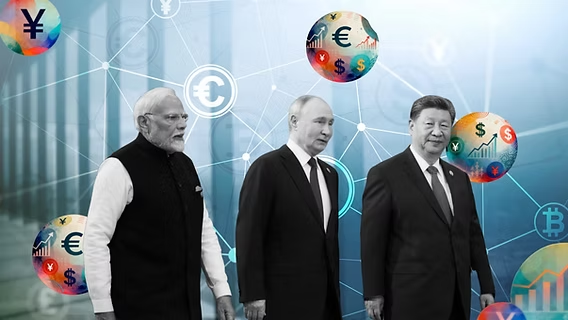
The core structure of the global economy is undergoing a noticeable transformation. Before interrogating the contemporary realignment of the global economic system, it is very crucial to comprehend what the concepts of globalisation and fragmentation respectively represent.
The term Globalisation broadly refers to the increasing interconnectedness of economies through the free movement of goods, capital, technology, and information. Over the past several decades, the global supply chains have connected multiple countries in complex production networks. Various international institutions such as the World Trade Organization, the International Monetary Fund, and the World Banksupported an open trading system that encouraged wider economic integration.
In a globalised system, the production processes are often substantially distributed across several regions. A product may be designed in one country, manufactured in another, assembled elsewhere before being marketed globally.
Economic efficiency and cost advantages largely are often determined where the production has occurred. This interconnected model formed the foundation of the modern globalised economy.
Fragmentation, however, clearly embodies a different trajectory. In a fragmented system, the global economy no longer functions as a single integrated network driven solely by economic efficiency. Instead, the economic relationships increasingly reflect geopolitical alliances, security considerations, and strategic competition. Countries are beginning to prioritise national security, political partnerships, and technological control alongside economic interests. Fragmentation therefore does not imply the complete end of globalisation, but rather a complete restructuring of the existing global economic relations.
For nearly three decades after the end of the Cold War, the world economy has experienced deep integration. From the early 1990s until roughly the mid-2010s, international trade expanded significantly and global supply chains became increasingly interconnected. Production networks stretched across continents while international institutions facilitated trade liberalisation and economic cooperation.
However, in the past decade several developments have begun to challenge this particular model of integration. Governments are increasingly prioritising strategic autonomy, geopolitical security, and political alliances over purely economic efficiency. The geopolitical analysts therefore strongly argue that globalisation is not disappearing but gradually becoming more fragmented.Geopolitical Competition and Economic Decoupling
One of the most visible drivers of fragmentation is the growing economic rivalry between the United States and China. Competition between these two major powers extends beyond the military and diplomatic domains and this progressively affects technology, trade, and several industrial policies.
Export controls on advanced semiconductor technology, restrictions on technology transfers, and efforts to relocate manufacturing away from China clearly portray how geopolitical tensions are reshaping various global supply chains. These developments are contributing to what many analysts often describe as an economic decoupling between major economies.
Related to this shift is the rapid growing practice of friend-shoring, where supply chains are possibly relocated to politically trusted partners rather than purely cost-efficient locations; this change has not been a drastic one. Manufacturing has increasingly expanded into countries such as India, Vietnam, and Mexico as companies attempt to reduce their dependence on a single production hub. In this competitive environment, geopolitical trust increasingly influences several economic decision making powers.
Sanctions and the Weaponisation of Economic Policy
Sanctions have also surfaced as one of the most powerful instruments of economic statecraft. Following the outbreak of the Russia–Ukraine War in 2022, Western countries have strictly imposed extensive sanctions on Russia. These measures included restrictions on banking systems, freezing foreign reserves, and limiting access to global financial networks.
Such actions have clearly negotiated how deeply coordinated financial systems can be used as tools of geopolitical pressure, which can literally turn the game of geopolitics and redraw a new political map. When the financial systems are weaponised in this way, countries begin exploring alternative arrangements to reduce their vulnerability to sanctions and external pressure. As a result, several economic relationships increasingly reflect strategic considerations rather than purely commercial interests.
Case Study 1: Russia–Ukraine War and Global Economic Disruption
The Russia–Ukraine War which roughly began in February 2022 when Russia launched a large-scale invasion of Ukraine. Russia strongly argued that Ukraine’sgrowing alignment with NATO and the European Union could be seen as a fierce threat to its security, while Ukraine emphasised its sovereignty and its right to determine its alliances. The conflict quickly expanded beyond a regional war as Western countries, particularly the United States and European states, provided financial, military, and diplomatic support to Ukraine.
The economic repercussions were quite significant. Western countries imposed extensive sanctions on Russia, restricting access to international financial networks and trade systems. Europe, which had previously depended heavily on the Russian energy supplies, was forced to reduce imports of Russian oil and gas and search for several other alternative suppliers immediately.
The war also completely shattered the global food markets. Ukraine is one of the world’s largest exporters of wheat and other agricultural commodities, and disruptions in its exports contributed to volatility in global food prices. These developments demonstrated how regional conflict can reshape global economic networks.
Case Study 2: Iran–Israel Tensions and Energy Security
Another recent and major example of the ongoing geopolitical tensions affecting the global economy is the rivalry between Iran and Israel, often involving the United States.
Although not a full-scale war, the existing tensions between these actors repeatedly lead to severe missile strikes, cyber operations, maritime confrontations, and attacks on strategic infrastructure. The global significance of this rivalry stems largely from its connection to the huge energy markets.
The Middle East remains one of the most important energy-producing regions in the world. A large proportion of global oil trade passes through the Strait of Hormuz, which is basically a narrow maritime passage connecting the Persian Gulf to international markets. Instability in this region can disrupt tanker movements, increase shipping insurance costs, and spark fluctuations in global oil prices.
Consequently, the tensions between Iran and Israel have implications that extend far beyond the region, influencing global energy markets and trade networks.
Case Study 3: U.S. Pressure on India Over Russian Oil
A third intrusive example exemplifying the convergence of geopolitics and economics is the diplomatic pressure surrounding Russian oil exports. After theRussia–Ukraine war, Western countries introduced sanctions and price caps aimed at limiting Russia’s energy revenues.
However, there are few countries such as India that have continued purchasing discounted oil from Russia, bytaking the mere advantage of lower prices to support domestic energy demand.
This situation led to severe diplomatic pressure from the United States and its allies, who sought to reduce global purchases of Russian energy. While the United States cannot legally force India to halt these imports, we need to pause a bit here and rethink how it can exert influence through financial systems, shipping insurance networks, and international banking channels.
India has therefore adopted a strategic balancing approach; maintaining energy trade with Russia while continuing diplomatic engagement with Western partners and diversifying its energy imports.
This case clearly reflects how geopolitical pressure increasingly influences global trade decisions.
Strategic Resources and the Multipolar Economic Order
Beyond the politics of power confrontation and economic sanctions, competition over strategic resources has also contributed to diverse fragmentation. Critical minerals such as lithium, cobalt, and rare earth elements are essential for emerging technologies including electric vehicles, renewable energy systems, and advanced electronics.
Governments are increasingly pursuing industrial policies formulated to secure access to these resources and reduce dependence on external suppliers. At the same time, various new forms of economic cooperation are emerging among developing economies through platforms such as BRICS.
These developments indicate the gradual emergence of a more multipolar economic landscape in which economic influence is distributed among several major powers rather than intensified in a single global centre.
Conclusion
Taken together, these developments reveal a clear pattern. Geopolitical rivalry most often generates economic disruption, which fosters the reconstruction of global trade networks. As the countries reassess strategic dependencies and economic vulnerabilities, the structure of the global economy gradually shifts away from a fully integrated system toward a network of partially overlapping economic blocs. Globalisation, therefore, is not collapsing. International trade, financial flows, and technological exchanges continue to connect economies around the world. What is changing is the framework within which these interactions occur. Economic decisions are increasingly shaped by geopolitical competition, security concerns, and tactical alliances.
In this evolving landscape, the global economy appears to be moving towards a more politically structured form of interdependence; the absolute one in which economic relationships are increasingly determined by the evolving dynamics of global power.
The evolving global economic order reflects a growing urgency among the states to secure strategic advantages in an increasingly uncertain international environment.
As geopolitical rivalries intensify and economic interdependence becomes more politically debated, countries are attempting to reposition themselves within the emerging networks of trade, technology, and security partnerships. In many ways, this moment echoes the wisdom of the medieval poet Kabir, who wrote: “Kal kare so aaj kar, aaj kare so ab; Pal mein pralay hoegi, bahuri karega kab.” The message of the doha; that delayed action may lead to lost opportunity; this resonates strongly with contemporary geopolitical behaviour.
States today increasingly act with this sense of urgency, seeking to secure energy resources, technological capabilities, and strategic alliances before shifting power dynamics alter the global balance.