

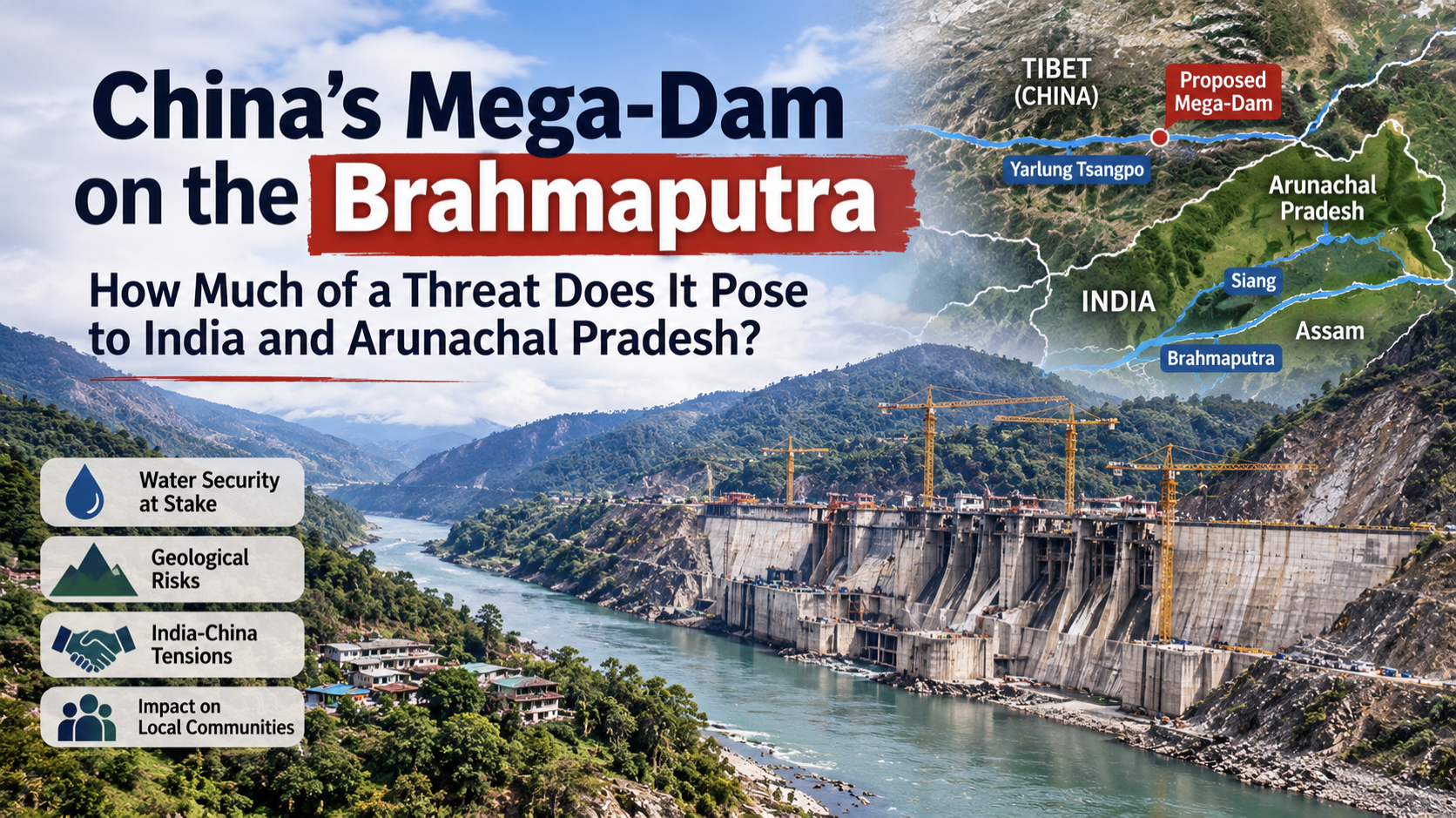
A river does not follow political boundaries. It flows from one region to another, supporting different communities, industries, agriculture, and ecosystems along its course. But when a country builds a big dam on a river that starts in its territory and flows into neighbouring countries, that kind of project can become more than an infrastructure development. It can raise various questions about the security of water, regional stability, and national interests.
China’s proposed mega hydropower project on the Yarlung Tsangpo River in Tibet has brought these concerns into focus.
The river enters India through Arunachal Pradesh, called the Siang, before flowing into Assam, where it is known as the Brahmaputra. Millions of people are fully dependent on this river system for their livelihoods, making developments upstream a matter of concern for India.
China designed this project to generate electricity, and they don’t want to harm downstream countries.
India, however, remains concerned about the probable effects on the river flows, geological safety, and the availability of reliable information.
The question is not only whether China can control the Brahmaputra River. It is whether a project of such scale, located nearest to India’s northeastern frontier, could create risks for communities and the region widely.
What Is China Building on the Yarlung Tsangpo?
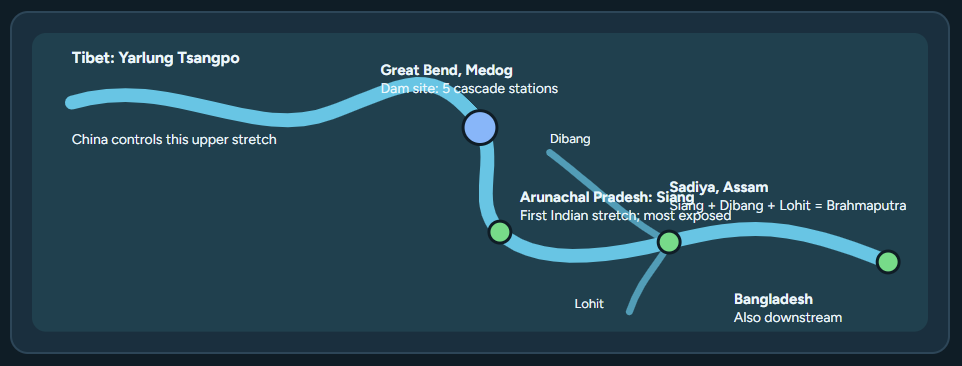
The Brahmaputra River originates in the Tibetan Plateau, called the Yarlung Tsangpo. The river flows eastwards across Tibet before making a dramatic turn at the Great Bend in Medag County. Afterward, it enters Arunachal Pradesh, where it is known as the Siang or Dihang.
Further downstream, the Siang joins the Dibang and Lohit rivers near Sadiya in Assam. Their combined waters form the Brahmaputra. It is one of India’s most important river systems.
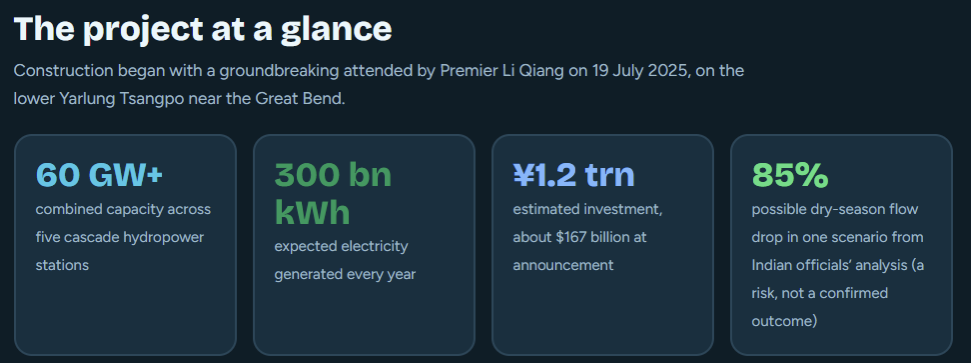
China has planned a big hydropower project along the lower reaches of the Yarlung Tsangpo, nearest to the Great Bend. Chinese Premier Li Qiang formally attended the project’s groundbreaking ceremony on July 19, 2025, marking the beginning of its construction phase.
The scale of the project is significant.
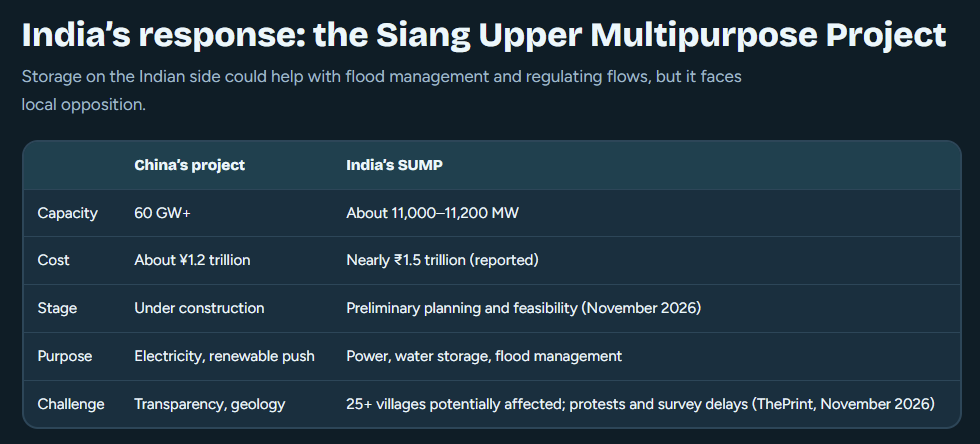
According to reported project estimates, it will consist of five cascade hydropower stations with a combined installed capacity of more than 60,000 megawatts (60 GW). The project is expected to generate more than 300 billion kilowatt-hours of electricity annually.
If completed as planned, it would become one of the world’s largest hydropower projects, surpassing China’s Three Gorges Dam in installed capacity. The project is part of China’s massive effort to expand renewable electricity generation and develop big infrastructure in Tibet.
However, its location has made it particularly important for India.
Why Is India Concerned About China’s Mega-Dam?
India’s concerns and risks are not limited to electricity generation or the size impact of the project. They are also connected to the fact that China controls the upper reaches of the river, while India as well as Bangladesh depend on its downstream waters.
There are three major areas of concern.
1. Water Security and Possible Changes in River Flow
The first concern is the possibility that China’s dam operations could affect the amount and timing of water reaching India.
A large hydropower project can influence river flow through the storage of reservoirs, water releases, and electricity generation timing. Even if a dam is not basically designed to divert water permanently, its operation can change the pattern of natural flow.
For Arunachal Pradesh, this matters because the Siang is a major source of water for people living along its banks. Seasonal flow changes could affect agriculture, local ecosystems, fishing, and other livelihood activities.
An analysis by Indian officials, reported by Reuters and subsequently covered by Business Standard, estimated that dry-season flows at a key downstream point could fall by nearly 85% under certain scenarios. It can be considered as the possibility of diverting up to 40 billion cubic metres of water.
The distinction is important. There is no public evidence that the new project will divert the Brahmaputra’s waters away from India.
Nevertheless, the possibility of changes in water releases remains a concern, particularly because India has limited information about China’s future reservoir operations.
2. The India-China Border Dispute Adds a Strategic Dimension
The project also has a geopolitical dimension.
China claims Arunachal Pradesh as part of what it calls South Tibet, a position firmly rejected by India. The region still remained as an important part of the wider India-China boundary dispute.
Against this background, China’s decision to develop a big infrastructure project close to the Indian border has raised concern about the strategic implications of controlling infrastructure in the upper reaches of a transboundary river.
Water infrastructure can become an important factor in relations between upstream and downstream countries. A country controlling the upper reaches may have greater influence over the timing of water releases, particularly during periods of low rainfall or other water-related emergencies.
This does not automatically mean that China will use the dam as a political instrument against India. However, the limited operating information makes it difficult for downstream countries to assess risks.
The project is therefore both a water-security issue and an important concern for India.
3. Earthquakes and Geological Safety
The third concern relates to the region’s geological conditions.
The eastern Himalayan region is seismically active because of the continuing movement and interaction of the Indian and Eurasian tectonic plates. It is also vulnerable to unstable slopes, landslides, and other natural hazards.
A hydropower project of this scale needs extensive construction, including tunnels, dams, roads and other supporting infrastructure. The stability of such structures is important in a region where earthquakes and landslides are possible.
Concerns became more serious in 2026 after Chinese geologists reportedly identified the active Paizhen Fault beneath the project area.
For downstream communities in Arunachal Pradesh and Assam, a major structural failure or an uncontrolled release of water could have serious consequences.
Read the Business Standard report on the geological concerns surrounding China’s Brahmaputra dam.
What Is China’s Position on the Project?
China has repeatedly maintained that its hydropower development on the Yarlung Tsangpo is intended primarily for the generation of electricity.
Chinese officials have assured downstream countries that this project will not impact negatively on their interests. Beijing has also stated that it will take all the responsibilities of downstream conditions into this account while developing the project.
From China’s perspective, hydropower development in Tibet offers a new opportunity to use the river resources for efficient electricity generation.
However, assurances alone cannot address India’s concerns.
The two countries have not established a comprehensive, legally binding treaty that is governing the allocation and Brahmaputra’s water management. Their cooperation relied on the limited arrangements for sharing hydrological information and discussing issues related to transboundary rivers.
This difference matters because the arrangement of data-sharing is not the same as a water-sharing agreement. Sharing river measurements does not establish how much water each country is entitled to use or how upstream projects must be operated.
India has consistently called for transparency and protection of downstream interests. China maintained that its projects will not affect countries further along the river.
The challenge is to move beyond official assurances towards a more dependable information exchange and cooperation system.
Why Has the Suspension of River Data Sharing Become a Major Issue?
One of the biggest problems in the India-China river relationship is the lack of reliable and timely hydrological information.
In the past, the two countries had arrangements for sharing information about river conditions during the flood season. They also established an Expert Level Mechanism in 2006 to discuss issues relating to transboundary rivers.
However, the Brahmaputra hydrological data-sharing Memorandum of Understanding expired in June 2023 and was not renewed at that time.
According to information reported by Indian officials, China had not resumed the relevant data-sharing arrangements by August 2026. This creates practical difficulties for Indian authorities, especially during the monsoon season.
River data helps governments to monitor water levels consistently, prepare flood forecasts and issue warnings to communities which are living downstream. Without timely information from upstream locations, forecasting sudden changes in river conditions becomes more difficult.
For India, restoring these arrangements is an immediate priority. Reliable information is necessary not only for diplomatic discussions but also for protecting people living along the Siang and Brahmaputra.
Are All the Fears About the Dam Justified?
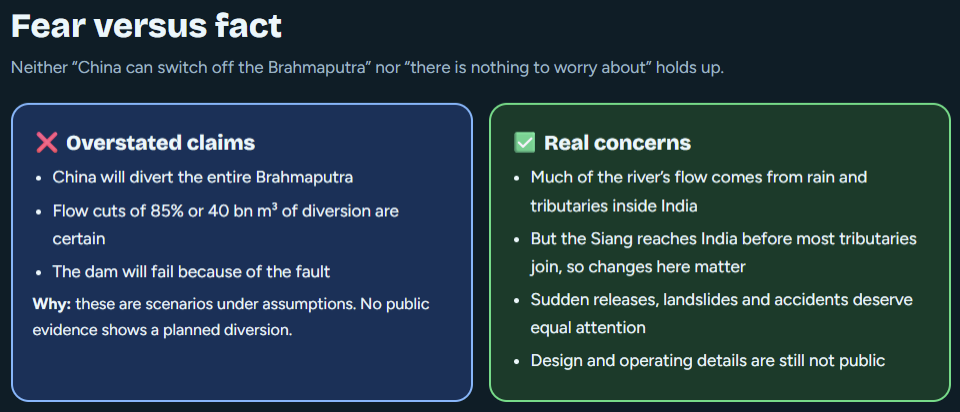
While India’s concerns deserve attention, it is equally important to separate scientific assessments from political statements and worst-case scenarios.
The Brahmaputra is a large river system with several tributaries. A substantial share of its total water yield comes from rainfall and tributaries within India, particularly during the monsoon season.
This means that China does not control the entire water supply of the Brahmaputra.
The river receives significant contributions from the eastern Himalayas, Arunachal Pradesh, Assam and other parts of the basin. Therefore, an upstream intervention cannot automatically determine the total flow of the river throughout India.
However, this does not mean that China’s project is harmless.
Another issue is the limited availability of information about the project’s design and operating procedures. Without greater transparency, independent experts cannot accurately assess every possible downstream impact.
The most reasonable position, therefore, is neither to assume that China can simply switch off the Brahmaputra nor to dismiss the risks associated with such a large upstream project.
What Does the Project Mean for Arunachal Pradesh?
Arunachal Pradesh is likely to be among the first Indian regions affected by any major change in the Siang’s flow. Communities living along the river depend on it for agriculture, fishing, transportation and other everyday activities. The river also has cultural and ecological importance for indigenous communities.
The October 2018 landslide incident provides an example of how natural events in Tibet can affect downstream areas. A landslide near Jiala village in Tibet blocked the Yarlung Tsangpo and created a temporary barrier lake. China informed India through an emergency information-sharing mechanism, allowing Indian authorities to take precautionary measures.
The incident demonstrated why cooperation and timely communication are important for both countries.
For Arunachal Pradesh, the concern is not limited to the normal operation of the proposed dam. It also includes the possibility of unexpected natural events and the need for effective emergency preparedness.
What Should India Do Next?
China’s project is already moving forward, and India cannot depend entirely on diplomatic assurances. However, responding with another large dam should not be the only part of its strategy.
A broader approach is needed.
1. Restore Hydrological Data Sharing
India should continue pressing China to restore regular river-data exchange. Information about water levels, rainfall and upstream conditions is essential for flood forecasting and emergency planning.
2. Strengthen Diplomatic Engagement
Transboundary rivers should remain an important part of India-China discussions. Regular meetings of the Expert Level Mechanism could help address concerns before they develop into larger disputes.
3. Improve Early-Warning Systems
India should strengthen monitoring stations, flood forecasting systems and communication networks along the Siang and Brahmaputra. Communities in vulnerable areas must receive timely warnings during emergencies.
4. Make Independent Safety Assessments a Priority
The geological risks associated with large hydropower projects require careful examination. India should strengthen its own disaster preparedness while seeking greater transparency about China’s project design and safety measures.
5. Address Local Concerns Around the Siang Project
India’s response should not ignore the people of Arunachal Pradesh. Any decision involving large-scale infrastructure must include meaningful consultation, environmental assessment, fair compensation and proper rehabilitation planning.
6. Include Bangladesh in Regional Discussions
Bangladesh is also a downstream country in the Brahmaputra river system. Greater cooperation between India, China and Bangladesh could help improve regional understanding of water management and disaster preparedness.
Conclusion: A Water-Security Challenge Beyond Hydropower
China’s mega-dam on the Yarlung Tsangpo is more than an electricity-generation project. Its location, scale, and geological setting give light to the questions about the future security of water in the eastern Himalayas.
For India, the big concern is not that China controls the upper reaches of the river. It is the combination of less hydrological information, the absence of a complete water-sharing framework, geological uncertainty and the future impact on communities downstream.
At the same time, the most dramatic claims about China diverting the entire Brahmaputra should not be treated as one of the main established facts. The river receives substantial contributions from within India, and the actual downstream impact will depend on the project’s storage capacity, design, and operating practices.
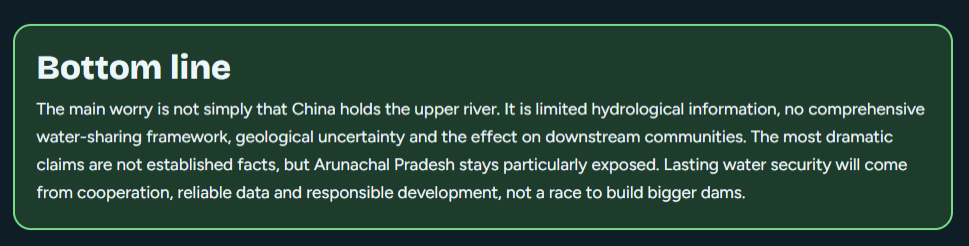
India must remain alert, demand transparency and protect national interest. But it must also recognise that lasting water security will require cooperation, reliable information and responsible development rather than competition over increasingly large infrastructure projects.